
BaRe-Mem: Bayesian Reliability Memory to Support Robust and Adaptive Agent Consultation
BaRe-Mem learns context-dependent advisor reliability from verified feedback, modulates advice, and helps agents choose consultation or reasoning.
Key Points Summary
- BaRe-Mem is an online Bayesian reliability memory that learns advisor reliability from verified interactions instead of only storing past advice.
- It treats reliability as context-dependent, so the same advisor can be trusted more or less depending on the task or situation.
- The system uses learned reliability to modulate external advice, adjusting how much influence the advice should have rather than simply accepting or rejecting it.
- It adaptively decides whether to consult an external source or reason autonomously based on the expected value of seeking advice.
- Its core value is connecting memory, trust assessment, and action selection into one dynamic decision process for more robust AI agents.
Meta description: BaRe-Mem is an online Bayesian reliability memory that learns advisor reliability from verified interactions and decides to consult or reason.
Tags: BaRe-Mem, Bayesian memory, reliability learning, context-dependent advice, AI memory systems
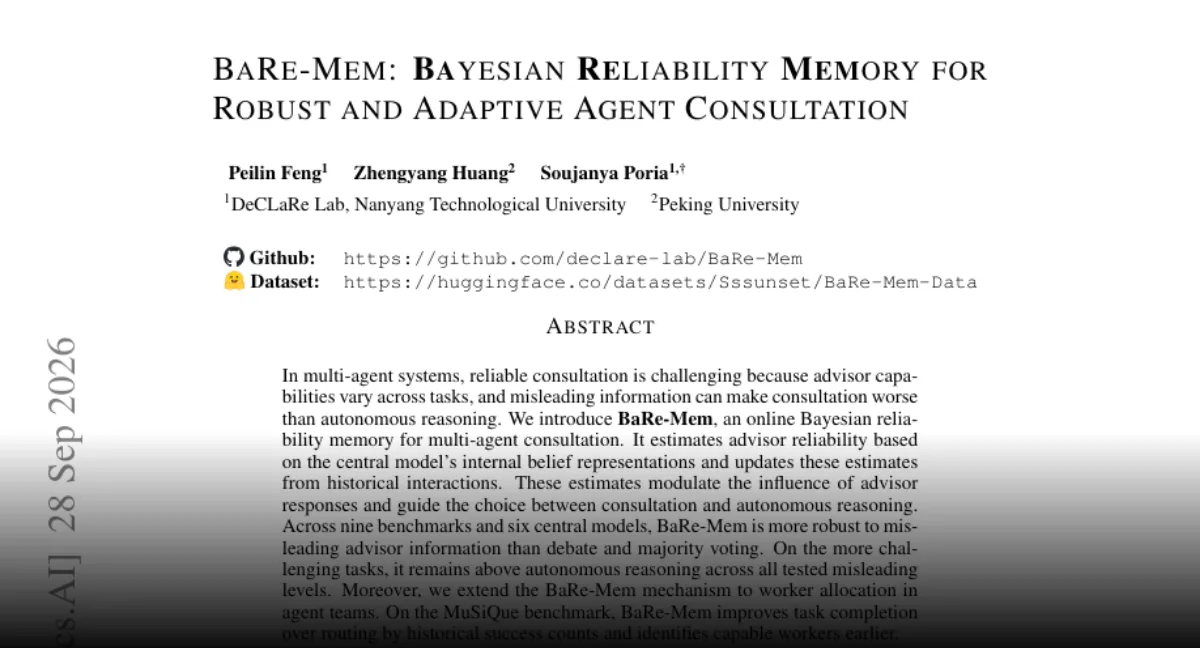
Featured image: Abstract technology illustration of a Bayesian reliability memory network with weighted advisor nodes, probability edges, and decision paths; no real people, no company logos, no text.
BaRe-Mem is an online Bayesian reliability memory that learns context-dependent advisor reliability from verified interactions, modulates external advice accordingly, and adaptively decides whether to consult or reason autonomously. The idea matters because external advice is not equally useful in every situation. A source that helps with one task may mislead another, so a memory system needs a way to track trust as it operates, not only store past facts.
Background: The reliability problem in external advice
Many systems that answer, plan, or act do not rely only on internal knowledge. They may consult an advisor: a person, a tool, a database, a document set, or another model. That advisor can provide useful evidence, but its usefulness changes with the problem. A specialist, a retrieval tool, or a reasoning model may be strong in one context and weak in another.
If a system stores only the advice, it cannot easily decide whether to follow it. If it stores only a fixed reputation score, it may miss context. BaRe-Mem is positioned to address that gap by learning reliability from verified interactions. “Verified interactions” means the system receives feedback that confirms whether an exchange was useful or accurate. “Online” means the reliability estimate can be updated during operation rather than after a single offline training phase. “Bayesian” means the system keeps probabilistic beliefs and revises them when new evidence arrives.
Development process: From verified interactions to advice modulation
The described mechanism can be read as a sequence. First, the system receives external advice. Second, the outcome of that advice is verified through feedback. Third, the memory updates a reliability estimate that is tied to the context in which the interaction occurred. Fourth, the system uses that estimate to modulate the influence of future external advice.
This last step is important. Modulation does not simply mean “accept” or “reject” an advisor. It means adjusting how much weight the advice should carry. A reliable advisor in a similar context may be allowed to shape the answer more strongly. A weak advisor may still contribute information, but its influence is reduced. The system also adaptively decides whether to consult or reason autonomously. In practical terms, that creates a choice point: gather more external advice, or continue with internal reasoning when the expected value of consulting is low.
Latest progress: Connecting memory, trust, and action
BaRe-Mem’s distinctive value is that it connects three functions that are often treated separately. Memory stores what was learned. Reliability assessment tracks who or what can be trusted. Action selection decides whether to seek advice or reason alone. By making reliability context-dependent, the system can adapt to changing environments instead of applying one global trust score to all advisors.
For readers, the incremental takeaway is a design pattern: when AI systems interact with external sources, trust should be learned from evidence and linked to the situation. This matters for AI agents, retrieval systems, and human-AI collaboration, where the same advisor may be excellent in one task and misleading in another. The system’s described behavior is therefore less about static knowledge storage and more about dynamic judgment.
Current stage: What to watch next
The current stage is defined by the mechanism itself: online Bayesian reliability learning from verified interactions, followed by advice modulation and adaptive consult-or-reason decisions. The next signals to watch are how “context” is represented, how “verified” feedback is obtained, and how the Bayesian update avoids overconfidence after rare successes or failures. These details determine whether the system remains practical in real environments where advice quality, task difficulty, and source behavior can shift over time.
Comments
No comments yet. Be the first to comment.