
Imprint Reader: From Decoding Weight Updates to Behavioral Intervention
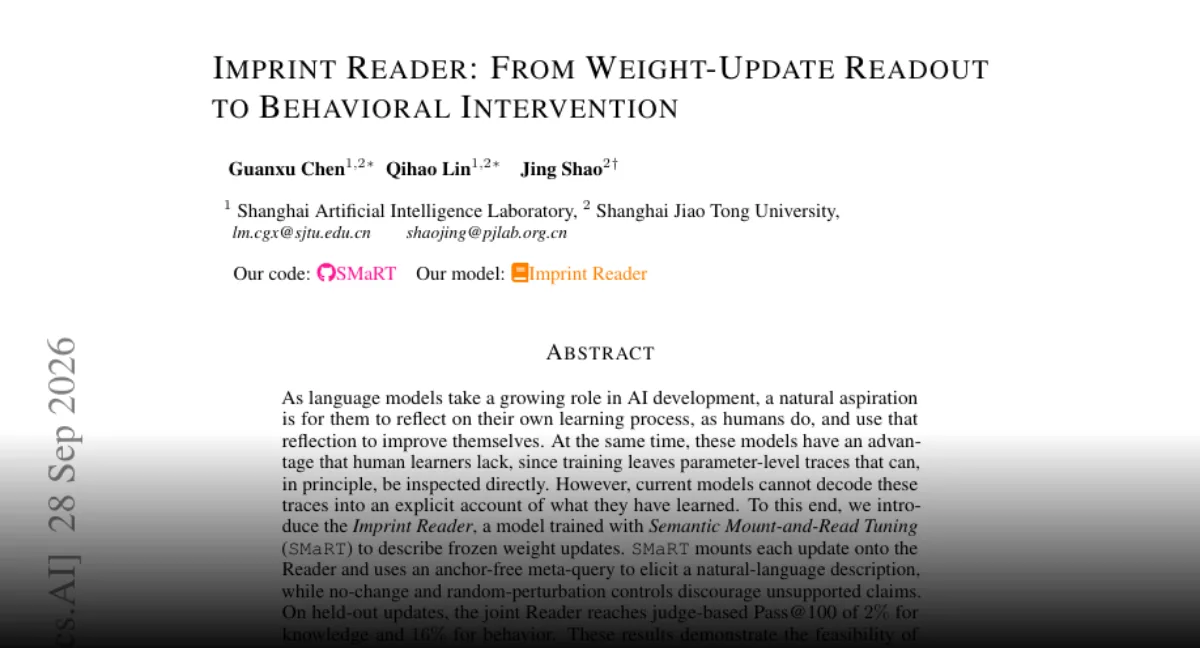
The article explains Imprint Reader, a component of SMaRT-Vibe-Alignment that inspects model weight updates created without task-specific training data. It can state what an update taught a model, though free-form readout is still rough. The newer release and prefix scoring turn readouts into a usable vibe aligner, with GitHub and Hugging Face links provided. The stage remains early, but prefix scoring may help track how word-based intent changes model behavior.
Key Takeaways
- Imprint Reader inspects model weight updates that do not rely on task-specific training data, revealing what a model has learned from an expressed alignment intent.
- Vibe alignment converts free-form intent into a weight update, moving beyond conventional alignment methods that depend on instruction examples, preference labels, or reward signals.
- The current reader can describe what an update taught the model, but its free-form output remains rough and still under development.
- Prefix scoring is the key usable step: it turns free-form readout into a practical vibe aligner, as shown by the imprint-reader-v1.0-0928 release and associated code/model resources.
- The technology is still early-stage; the main open question is how reliably prefix scoring tracks useful model changes when intent is expressed in words rather than task data.
Meta description: Imprint Reader reads model weight updates that lack task-specific training data, turning free-form alignment intent into a prefix-scored vibe aligner.
Tags: Vibe alignment, Imprint Reader, weight updates, model readout, prefix scoring

Vibe alignment turns an expressed intent into a weight update that does not use task-specific training data. Imprint Reader, part of SMaRT-Vibe-Alignment, is trained to inspect weight updates and state what a model has learned. The imprint-reader-v1.0-0928 release and 'prefix' scoring turn free-form readout into a vibe aligner.
Background: Alignment Without Task Data
Conventional alignment often depends on instruction examples, preference labels, or reward signals. Here, a wish can become a model weight update that does not use task-specific training data.
Development: Reading What the Update Learned
The reader can state what an update taught the model, but the output is still rough. Free-form readout remains a work in progress.
Latest: Prefix Scoring as the Usable Step
GitHub code: https://github.com/biuboomc/SMaRT-Vibe-Alignment. Hugging Face model: imprint-reader-v1.0-0928 at https://huggingface.co/quantumfr/imprint-reader-v1.0-0928. 'prefix' scoring turns free-form output into a vibe aligner.
The stage is early: vibe alignment has a reader and scoring hook, but free-form readout remains imperfect. The next question is how reliably prefix scoring tracks useful model changes when intent is expressed in words rather than task data.
Comments
No comments yet. Be the first to comment.