
Adaptively Consistent Graph for Long-Horizon Agents
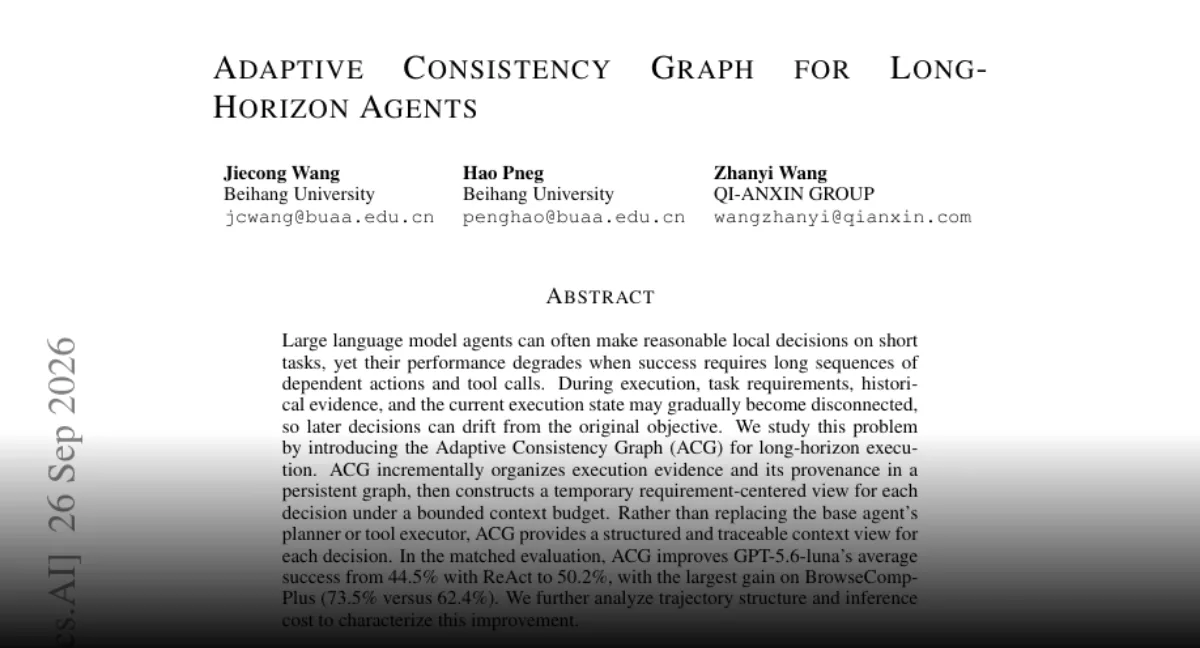
ACG structures agent evidence into traceable graphs and selects relevant context, reducing goal drift and improving GPT-5.6-luna long-task success.
Key Takeaways
- Adaptive Consistency Graph (ACG) helps long-horizon AI agents avoid goal drift by keeping goals, evidence, and actions connected.
- It stores execution evidence in a persistent, traceable graph instead of repeatedly inserting everything into a limited prompt context.
- ACG dynamically selects task-relevant information at each decision point, improving grounding during long workflows.
- In matched evaluations, ACG raised GPT-5.6-luna’s average success across three benchmarks from 44.5% to 50.2%, with BrowseComp-Plus improving from 62.4% to 73.5%.
- The results are research-stage evidence, highlighting the need to test ACG on noisier sources and longer, more complex agent tasks.
Meta description: Adaptive Consistency Graph helps AI agents stay goal-aligned on long tasks, raising GPT-5.6-luna average success from 44.5% to 50.2% in matched evaluations.
Tags: AI agents, long-horizon tasks, Adaptive Consistency Graph, GPT-5.6-luna, BrowseComp-Plus
Featured image: abstract network graph over a timeline, glowing nodes and edges, no text, no logos, no people
The paper behind ACG, or Adaptive Consistency Graph, addresses a practical problem for AI agents on long tasks: an agent can take many locally reasonable steps and still drift from the goal it was given. The reported method gives long-running models a more structured way to carry forward evidence, while the evaluation numbers show measurable improvement for GPT-5.6-luna.
Background: Why long tasks pull agents away from goals
AI agents differ from one-shot question answering because they must plan, act, observe, and revise. In a long task, the useful information is not only the original request. It also includes facts discovered during execution, failed attempts, tool outputs, and constraints that only become visible after several steps. When all of that is pushed through a limited context budget, the model may keep only the most recent or most salient fragments.
That creates a drift problem. A step that looks sensible in the current prompt can still move the overall workflow away from the original requirement. The source frames this as the central question: how can agents go further on long tasks while staying connected to their original goals, and how can they maintain the link between goals, evidence, and actions throughout long-horizon execution.
Development: How ACG converts scattered evidence into a traceable graph
ACG responds by treating execution evidence as something that should be retained and connected, not simply reinserted into a shrinking prompt. The framework organizes evidence and its sources into a persistent graph. The graph idea is not presented as a generic memory trick; the paper’s point is that the source of each piece of evidence remains traceable, which can help the agent ground its next action.
The second part of the method is selection. At each decision point, ACG dynamically chooses task-relevant information within a limited context budget. That matters because long tasks can produce far more intermediate information than a model can process at once. A selection step can decide which prior observations, requirements, and source records are relevant to the current step.
For readers, the design suggests that the reliability of long-running agents may depend less on raw model size alone and more on how the system preserves the chain from goal to evidence to action. A traceable graph is a mechanism for making that chain auditable and reusable during execution.
Latest progress: Matched evaluation reports gains across three benchmarks
The reported results are presented as a matched evaluation, with the focus on GPT-5.6-luna. Across three benchmarks, ACG improves the model’s equally weighted average success rate from 44.5% to 50.2%. The source also gives a benchmark-specific number: on BrowseComp-Plus, success rises from 62.4% to 73.5%, a gain of 11.1 percentage points.
Those figures are important because they turn the architectural claim into a testable outcome. The numbers show that the proposed graph-based retention and selection changes the measured success rate in the reported setup.
The BrowseComp-Plus result is especially relevant for long-task agents because success on a task-oriented benchmark can reflect whether the agent stayed aligned with the requested goal over multiple steps. The three-benchmark average also prevents the story from resting on a single dataset: the reported improvement is presented as a broader pattern across the evaluation set, though the source does not name the other two benchmarks.
Current stage: What the numbers say about long-horizon agent memory
The current stage is research evidence, not a full deployment account. The material introduces ACG as a framework and reports matched evaluation gains for GPT-5.6-luna, with BrowseComp-Plus rising from 62.4% to 73.5% and the three-benchmark average moving from 44.5% to 50.2%. The open question now is how the persistent graph handles noisier sources, longer workflows, and tasks where relevance changes over time.
What follows is likely to depend on whether the traceable evidence structure can be maintained as agent tasks become more complex. The next stage will show whether traceable graph memory can keep goals, evidence, and actions connected as tasks grow longer.
Comments
No comments yet. Be the first to comment.