
A Generalizable Method for Dense Correspondence Matching Without Relying on Spatio-Temporal Priors
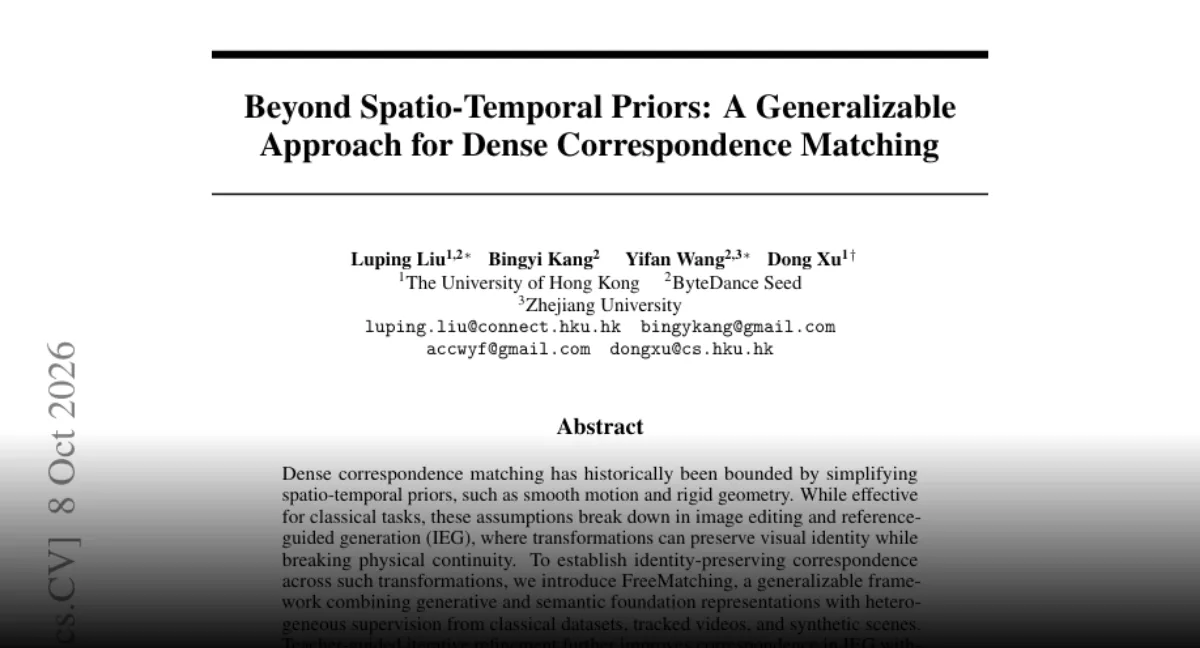
FreeMatching extends dense correspondence to image editing and reference-guided generation. It combines generative and semantic foundation representations, heterogeneous correspondence supervision, and teacher-guided iterative refinement. The method bridges matching and generation, helping systems transfer content, preserve structure, and use references for shape and layout guidance.
Key Takeaways
- FreeMatching extends dense correspondence from image matching to image editing and reference-guided generation.
- It uses generative and semantic foundation representations to capture appearance, structure, and part-level meaning.
- Heterogeneous correspondence supervision allows training from mixed and imperfect alignment signals.
- Teacher-guided iterative refinement improves initial matches and makes generation more controllable.
- Dense correspondence acts as an explicit map between source and target images, supporting more reliable editing and generation.
Meta description: FreeMatching extends dense correspondence to editing and generation using foundation representations, heterogeneous supervision, and teacher-guided refinement.
Tags: dense correspondence, image editing, reference-guided generation, foundation representations, FreeMatching
Featured image: abstract technology style image of two linked visual maps formed by nodes and flowing lines, no real people, no company logos, no text.
Background: The Alignment Problem Behind Image Editing
Dense correspondence asks a simple but difficult question: for every visible point in one image, which point in another image describes the same thing? That question has long sat at the center of visual computing. Early systems usually handled alignment through local feature matching, geometric constraints, and category-level assumptions. Those methods could work when objects shared the same viewpoint and appearance, but they often broke when lighting changed, parts were occluded, or the target needed a different pose.
For image editing, the limitation was practical. A user may want to transfer a sleeve from one garment to another, move a background element, or preserve the structure of an object while changing its style. To do that reliably, a system needs a map between the source and the target, not just a caption or a global similarity score. Dense correspondence provides that map. It connects regions, parts, and pixels across images, making the relationship between inputs explicit.
Development: From Matching Signals to Foundation Representations
The field moved in stages. The first stage focused on matching itself: finding correspondences between images. The second stage expanded what could be used as a matching signal. Deep visual features made it possible to compare appearance and structure at a much finer level than handcrafted descriptors alone. Later, semantic representations added another layer, helping systems understand that a car door, a shirt sleeve, or a tree branch can correspond even when their pixels look different.
That shift matters for FreeMatching. The method is described as extending dense correspondence to image editing and reference-guided generation through generative and semantic foundation representations. Those two kinds of representations play different roles. Generative foundation representations carry appearance and structure information useful for synthesis, while semantic foundation representations carry part-level and category-level meaning. Together, they give a correspondence system more than one way to decide what matches what.
Another part of the timeline is supervision. Correspondence data is rarely uniform. Some pairs may come from the same category, some from different viewpoints, and some from images that are only partially related. FreeMatching uses heterogeneous correspondence supervision, a phrase that signals a training strategy built to combine different sources of alignment evidence rather than relying on one clean dataset.
The final development step is refinement. A single forward pass through a matching model can produce imperfect correspondences, especially in complex scenes. Teacher-guided iterative refinement suggests a loop in which a guiding signal improves the initial matches over repeated passes. The result is not a new task list, but a stronger path from matching to generation.
Latest Progress: How FreeMatching Connects Matching to Generation
FreeMatching positions dense correspondence as a bridge between two visual tasks: image editing and reference-guided generation. In editing, correspondence helps a system know where to move, replace, or transfer content. In reference-guided generation, it helps a model use an image as more than inspiration; the reference can guide shape, layout, or part placement.
The contribution is organizational as much as technical. It brings three ingredients into one framework: foundation representations that combine generative and semantic cues, heterogeneous supervision that accepts mixed correspondence signals, and teacher-guided iterative refinement that improves matching quality. That combination is relevant because editing and generation often fail at the same point: the model can create plausible visuals, but cannot keep them aligned with the intended source.
Current Stage: A Shared Layer for Understanding and Creating
At this stage, FreeMatching appears as a method for expanding dense correspondence beyond matching tasks and into editing and generation workflows. It does not change the basic task of finding corresponding pixels; it changes how those correspondences are learned and used. The key number is small but clear: two application areas, two representation types, and three technical mechanisms named in the description.
What to watch next is how this layered correspondence strategy behaves outside controlled settings. Real images contain ambiguity, occlusion, and weak supervision. A framework that uses generative and semantic foundation representations, heterogeneous correspondence supervision, and teacher-guided iterative refinement needs to prove that its alignment remains useful when references are distant, categories vary, or the target image is mostly synthetic. For now, the central idea is straightforward: better matching can make both editing and reference-guided generation more controllable.
Comments
No comments yet. Be the first to comment.