
TestPrism: Reimagining Test Evaluation Beyond a Single Reference
TestPrism reveals strict multi-candidate testing gaps; TestHelix improves scores via repair pairs, cross validation, and self-improvement.
Key Takeaways
- TestPrism introduces a stricter evaluation standard for LLM-generated tests, requiring them to pass all valid implementations and fail all invalid ones, rather than checking only against a single reference solution.
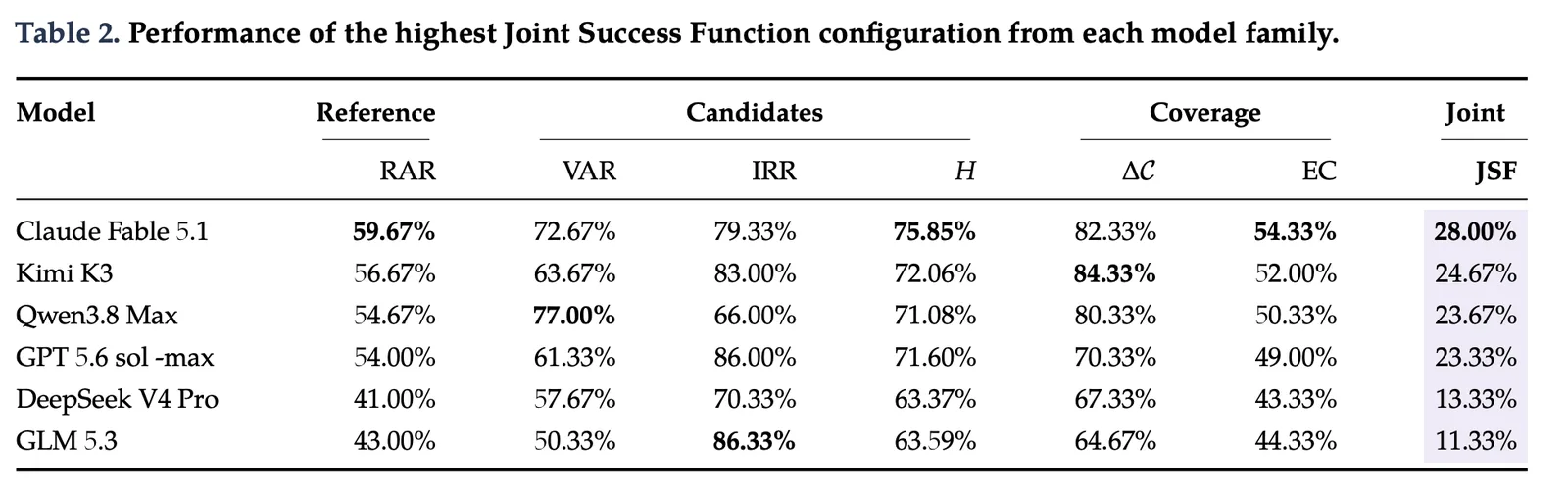
- Under TestPrism’s Joint Success Function metric, baseline coding agents achieve only 28.00%, compared with 59.67% under single-reference evaluation, revealing that many tests appear reliable but are actually incomplete or brittle.
- Test failures mainly come from missing behaviors, unsupported assertions, and faulty test construction, which can create false confidence in automated coding workflows.
- TestHelix addresses these weaknesses by combining test synthesis, repair candidates, peer cross validation, and recursive self-improvement, improving Joint Success Function scores by 8.67 to 9.00 percentage points over baseline harnesses.
Meta description: TestPrism shows LLM coding agent tests pass only 28.00% on a strict metric, while TestHelix lifts scores by 8.67 to 9.00 points in new benchmark.
Tags: LLM coding agents, automated testing, TestPrism, TestHelix, code generation
Featured image: Abstract technology illustration showing code tests, program states, and validation paths, no people, logos, or text.
Background: The Test Generation Problem Before TestPrism
LLM coding agents, meaning large language model systems that generate and evaluate code, have advanced test generation across diverse programming tasks. The common practice was to evaluate generated tests against a single reference solution. That approach treats one correct implementation as the whole specification, even though many valid implementations can satisfy the same task. When a test suite is judged only by that one solution, it can look more reliable than it is, because it may miss edge cases, alternative behaviors, or invalid programs that should fail.
Development: TestPrism Puts Tests Under a Stricter Joint Standard
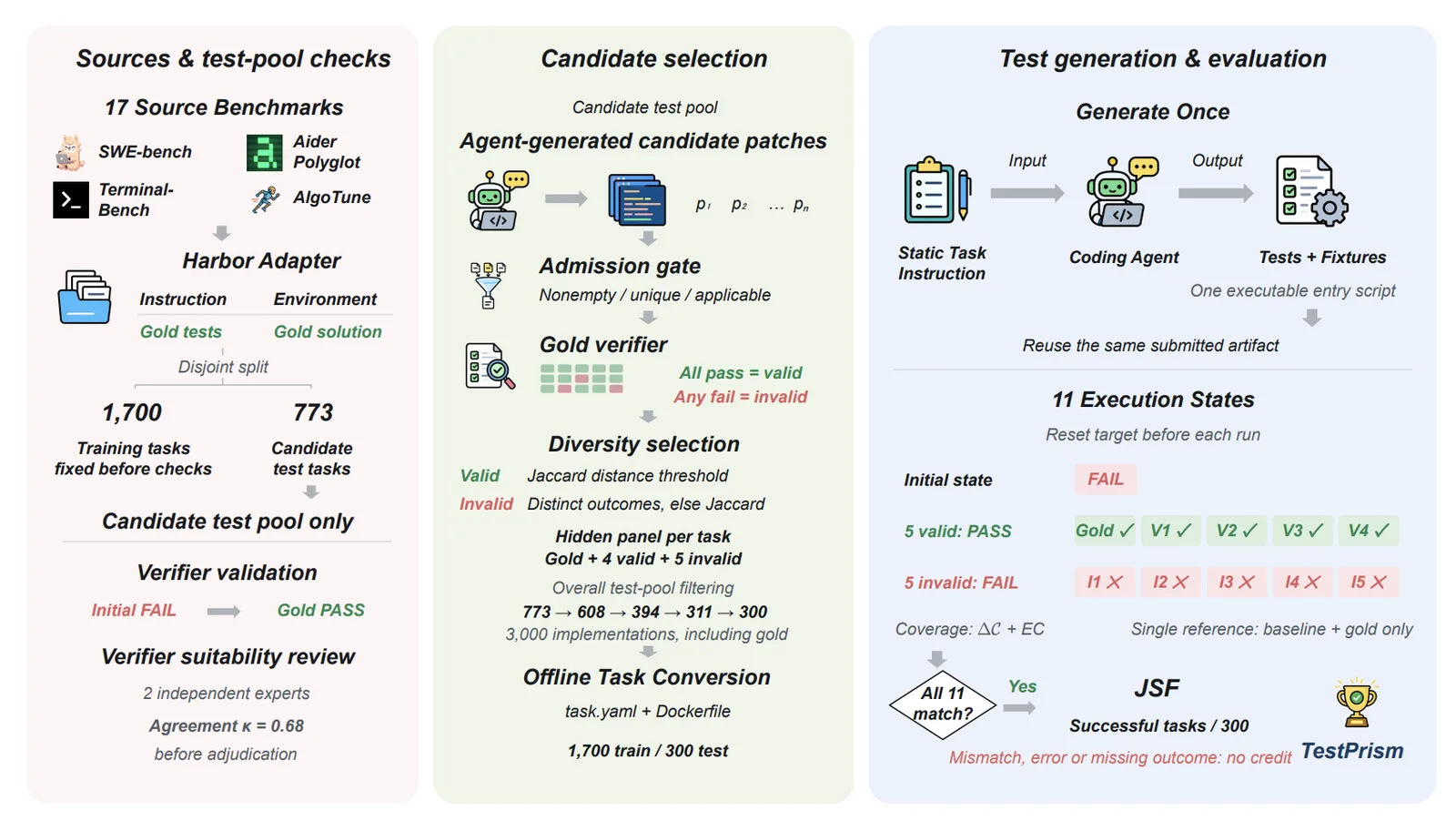
TestPrism was introduced to measure this blind spot. It comprises 300 test tasks from 17 sources and 3000 candidate implementations, evenly split between valid and invalid solutions. Its primary metric is the Joint Success Function. A generated test suite must fail on the initial program state, accept every valid candidate, and reject every invalid candidate.
Across fourteen baseline coding agent configurations, the Joint Success Function reaches only 28.00%, while single reference success reaches 59.67%. The gap suggests that tests which appear useful under a single reference may still be incomplete or brittle when exposed to a wider set of implementations.
Analysis: Why Strict Test Scores Remain Low
The results point to three failure patterns. Generated tests can miss behaviors, meaning they do not check parts of the program that distinguish correct from incorrect implementations. They can contain unsupported assertions, which are claims about program behavior that the test environment or code does not justify. They can also reflect faulty test construction, such as malformed checks or assumptions that make the tests unstable.
These weaknesses matter for readers because coding agents are often used to accelerate development workflows. If a test suite is too easy or too narrow, it can create false confidence. A single passing reference solution is not enough proof that a test suite protects real behavior.
Latest Progress: TestHelix Attempts a More Repair-Oriented Workflow
To address the weaknesses, the work introduces TestHelix. It combines heterogeneous synthesis of test and repair pairs with peer cross validation and recursive self improvement, abbreviated as RSI. The method aims to produce not only tests but also repair candidates, then use cross validation to check whether generated tests distinguish valid from invalid behavior.
Across two models, TestHelix improves the Joint Success Function by 8.67 to 9.00 percentage points over the native harness comparators in the TestHelix evaluation. The improvement is not a full solution, but it shows that structured self checking can raise performance beyond a simple baseline harness.
What to Watch Next
The current evidence positions automated test generation between two stages. Earlier systems made it practical to create test drafts quickly. TestPrism shows that stricter evaluation still reveals large gaps. TestHelix shows one possible direction: combine test synthesis, repair, cross validation, and self improvement in the same loop.
For readers following LLM coding agents, the key question is no longer whether an agent can write tests that pass one reference solution. It is whether those tests remain valid when many candidate programs are considered. The 28.00% Joint Success Function result, the 59.67% single reference result, and the 8.67 to 9.00 percentage point gains from TestHelix together suggest that reliable test generation is still an open engineering problem.
Comments
No comments yet. Be the first to comment.