
Post-Training State-of-the-Art Text-to-Image Models through Composed Preference and Rubric Rewards
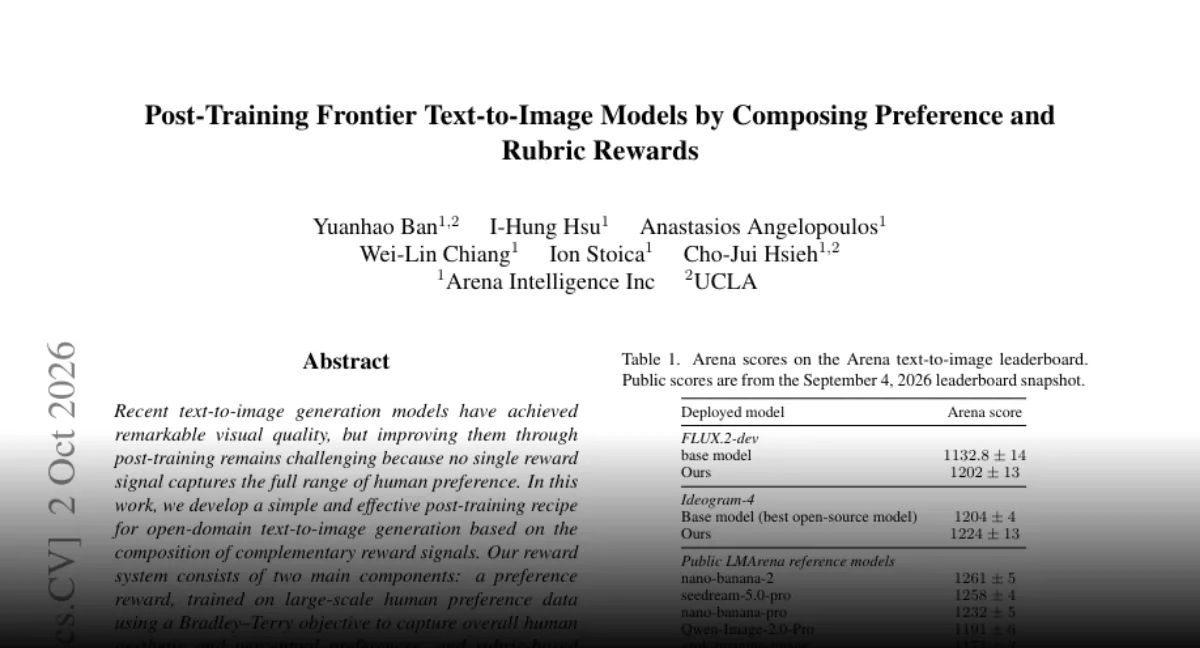
This article describes a text-to-image post-training recipe that combines human preference rewards, rubric rewards for prompt faithfulness, anti-reward-hacking gates, and weight averaging. In blind human evaluation, FLUX.2-dev gains 69 Arena points, and post-trained Ideogram 4 surpasses listed open-source models on the Text-to-Image Arena leaderboard.
Key Takeaways
- Human preference alone can favor appealing but unfaithful images; the proposed post-training recipe combines preference rewards with rubric-based prompt-faithfulness and constraint checks.
- The method trains a preference reward model on about 5 million human votes, adds anti-reward-hacking gates, and merges policies through weight averaging.
- In blind human evaluation, FLUX.2-dev improves by 69 Arena points, showing gains on both taste and instruction-following dimensions.
- Post-trained Ideogram 4 leads publicly listed open-source models on the Text-to-Image Arena leaderboard as of the September 4, 2026 snapshot.
- The work marks a shift from preference-only tuning to hybrid reward design for more reliable text-to-image model optimization.
Hybrid Rewards Boost FLUX.2-dev and Ideogram 4 by 69 Arena Points
Meta Description: Hybrid preference and rubric rewards improve FLUX.2-dev by 69 Arena points and push Ideogram 4 past listed open-source models in blind human tests.
Tags: text-to-image post-training, reward models, FLUX.2-dev, Ideogram 4, Arena leaderboard
Featured image: Abstract layered network of glowing nodes and prompt tokens in blue and silver, no people, logos, or text.
A new text-to-image post-training recipe argues that human preference alone is not enough to guide image models. The approach combines a preference reward model trained on ~5 million human votes with rubric rewards for prompt faithfulness and constraint satisfaction, then adds anti-reward-hacking gates and weight averaging. In live, blind human evaluation, the method improved already strong models: FLUX.2-dev gains 69 Arena points, and the post-trained Ideogram 4 surpasses all publicly listed open-source models on the Text-to-Image Arena leaderboard as of the September 4, 2026 snapshot.
Background: The Limits of Preference-Only Training
Text-to-image systems are often tuned after training by using human feedback. Preference data can tell a model which output a viewer likes more, but that signal can be broad. An image may look visually appealing while still missing prompt details, ignoring style requirements, or breaking explicit constraints. This is especially important in production use, where prompts may contain multiple conditions at once.
The work frames this as a core post-training problem: a reward model built only on preference may optimize taste rather than faithfulness. A model can learn to produce attractive scenes, but not reliably preserve the requested subject, layout, style, or excluded elements. The starting point of the method is therefore not to discard preference data, but to treat it as one part of a wider reward system.
Development: Combining Votes, Rubrics, and Gates
The method begins with a preference reward model trained on ~5 million human votes. That gives the system a large signal about human judgment. On top of that, it adds rubric rewards for prompt faithfulness and constraint satisfaction. Rubric rewards are more explicit checks: they can evaluate whether the image satisfies details requested in the prompt, rather than only whether people prefer one image over another.
The design also introduces anti-reward-hacking gates. This addresses a common issue in model training: a generated output can score well on a reward signal without actually being better for the user. Gates are meant to block or penalize policies that exploit the reward system instead of following the intended task.
Finally, the recipe combines complementary policies through weight averaging. Weight averaging is a technique that merges model parameters from different policies. The goal is to preserve strengths from each policy rather than letting one training signal dominate.
Latest Progress: A 69-Point Gain for FLUX.2-dev
The reported gains are measured in live, blind human evaluation. This matters because leaderboard points can be influenced by isolated test sets or automatic metrics. In this case, the evaluation is described as blind and human-led, which makes the result more relevant to real user judgment.
FLUX.2-dev gains 69 Arena points under the recipe. The result is notable because the model is already described as strong before post-training. That suggests the improvement is not simply fixing a weak baseline, but pushing an existing model further along both preference and constraint dimensions.
The post-trained Ideogram 4 also moves to the front of the Text-to-Image Arena leaderboard. As of the September 4, 2026 snapshot, it surpasses all publicly listed open-source models. This places the result in a competitive context: the model is not only improved internally, but also visible in a public human-evaluation ranking.
Current Stage: The September 4, 2026 Leaderboard Snapshot
At this stage, the work shows a shift from preference-only tuning to hybrid reward design. Preference votes still matter, but they are paired with rubric-based checks, hacking safeguards, and policy merging. The September 4, 2026 snapshot marks the point where the post-trained Ideogram 4 leads publicly listed open-source models on the Text-to-Image Arena leaderboard.
The result also leaves room for follow-up. Leaderboards change, new models appear, and evaluation snapshots are time-specific. The core signal, however, is that combining human preference with explicit prompt-faithfulness rewards improved already strong systems, with FLUX.2-dev gaining 69 Arena points in live, blind human evaluation. The announcement closes by inviting reader feedback with the line “We’d love to hear your thoughts!”
Comments
No comments yet. Be the first to comment.