
Can Large Language Models Grasp Sequential Structure? A Controlled Examination of Inference and Generation
Controlled arXiv study shows LLMs can recognize sequential strategies but often fail to simulate them, exposing gaps in agent evaluation.
Key Takeaways
- A controlled arXiv study examines whether large language models truly understand sequential behavior or merely reproduce surface patterns.
- The research tests three levels of ability: strategy recognition, Markov-style rule following, and handling higher-order sequential dependencies.
- It finds a key gap between recognizing a behavioral strategy and faithfully simulating it through correct sequence generation.
- Longer context does not necessarily improve sequential understanding, and similar action distributions can hide incorrect underlying generative mechanisms.
- The findings suggest that evaluating LLMs as interactive agents requires testing hidden generative logic, not just observable outputs.
Meta description: A controlled arXiv study finds LLMs may recognize behavioral strategies yet fail to simulate them, challenging how interactive agents are evaluated.
Tags: LLM evaluation, sequential behavior, behavioral simulation, interactive agents, arXiv research

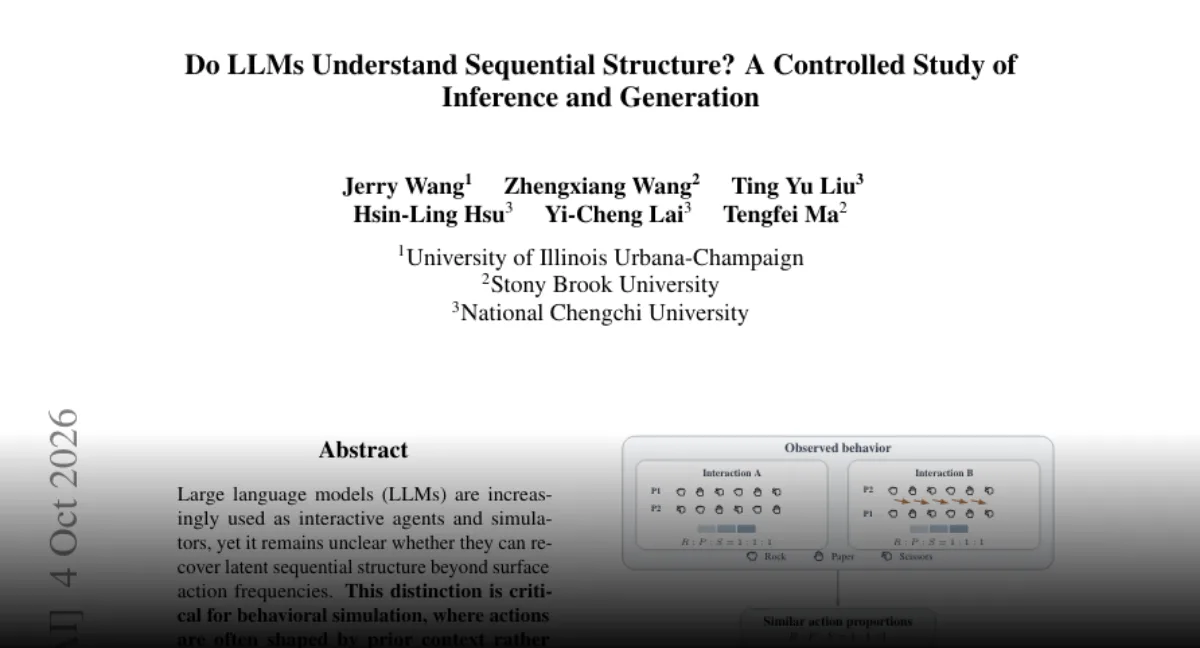
A controlled arXiv study, listed as 2610.04977, asks a deceptively simple question: do large language models truly understand sequential behavior, or do they only reproduce surface patterns? The answer matters because LLM sequential behavior is no longer a niche benchmark concern. It is the foundation for systems that play games, manage workflows, interact with users, and act as agents over time.
Background: From Pattern Matching to Agent Simulation
For years, language models have been evaluated mainly by what they output next. If the next word, move, or action looks plausible, the model is treated as competent. That evaluation method works for text completion, but it becomes riskier when models are used as behavioral simulators. A simulator should not merely produce a sequence of actions; it should reproduce the process that generates the sequence.
The paper places this concern inside three controlled experiments. The first deals with strategy identification, where a model is tested on whether it can recognize a behavioral strategy. The second uses Markov rule following. Markov refers to a process where the next action depends on the current state rather than the entire past. The third examines higher-order sequential dependencies, where future behavior depends on chains of context that are more complex than a single state transition.
Development: Probing Strategy, Markov Rules, and Dependencies
The timeline of the investigation moves from simple recognition to harder simulation. In the strategy-identification stage, a model may be able to name or infer a strategy from observed actions. That is a descriptive ability. It tells the evaluator what the model can detect.
The Markov stage tests a more mechanical ability: can the model follow state-to-state transition rules? Here, the question is not whether the model can summarize a pattern, but whether it can generate behavior according to the rule that links one state to the next. Higher-order dependency tests raise the difficulty further. They examine whether the model can handle sequences where the correct next action depends on multiple prior states or longer structural relationships.
Across these experiments, the study finds a split. Recognition does not automatically become faithful simulation. A model may identify the strategy it observes and still fail to generate actions using the correct underlying sequence logic.
Latest progress: The gap between recognition and simulation
The central result is a critical gap between recognizing a strategy and faithfully simulating it. The paper also reports a counterintuitive point: longer context does not necessarily help. More history does not guarantee better sequential understanding. In some cases, additional context may not improve the model’s ability to follow the hidden rule that produces behavior.
The finding about action distributions is especially important for evaluation. Two systems can produce similar distributions of actions while using fundamentally different generative mechanisms. A distribution match can make a model look behaviorally accurate, even when its internal sequence-following process is wrong. This means tests that compare only final action frequencies can miss serious simulation errors.
The research challenges how LLMs are assessed as behavioral simulators and interactive agents. If a model can mimic the surface statistics of behavior without reproducing the causal sequence, then benchmark scores based on outputs alone may overstate its real capabilities.
Current stage: Why this changes LLM agent evaluation
The paper leaves the field at a useful checkpoint: LLMs may be good at describing patterns, but that does not prove they are reliable at generating them. For readers, the practical implication is that agent evaluations need to separate observable behavior from hidden generative logic. The paper at https://arxiv.org/abs/2610.04977 marks a stage where benchmark design is being asked to test more than action plausibility.
Comments
No comments yet. Be the first to comment.