
OmniCapBench: A Structured Benchmark for Assessing Detailed Audio-Visual Captioning
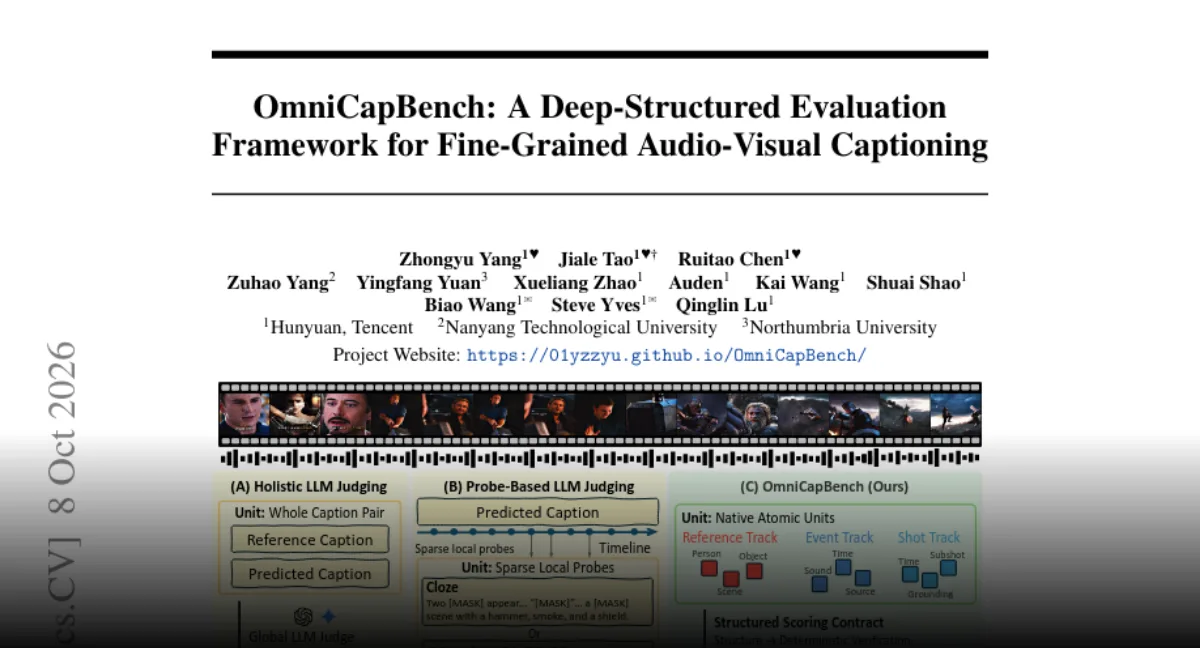
OmniCapBench evaluates audio-video captions via structured checks and local judging, enabling precise diagnosis of model failures.
Key Takeaways
- OmniCapBench reframes audio-video captioning evaluation as structured prediction instead of relying only on holistic scores or broad judge decisions.
- It separates deterministic constraint checks from local semantic judging, allowing model failures to be diagnosed more precisely.
- The benchmark distinguishes structural correctness from semantic accuracy, helping identify whether a caption violates format rules, misses audio-visual cues, or contains incorrect local descriptions.
- Its main value is fine-grained failure diagnosis, revealing whether problems stem from constraints, local meaning, or both.
- OmniCapBench reflects a broader shift in multimodal evaluation from asking whether a caption sounds acceptable to explaining where and why a model fails.
Meta description: OmniCapBench reformulates audio-video captioning as structured prediction, using deterministic checks and local semantic judging to diagnose model failures.
Tags: OmniCapBench, audio-video captioning, structured prediction, model evaluation, multimodal AI
Featured image: Abstract technology image with layered audio waveforms and video frames forming a structured grid, no people, no logos, no text.
OmniCapBench is a proposed benchmark that changes how audio-video captioning is evaluated by treating caption generation as structured prediction. Rather than relying only on a broad judgment about whether a caption feels correct, the benchmark separates structural validity and local meaning into measurable checks. That separation gives researchers a clearer path from aggregate scores to reliable, fine-grained diagnosis of model failures.
Background: Why Audio-Video Captioning Evaluation Became Harder
Audio-video captioning sits at the intersection of speech, sound, visual context, and language generation. A model may produce a fluent sentence while still missing the relationship between an event seen in a video and the sound that accompanies it. As multimodal systems become more capable, the obvious failures—garbled text, empty output, or complete topic mismatch—become easier to spot, while subtler failures become more common.
Traditional evaluation often asks whether a generated caption is broadly similar to a reference description or whether a judge considers it acceptable. Those methods can be useful, but they can also compress many different problems into one score. A low score may come from missing a required element, inventing an unsupported detail, ignoring an audio cue, or describing the visual scene in the wrong order. When the failure is not broken apart, diagnosis becomes guesswork.
Development Process: From Holistic Scores to Structured Prediction
The key move in OmniCapBench is the reformulation of captioning as structured prediction. In this framing, an output is not only a free-form paragraph. It is treated as a collection of components that can be checked against explicit constraints and assessed at the local semantic level. Structured prediction, in this context, means the evaluation task is organized around identifiable parts of the caption rather than a single global similarity impression.
This development matters because it creates two complementary layers of judgment. Deterministic constraint checks answer questions that should not depend on evaluator opinion: whether the output satisfies defined structural requirements, whether required fields are present, and whether the result follows benchmark-defined rules. Local semantic judging then focuses on meaning in narrower units, where a judge can assess whether a specific part of the caption aligns with the audio-video input.
The split is important because structural correctness and semantic quality are not the same thing. A caption can pass a format check while still containing a wrong local description. It can also capture a correct overall impression while violating an explicit constraint. OmniCapBench makes those cases separable, giving researchers a more precise diagnostic vocabulary.
Latest Progress: A Benchmark Built for Failure Diagnosis
The stated contribution of OmniCapBench is not simply another leaderboard score. It is designed to support reliable, fine-grained diagnosis of model failures. The benchmark’s structure aims to reveal whether an issue is mainly a constraint problem, a local semantic problem, or a combination of both. For audio-video captioning systems, that distinction can be more actionable than a single aggregate number.
The proposal also reflects a broader evaluation trend: moving from asking whether a model sounds good to asking where it breaks. Because audio-video captioning requires cross-modal alignment, a failure may occur in perception, event grounding, temporal reasoning, language fluency, or output formatting. OmniCapBench does not resolve every possible multimodal challenge, but its reformulation gives evaluation a clearer diagnostic shape.
Current Stage: Evaluation Moves From Judgment to Diagnosis
OmniCapBench represents the latest stage in this timeline: an explicit attempt to turn audio-video captioning evaluation into a structured, diagnosable process. The benchmark’s value lies less in producing a single final score than in separating deterministic constraint checks from local semantic judging. At this stage, the main signal is that evaluation design is shifting toward tools that can explain why a caption fails, not only whether it fails.
Comments
No comments yet. Be the first to comment.