
SanSi: An Iterative Typed Decision Model for System 1.5 Thinking
SanSi 1.4B refines option probabilities across eight loops, avoids reasoning tokens, and comes within 1.8 points of Qwen3.5-4B on reported tasks.
Key Takeaways
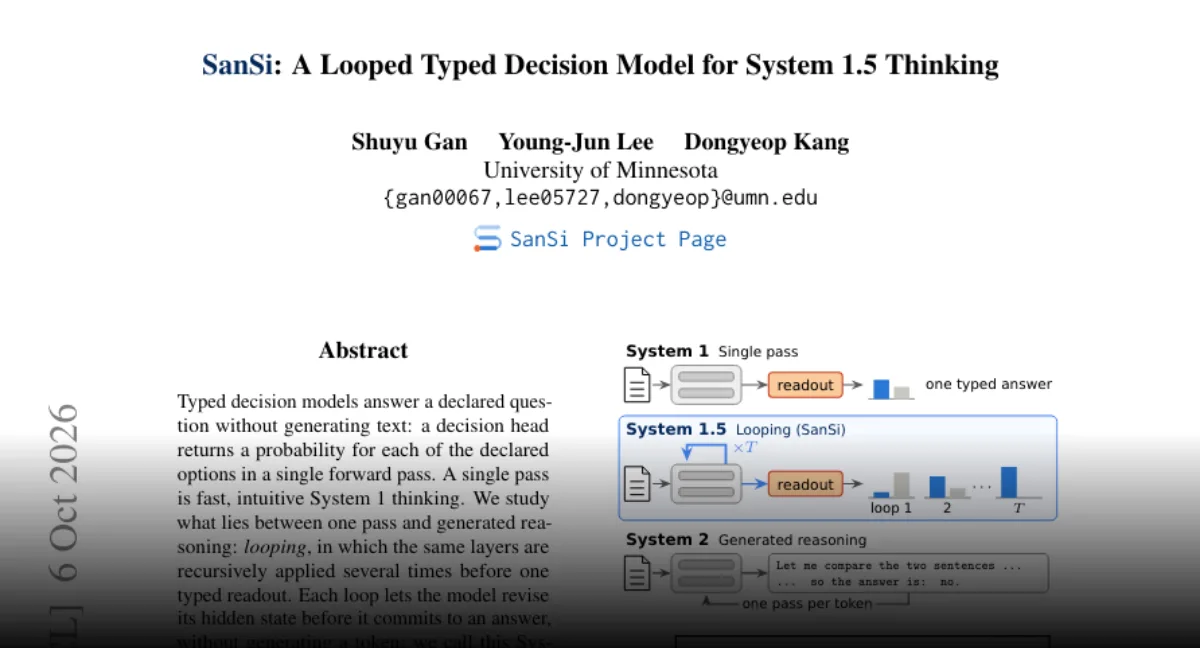
- SanSi 1.4B is a small looped typed decision model that outputs probabilities for declared options instead of generating free-form reasoning tokens.
- Its eight-loop design allows results to be read after any loop, creating an early-exit mechanism and making inference cost controlled by loop count rather than answer length.
- The reported model closes a 1.8-point gap with Qwen3.5-4B under the same data and training recipe, suggesting architectural and output-format advantages rather than scale alone.
- SanSi is described as handling reasoning chains longer than those seen during training, pointing to repeated decision refinement as a potential source of flexible reasoning depth.
- The current report provides an early signal; further validation is needed on task scope, option definitions, evaluation details, and real-world deployment budget behavior.
Meta description: SanSi 1.4B looped decision model closes a 1.8-point gap with Qwen3.5-4B by reading probabilities after any of eight loops without reasoning tokens.
Tags: SanSi, Qwen3.5-4B, looped typed decision model, flexible inference compute, small language models
Featured image: Abstract technology style, a glowing decision graph looping through eight nodes, no real people, no company logos, no rendered text.
SanSi 1.4B, a looped typed decision model, is described as a small model that returns a probability for each declared option and can be read after any of eight loops without generating reasoning tokens. In the reported comparison, it comes within 1.8 points of Qwen3.5-4B using the same data and recipe, and it is described as solving reasoning chains longer than any seen in training. The result matters because it reframes a familiar trade-off: instead of relying only on larger models or longer text answers, the work explores repeated decision computation as the source of flexibility.
Background: Why Option Probabilities Change the Compute Story
Small language models often operate under a fixed parameter budget, and the answer path can grow if a model produces intermediate reasoning tokens. For tasks that need a choice among defined options, a long free-form answer may not be the most useful output. A model that returns probabilities for declared options can be easier to parse, easier to compare against a fixed set of choices, and more predictable in deployment. The SanSi description places that idea inside a looped architecture: the model does not simply emit one final answer; it refines a decision repeatedly, and the result can be read at different loop depths.
Development: From One-Shot Answers to Eight Readable Loops
The looped typed decision model is built around three concrete elements. First, the task is expressed through declared options, so the model returns a probability for each option. Second, the computation is organized into eight loops. Third, the model can be read after any of those loops, which creates an early-exit mechanism. A caller can take a decision available after a shorter run or wait for the full eight-loop path. Because the model does not generate reasoning tokens, the inference path is shaped by loop count rather than by the length of intermediate text. The structure also gives a fixed maximum path: eight loops.
Latest Progress: SanSi 1.4B Narrows the Distance to Qwen3.5-4B
The headline number is the gap: SanSi 1.4B is reported to be within 1.8 points of Qwen3.5-4B. The comparison is described as using the same data and recipe, which points to the architecture and output format as the variable of interest rather than a different training mixture. The parameter names place the two models at the 1.4B and 4B scale, so the 1.8-point result suggests that the looped decision model can recover much of the difference on the reported tasks. The second detail is about reasoning depth. The model is described as solving reasoning chains longer than any seen in training. That raises the question of whether repeated option-level decision-making can extend a model’s usable reasoning path without a longer training-time chain.
Current Stage: What the Report Establishes and What Remains to Be Seen
At this stage, the available report gives a clear early signal rather than a broad benchmark program. It establishes that a 1.4B SanSi model can use eight loops, return probabilities for declared options, avoid generating reasoning tokens, come within 1.8 points of Qwen3.5-4B, and handle longer reasoning chains than those seen in training. The next checks are the task set, the definition of declared options, the evaluation details behind the 1.8-point gap, and whether the eight-loop reading path behaves consistently under different deployment budgets.
Comments
No comments yet. Be the first to comment.