
IterSynth: Revisiting Deep Search Agents through Role-Separated Iterative Synthesis
IterSynth uses role-separated iterative synthesis and RDPO to keep deep search context bounded, reaching 50.7 average on four text search benchmarks.
Key Points
- IterSynth replaces a single long-context ReAct agent with alternating Planner and Synthesizer roles trained under one shared policy, keeping the search state bounded and stable.
- It uses summary-based iterative synthesis so retrieved evidence is integrated into a compact workspace, reducing context exhaustion and shortening search rounds to 7-8.
- Role-Decoupled Policy Optimization trains each role with separate credit assignment using terminal answer rewards and turn-level rubric rewards, raising performance to 50.7 average on GAIA-text-only, xBench, BrowseComp, and BrowseComp-ZH.
- IterSynth-8B reaches 50.7 average, a +4.2 gain over the strongest prior ≤8B agent, while competing with several 30B-scale agents using less than one third of the parameters.
- The method also works as a model-agnostic prompting paradigm, improving ReAct zero-shot performance on large models, while ablations show that removing the trained Planner causes a roughly 41-point drop.
Meta description: IterSynth-8B hits 50.7 average on GAIA-text-only, xBench-2505/2510, BrowseComp and BrowseComp-ZH by role-decoupled iterative synthesis using one shared policy.
Tags: IterSynth, deep search agents, RDPO, BrowseComp, GAIA
Featured image: An abstract technology illustration of a bounded workspace refreshed by two alternating roles, with no real people, no company logos, and no text.
IterSynth is a deep-search agent framework that changes how long-horizon search is organized. Instead of forcing one policy to plan, read evidence, and combine results in the same growing context, it splits those duties into two alternating roles trained under a single shared parameter set. The result matters because deep-search agents are often limited by context growth and unstable long trajectories. On GAIA-text-only, xBench-2505/2510, BrowseComp and BrowseComp-ZH, IterSynth-8B reaches 50.7 average, adding +4.2 over the strongest prior ≤8B agent and competing with several 30B-scale agents at less than one third of the parameters.
Background: ReAct Trajectories Run Out of Context
Deep-search agents built on the ReAct recipe have one policy handle planning, evidence use, and synthesis at the same time. That coupling creates a practical failure mode: the model’s context keeps expanding as more retrieved material is added, and the agent can lose control over the task before it finishes. In the original problem framing, over 59% of ReAct trajectories on BrowseComp never terminate within a 64K budget. For readers tracking agent reliability, that statistic is the core issue: the bottleneck is not only reasoning quality, but context management under long search horizons.
Development: Planner and Synthesizer Alternate on a Shared Policy
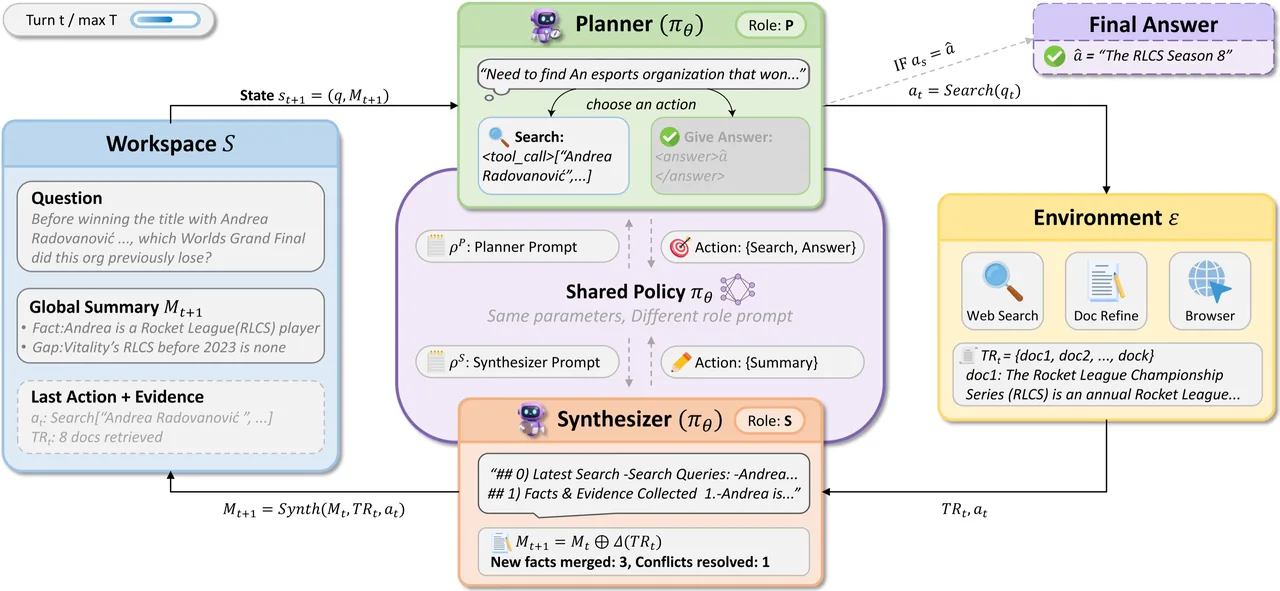
IterSynth introduces a role-decoupled, summary-based paradigm. Two roles are instantiated from a single shared parameter set. The Planner identifies unresolved information needs and formulates the next sub-query from a compact, persistent state. The Synthesizer integrates newly retrieved evidence into that summary, making summary updates a learned part of the search policy instead of an external compression module.
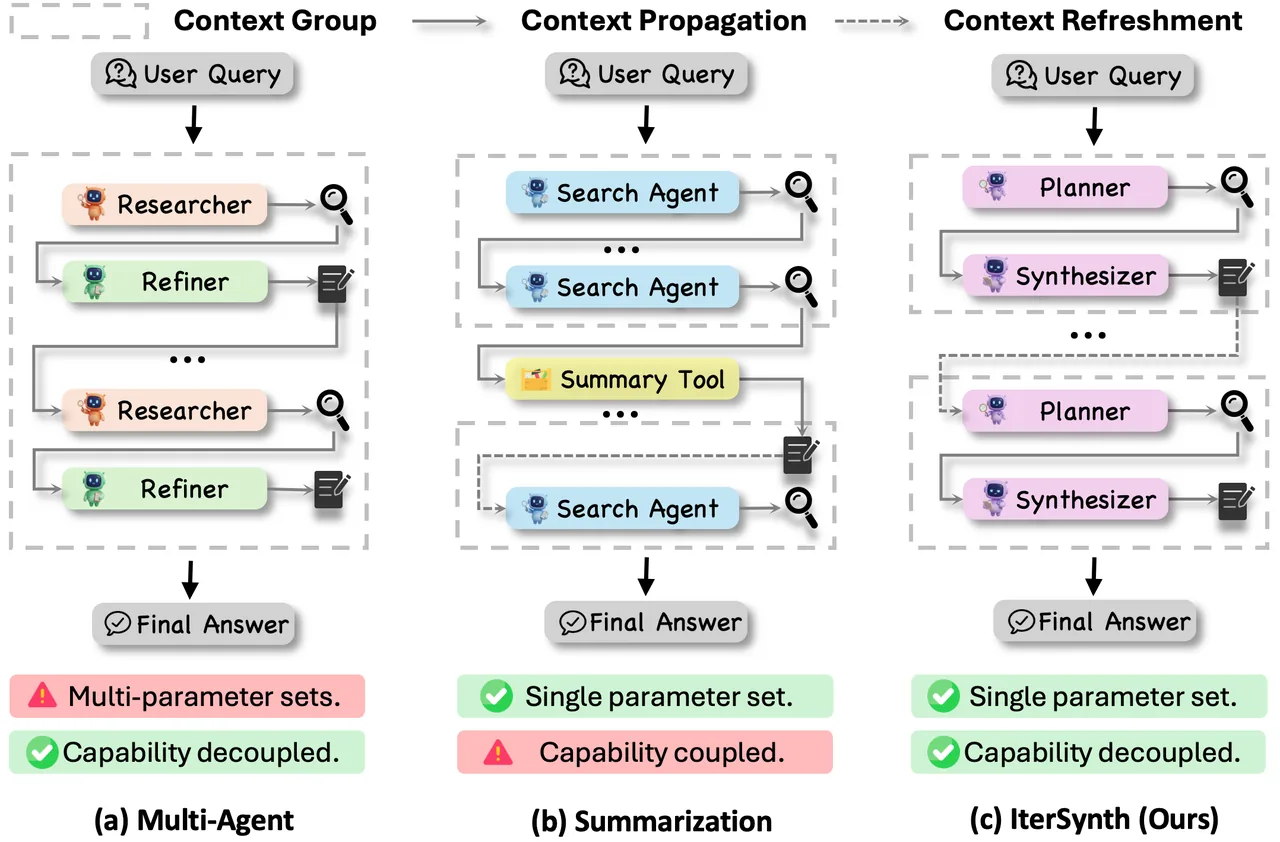
The paper’s Figure 1 contrasts multi-agent specialization, summarization-based context refreshment, and IterSynth, framing the method as capability decoupling on a single shared policy. Figure 2 then shows the Planner–Synthesizer loop: each iteration reasons over a bounded, reconstructed workspace rather than an ever-expanding transcript. That structure gives the agent a stable operating state, while still allowing evidence to be folded into the policy through learning.
Training: RDPO Assigns Credit Separately by Role
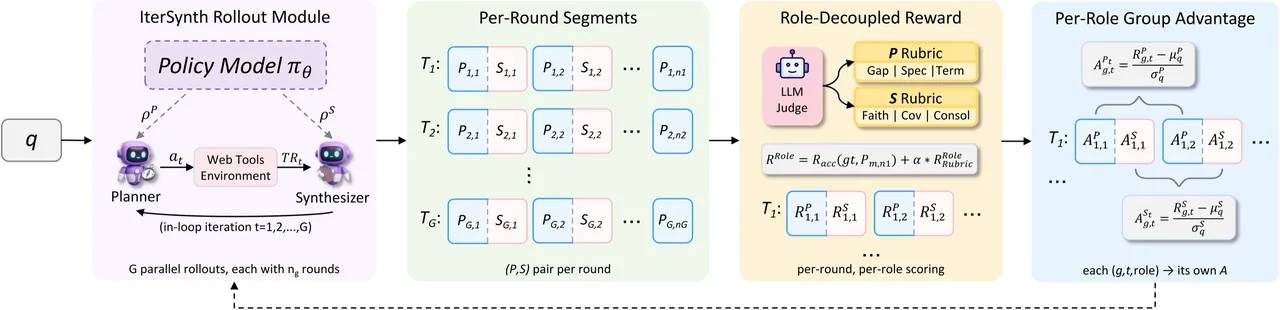
To train the two roles without changing the underlying optimization family, the method uses Role-Decoupled Policy Optimization, or RDPO. RDPO blends a terminal outcome reward with turn-level rubric rewards, and computes group-relative advantages independently per role. Figure 3 summarizes this mechanism: the terminal signal tells the system whether the final answer succeeded, while rubric scores provide more granular feedback for each turn. The role-by-role normalization is presented as more precise credit assignment with no algorithmic change beyond GRPO.
The training ablation shows the progression clearly. SFT reaches 44.1, outcome-only GRPO reaches 48.9, and RDPO reaches 50.7. The largest architectural signal comes from removing a trained Planner: replacing the Planner with an untrained model costs ~41 points. That gap supports the paper’s central claim that role decoupling is what turns the design into reliable long-horizon capability.
Latest Progress: Compact Search and Transfer to Stronger Models
The benchmark results place IterSynth-8B at 50.7 average on GAIA-text-only, xBench-2505/2510, BrowseComp and BrowseComp-ZH. That is +4.2 over the strongest prior ≤8B agent, and the report also positions the model as competitive with several 30B-scale agents at less than one third of the parameters. The bounded, reconstructed context also changes the agent’s behavior: search rounds drop to 7-8 versus 12+, and context exhaustion falls below 5%.
IterSynth is not only a trained 8B agent. It is also described as a model-agnostic prompting paradigm. In zero-shot use, it gives average gains over ReAct of +5.5 on Claude-4.5-Opus and +4.5 on DeepSeek-V3.1, with up to +10.0 on BrowseComp-ZH. For readers evaluating agent architectures, that is an important secondary signal: the Planner-Synthesizer loop can improve long-horizon search even when the model is not fine-tuned with RDPO.
At present, IterSynth appears to have reached a validated prototype stage. It demonstrates that deep-search agents can move away from unbounded ReAct context growth by training a single shared policy to alternate between planning and synthesis. The next signal to watch is whether the same role-decoupled loop remains stable across more tool-using tasks, longer budgets, and models at different scale points.
Comments
No comments yet. Be the first to comment.