
Revisiting World Modeling for LLM Agents through an Agent-Editing World Model
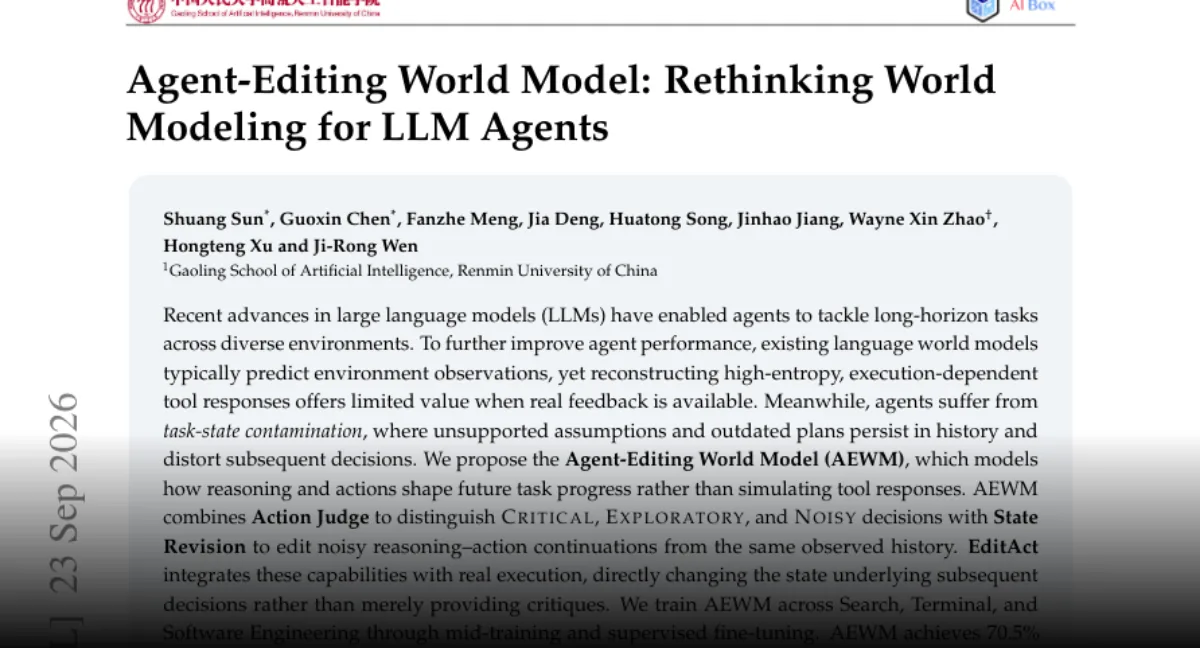
AEWM shifts long-horizon LLM agent world modeling from predicting observations to editing reasoning and action trajectories. It uses an Action Judge to classify critical, exploratory, and noisy steps, plus State Revision to revise plans. EditAct integrates this with live environments, enabling online correction. Reported results include 70.5 macro-F1 on Action Judge and 3.2-6.7 point average gains across Search, Terminal, and coding tasks.
Summary of Key Points
- AEWM reframes world modeling for long-horizon LLM agents from predicting future observations to editing the agent’s reasoning and actions to improve task progress.
- It uses two core mechanisms: an Action Judge that identifies critical, exploratory, or noisy decision steps, and State Revision that edits agent trajectories for more coherent long-term behavior.
- EditAct connects AEWM with live environment execution during inference, allowing the agent to adjust its next move based on both feedback and trajectory assessment.
- Reported results show strong gains, including 70.5% macro-F1 on the Action Judge benchmark and average task-level improvements of 3.2–6.7 points across Search, Terminal, and Software Engineering tasks.
- The work suggests a broader shift in agent evaluation: from forecasting what the environment will show next to measuring and editing what the agent should do next.
Meta description: AEWM moves long-horizon LLM agent world modeling from predicting observations to editing reasoning and actions, improving Search, Terminal, and coding tasks.
Tags: Agent-Editing World Model, LLM agents, world modeling, EditAct, Action Judge
Featured image: Abstract technology illustration of interconnected agent reasoning nodes being edited into a task-progress timeline, no people, no logos, no text.
Background: the gap between next observations and next steps
Long-horizon LLM agents are language-model systems that interact with tools, files, terminals, or environments over many sequential actions. In these settings, a conventional world model usually tries to predict the next observation an agent would receive after taking an action. That formulation helps the agent imagine consequences, but it can miss a more practical question: does the next move actually bring the agent closer to completing the task?
This is the gap Agent-Editing World Model, or AEWM, targets. Instead of treating world modeling as a passive forecast of what the environment will look like next, AEWM frames it around how an agent’s reasoning and actions shape future task progress. The shift matters because long tasks often fail not when an agent predicts the wrong screen or file state, but when it takes a step that is locally understandable yet strategically noisy, exploratory, or unnecessary.
Development: judging actions, then revising the trajectory
AEWM is organized around two connected mechanisms. The first is the Action Judge, which evaluates decision steps inside an agent’s sequence of reasoning and actions. It identifies steps that are critical, exploratory, and noisy, giving the system a way to distinguish necessary progress from drift, useful discovery, and wasted motion.
The second mechanism is State Revision. Rather than only scoring actions, AEWM edits agent trajectories so that long-horizon behavior becomes more coherent. This makes the model less like a simple predictor and more like a corrective layer: it can adjust the path the agent is taking while still respecting the task’s state and constraints. The design is useful for readers because it changes where the model spends its capacity. It is not merely asking, “What will happen next?” It is asking, “Which parts of this plan should be kept, changed, or removed?”
Latest progress: EditAct links the model to live execution
The implementation detail that turns AEWM from a representation idea into an operating pattern is EditAct. At inference time, EditAct integrates the model with the live environment. That means the agent can use AEWM while acting, not only during offline analysis of recorded traces. The result is a loop in which the agent’s next move is informed by both environmental feedback and the model’s assessment of whether the current trajectory remains useful.
The reported benchmark evidence centers on two numbers. AEWM reaches 70.5% macro-F1 on the Action Judge benchmark, outperforming the strongest frontier baseline by 10.6 points. Macro-F1 is an average of class-wise precision and recall, so the score suggests the Action Judge is not just guessing the most common class; it is handling multiple decision categories with better balance.
The second result is task-level. AEWM improves average performance by 3.2–6.7 points across six benchmarks and three agent backbones. The gains are reported on Search, Terminal, and Software Engineering tasks. Those areas matter because they stress different failure modes: Search rewards planning and evidence gathering, Terminal rewards precise state changes, and Software Engineering rewards long sequences of edits, tests, and repair loops.
Current stage: a stronger evaluation target, not a finished answer
AEWM’s current position is best read as a re-scoping of world modeling for agents. The framework does not claim that predicting observations is irrelevant; it argues that observation prediction alone is too narrow for agents that must survive many steps. By making Action Judge classification and trajectory editing the core objectives, AEWM gives researchers a way to measure whether an agent’s reasoning is moving the task forward.
The next question is how this pattern behaves outside the reported benchmark setting. A 10.6-point gap on the Action Judge benchmark and 3.2–6.7-point average improvements across six benchmarks and three agent backbones are concrete, but they still need testing across more environments, more agent architectures, and longer horizons. The direction is clear: world modeling for agents is moving from forecasting what the environment will show next to editing what the agent should do next.
Comments
No comments yet. Be the first to comment.