
Rufus-Air: An Open-Source Recipe for Post-Training Large Language Models
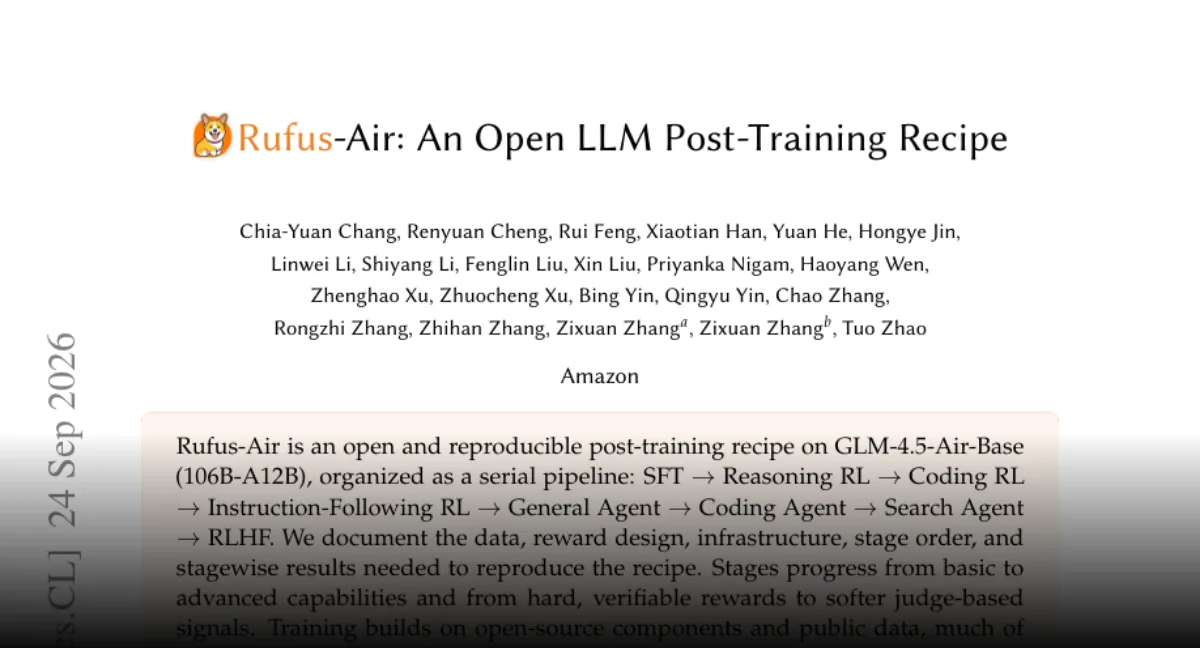
Rufus-Air presents an open-source, reproducible post-training pipeline for GLM-4.5-Air-Base (106B-A12B). It uses eight stages—SFT, Reasoning RL, Coding RL, Instruction-Following RL, General Agent, Coding Agent, Search Agent, and RLHF—to move a base model toward a capable chat system. The recipe emphasizes high-quality SFT, difficulty-filtered RL prompts, reliable reward signals, and transparent infrastructure and evaluation details. It frames its contribution as an ordered, documented training path rather than new pretraining, human annotation, or in-house distillation.
Key Takeaways
- Rufus-Air is an open-source post-training recipe for GLM-4.5-Air-Base that uses eight stages to turn a base model into a more capable chat system.
- The pipeline moves from SFT to reasoning, coding, instruction-following, agent, and RLHF stages, shifting from verifiable hard skills to softer feedback signals.
- Its value lies in reproducibility: it documents data, rewards, infrastructure, stage order, and stagewise results without new pretraining, human annotation, or distillation teachers.
- The recipe highlights lessons such as diverse SFT, difficulty filtering for RL, reliable reward-based stage ordering, and treating infrastructure as part of the method.
- It claims improvement over the official GLM-4.5-Air post-trained release, but benchmark details are limited, so independent replication remains important.
Meta description: Rufus-Air details an eight-stage post-training recipe on GLM-4.5-Air-Base 106B-A12B, covering data, rewards, infrastructure, and stagewise results.
Tags: Rufus-Air, GLM-4.5-Air-Base, post-training, reinforcement learning, open AI

Rufus-Air is an open and reproducible post-training recipe built on GLM-4.5-Air-Base (106B-A12B). The recipe matters because it gives a step-by-step path from a base model to a more capable chat-style system through eight stages: SFT, Reasoning RL, Coding RL, Instruction-Following RL, General Agent, Coding Agent, Search Agent, and RLHF.
Background: Turning a Base Model into a Useful Chat System
A base language model learns general text patterns, but it usually needs post-training to follow instructions, reason, write code, and respond in a more controlled way. Rufus-Air addresses that gap by treating the GLM-4.5-Air-Base model as the starting point rather than introducing a new pretraining effort. The material describes it as a recipe, not a hidden new pretraining run: it documents the data choices, reward design, infrastructure, stage order, and stagewise results so others can reproduce the process.
The open-source framing is part of the value. The recipe builds on open-source components and public data, and it says much of that material is used as released. It also states that there is no new human annotation and no in-house distillation teacher. That narrows the claim: the contribution is the ordered training path and the details needed to repeat it.
Development Process: Eight Stages Move from Hard Skills to Softer Feedback
The pipeline is serial. It begins with SFT, or supervised fine-tuning, where the model learns from labeled examples. It then moves into Reasoning RL and Coding RL, reinforcement-learning phases that target logical problem solving and code behavior. Next comes Instruction-Following RL, which sharpens how the model handles user requests. The last capability phases are General Agent, Coding Agent, and Search Agent, expanding the model from answer generation toward task-oriented use. The sequence closes with RLHF, reinforcement learning from human feedback.
This order reflects a progression from basic to advanced capabilities. The reward signal also changes as the pipeline advances. Early stages can use hard, verifiable checks—cases where a correct answer or code result can be measured directly. Later stages rely more on softer judge-based signals, because instruction quality, agent behavior, and preference alignment are harder to score with a single binary test.
Latest Progress: What the Recipe Claims and Why It Matters
Rufus-Air's practical contribution is not only the final model claim, but the explanation of how each stage fits together. The recipe highlights four lessons. First, diverse and high-quality SFT creates a strong capability floor. If the early fine-tuning is narrow or noisy, later reinforcement-learning stages have less to build on. Second, difficulty filtering matters in RL: prompts should sit in a productive range, not so easy that they add little signal and not so hard that training becomes unstable or uninformative.
Third, reward reliability is used as a practical principle for ordering stages. A stage can move to the next one when its reward signal is dependable enough for the behavior being trained. Fourth, infrastructure and engineering choices are treated as part of the recipe, not as invisible plumbing. That includes the systems needed to train, evaluate, and reproduce the stages.
The source states that the resulting Rufus-Air recipe improves over the official GLM-4.5-Air post-trained release and is competitive with similarly sized open models. It does not provide extra benchmark numbers in the material, so the claim should be read as the stated position of the recipe rather than as a detailed scorecard.
What to Watch Next
The next question is whether independent replication can use the published data, reward design, infrastructure details, and stagewise results. If the recipe remains reproducible, its value may lie as much in the transparent sequence as in the final model behavior.
Comments
No comments yet. Be the first to comment.