
SLCA-GRPO: Addressing Cross-Segment Credit Misassignment in Tool-Calling Reinforcement Learning
SLCA-GRPO separates tool and summary credit, improving success, cutting tool turns, and avoiding extra rollout cost.
Key Takeaways
- SLCA-GRPO fixes a credit-assignment problem in tool-calling RL by separating rewards for tool-call tokens and summary tokens instead of applying one trajectory-level advantage to both.
- The method prevents summary quality from distorting the training signal for tool decisions, making learning more precise.
- SLCA-GRPO improves learning without adding extra rollout cost, which matters because rollouts are often expensive in LLM agent training.
- Across three Qwen backbones and tool-calling benchmarks, it is associated with higher task success and fewer tool turns.
- The change points toward segment-level credit assignment as a useful refinement for more auditable and efficient tool-calling RL pipelines.
Meta description: SLCA-GRPO separates tool and summary credit in Qwen tool-calling RL, improving task success while reducing tool turns without extra rollout cost.
Tags: SLCA-GRPO, Qwen, reinforcement learning, tool calling, LLM agents
Featured image: Abstract technology style, a single reward stream splitting into two token paths, no people, no logos, no text.
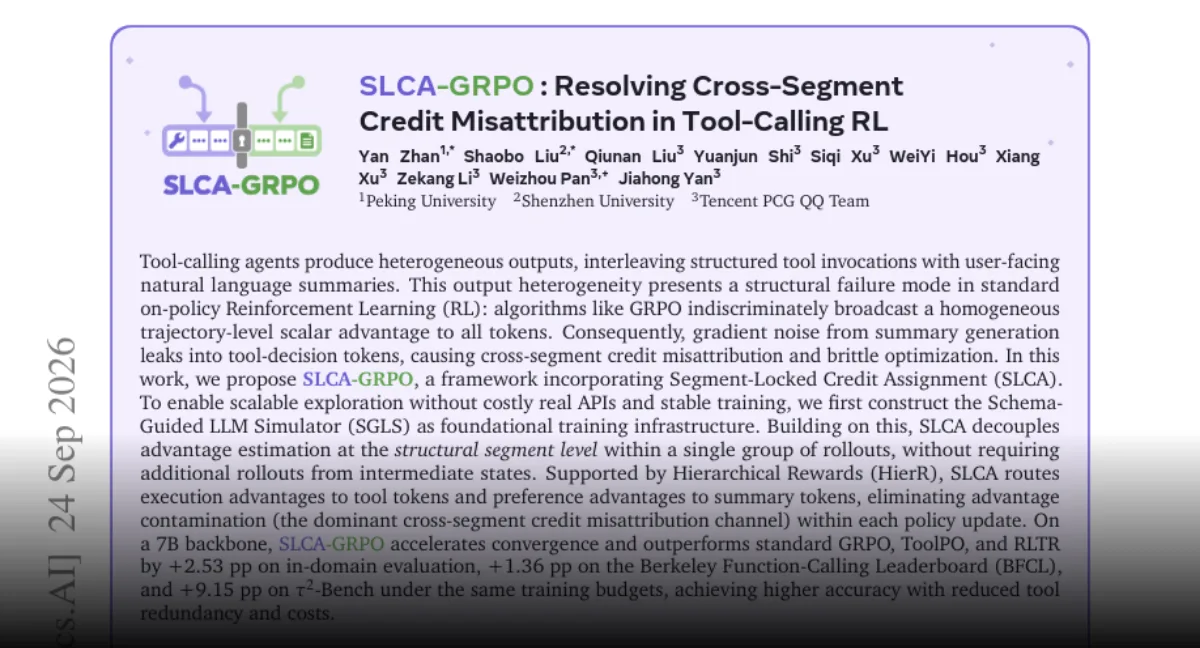
A method named Segment-Locked Credit Assignment, or SLCA-GRPO, targets a recurring weakness in tool-calling reinforcement learning: when one trajectory-level GRPO advantage is broadcast across both tool-call and summary tokens, summary rewards can distort the decisions an agent learns to make when calling external tools. The change matters because tool-calling agents are trained to choose actions and then report outcomes, and a shared signal can make those two jobs look like one job.
Background: A Shared Signal Distorted Tool Decisions
In tool-calling RL, a model is rewarded for a completed interaction, not only for the final answer. It may need to decide whether to call a tool, which tool to call, what arguments to use, and then summarize the result for the user. Those are different token roles. The training sequence contains tool-call tokens and summary tokens, yet GRPO-style setups often used a single trajectory-level advantage for the whole sequence.
That setup is efficient, but it can blur the source of learning. If a final summary earns a high score, the same credit may flow back to earlier tool decisions even when those decisions were poor. If a summary is penalized, a correct tool call may also be punished. The result is a training signal that is hard to interpret: the model is being asked to learn tool behavior from a reward that may actually be shaped by the way the final report was written.
Development: SLCA-GRPO Locks Credit to the Right Tokens
SLCA-GRPO responds by separating the credit path. Instead of applying one trajectory-level GRPO advantage across all tokens, it keeps tool-call and summary tokens distinct during the assignment of learning signals. The name points to the core idea: credit is locked to the segment of the trajectory that deserves it.
This does not add a new rollout. The method operates without additional rollout cost. That detail is important because rollout cost is often the bottleneck in RL for language models; collecting more trajectories means more inference, more tool execution, and more compute. By changing how an existing trajectory is credited, SLCA-GRPO aims to improve learning precision without changing the collection budget.
Latest Evidence: Results Across Three Qwen Backbones
The reported evidence covers three Qwen backbones and both in-distribution and out-of-distribution tool-calling benchmarks. In those settings, SLCA-GRPO is associated with improved task success and fewer tool turns. The two outcomes point in the same direction: better credit assignment can help the model complete the task while avoiding unnecessary tool calls.
Fewer tool turns is a meaningful metric for agent systems. Each extra turn can add latency, API cost, and opportunities for error. Task success, meanwhile, reflects whether the agent reached the requested outcome. Improving both at once suggests that the method is not merely trading verbosity for reliability; it appears to make the tool-use policy more targeted.
Current Stage: A More Auditable Path for Tool-Calling RL
The change is now visible as a refinement in the training signal, not as a new benchmark claim. It addresses a known source of noise in tool-calling RL by separating the consequences of action selection from the consequences of reporting. For readers tracking agent development, the next question is whether segment-level credit becomes a standard layer in RL pipelines, especially when models interact with tools that return structured results and summaries that serve different objectives.
Comments
No comments yet. Be the first to comment.