
The cost of AI performance is declining more rapidly than that of any prior technology
Two analyses from Epoch AI and MIT confirm that the cost of achieving last year's top AI performance is collapsing at 3x to 13x per year. A model matching o3's GPQA Diamond score now costs 1/725 of the original price. MIT estimates only about 3x of the drop stems from true algorithmic efficiency, with hardware gains and competition driving the rest, and warns some benchmark gains come from burning more compute per query, plus possible 'benchmaxxing' optimization effects.
Key Takeaways
- The cost of matching last year's top AI performance is collapsing at an estimated 3x to 13x per year — e.g., OpenAI's o3 scored 75% on GPQA Diamond for ~30 cents per question in early 2025; 18 months later, the same score cost only ~0.04 cents (1/725 of the original price).
- Epoch AI and MIT researchers agree on the steep price declines but disagree on the causes: MIT finds only about 3x per year stems from genuine algorithmic efficiency gains, with the rest driven mainly by cheaper hardware and market competition.
- Some apparent performance improvements come simply from burning more compute per query — so running today's best reasoning models on hard tasks can actually cost more, meaning peak AI performance is getting pricier even as yesterday's capability becomes nearly free.
- Both studies flag a "benchmaxxing" problem: AI companies may be optimizing for well-known benchmarks, inflating scores without real-world payoff — notably, costs fell slowest on Epoch's secret hidden test.
- Practical takeaway: aggregate price averages tell you little — model choice depends on quality, latency, output speed, and task fit, since cheap tokens can hide high compute costs and expensive frontier models may save money by reducing retries.
Meta description: MIT and Epoch AI both document collapsing AI inference costs, yet they split on how much comes from real algorithmic progress.
Featured image: abstract visualization of a steeply descending price curve made of glowing data points on a dark background, technology style, no people, no logos.
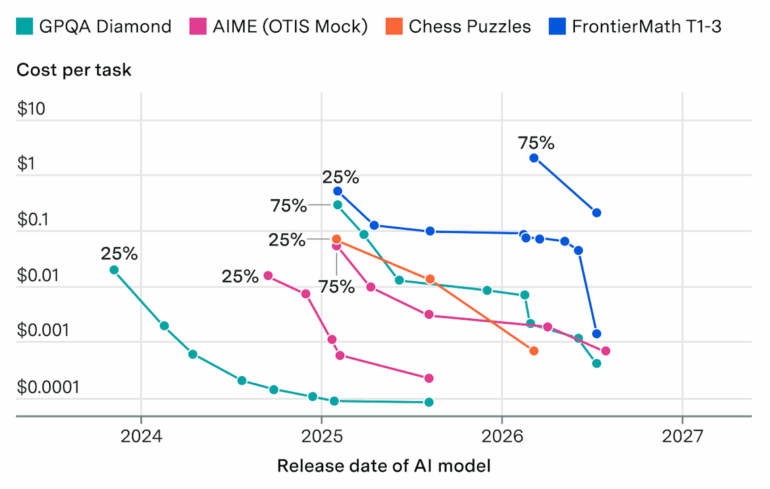
The price of running AI models is collapsing faster than almost any technology cost in recent memory, with estimates ranging from 3x to 13x cheaper per year depending on who is counting. Two new analyses, one from Epoch AI and one from researchers at MIT, agree that getting last year's top performance is now dramatically cheaper. They disagree, however, on what is driving the drop, and their findings carry a warning for anyone assuming that cheaper AI means better AI.
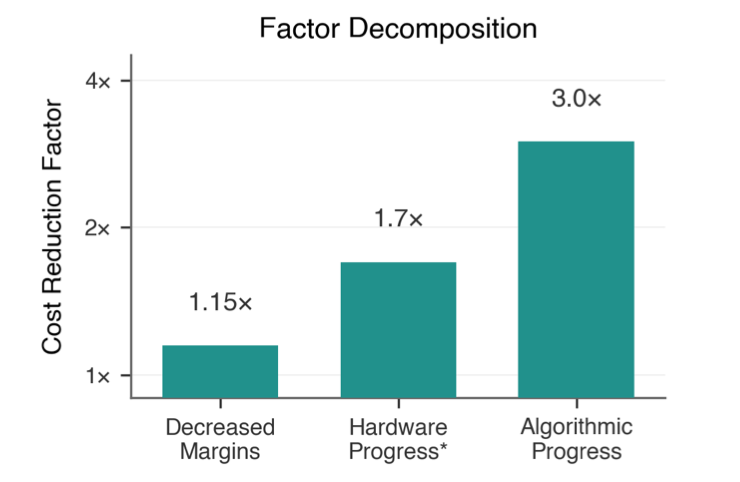
The story so far: two research teams, two different questions, and a gap between them that matters for how the industry judges progress.
Background: Two Teams Take On the Same Puzzle
Epoch AI, a research organization that tracks AI capabilities and costs, built its analysis on five benchmarks spanning math, science, and logic puzzles, tracking the price of reaching a fixed accuracy level on each test over time. It openly acknowledges the limits of the sample, calling its findings "reasonable but rough measurements based on the best available data."
MIT's team, led by Hans Gundlach, took a different route. The researchers used pricing data from the comparison platform Artificial Analysis, covering April 2024 through November 2025, and evaluated far more models per test than earlier work. Both teams looked at comparable data and both found steep annual cost declines of 5x to 10x. The divergence appears when they try to explain it.
Development: From 30 Cents to Four Hundredths of a Cent
The clearest illustration comes from OpenAI's o3 model. In early 2025, o3 scored 75 percent on GPQA Diamond, a PhD-level science benchmark, at an estimated 30 cents per question. Eighteen months later, a GPT-5.6 family model reached the same score for four hundredths of a cent. Epoch calculates that as 1/725 of the original price. To put that in perspective: if cars had dropped at the same rate, a 50,000-euro vehicle would now cost less than 70 euros.
The gap may already be wider. OpenAI launched the even cheaper GPT-6 Sol and Luna models just days ago, after the period these studies cover.
Matching last year's best capability, in other words, has become dramatically cheaper. Running the current best model on hard tasks is a different story, because newer reasoning models burn through far more compute per query, and peak performance per run can actually get pricier.
Latest Progress: Only About 3x Is Real Algorithmic Gains
The MIT team's core contribution is separating the drivers of the price drop. Cheap hardware accounts for part of the decline, and market competition for more; the researchers control for competition by analyzing open models separately. What remains, once hardware and pricing pressure are stripped out, is the pure gain in algorithmic efficiency, and that comes out to roughly 3x per year, not 13x. Epoch's higher figure is higher precisely because it does not strip out those hardware and competition effects.
MIT also found that some apparent performance gains come simply from spending more compute. A new model beating its predecessor on GPQA Diamond looks like progress, but a large share of the improvement, by the authors' estimate, comes from using more processing power per question. It scores higher and costs more to run. Coding and math benchmarks show a smaller version of the same pattern.
There is also a measurement problem the researchers flag as "benchmaxxing": AI companies could be optimizing for well-known tests, inflating scores without real-world payoff. Epoch tried to guard against this by including one test, "Mystery Game Puzzles," built on a game kept secret. Notably, costs fall slowest on that hidden test, which fits the benchmaxxing theory, though it could equally reflect the task format or noise in the data.
What This Means for Anyone Choosing a Model
For readers picking models in practice, the studies converge on one point: aggregate price averages tell you very little. Platforms like Artificial Analysis rank models across quality, price, latency, context window, and output speed, and the cheapest option rarely wins on every dimension.
A low-cost model with high latency is useless for a real-time chatbot. A powerful reasoning model may be too slow for automated workflows. A pricier frontier model can still save money if it gets answers right more often and reduces retries. None of that surfaces in a simple price-per-token comparison, since tokens, the text units providers bill for, hide how much extra compute reasoning models consume behind the scenes.
Where things stand: the field is in a phase where matching yesterday's frontier is becoming almost free, while pushing today's frontier on hard reasoning tasks keeps demanding more compute per query. The numbers to watch next are whether OpenAI's newly launched GPT-6 Sol and Luna compress the o3 gap further, and whether MIT's 3x algorithmic figure holds as reasoning models reshape the cost curve.
Tags: AI costs, inference pricing, MIT, Epoch AI, OpenAI o3
Comments
No comments yet. Be the first to comment.