
Raise the quality of insights in agentic analytics.
Agentic analytics is progressing, but only 48% of AI insights improve business, as context gaps, fragmented data, and excess volume limit reliability.
Key Takeaways
- Agentic analytics is showing early value, with 48% of agent-generated insights leading to business-improving actions, up from 37% a year earlier.
- Reliability remains the main gap: more than half of agent insights still fail to help, and poor-quality outputs can trigger costly or reputational risks.
- The biggest barriers are limited business context, fragmented or inaccessible data, and too many insights for organizations to evaluate effectively.
- “Insight leaders” perform much better, with over 70% of their agent insights driving business improvements, especially in prescriptive, action-oriented insights.
- Companies are responding by strengthening AI and data governance and adding semantic layers to improve context, data quality, and agent performance.
Featured image: abstract agentic analytics visualization with connected data nodes, workflow arrows and quality indicators, no people, no logos, no text.
Across surveyed organizations, 48% of insights generated by analytics agents lead to actions that improve the business. The figure, from a report produced by MIT Technology Review Insights, shows that agentic analytics is starting to deliver value, but it also shows why the technology remains unreliable: more than half of agent-generated insights still fail to help. The report places agentic analytics in a broader shift. Generative AI made enterprise analytics more accessible to users across organizations. Agentic AI promises to go further by automating workflows and taking actions from agent insights. The gap is quality.
Background: Generative AI opened analytics, agentic AI adds action
Generative AI changed the role of analytics inside enterprises by moving it beyond specialist teams. Agentic AI is expected to automate entire workflows and act on insights, but the report says the quality of current agent outputs still falls short. Fewer than half of agent-generated insights at surveyed organizations lead to business improvement. Respondents generally praise descriptive insights, while prescriptive insights, which inform actions, receive mixed reviews.
Development: A one-year step forward, not yet dependable
Agentic analytics is only starting to produce results. The surveyed average is 48% of agent insights leading to actions that improve the business, up from 37% a year earlier. The rise shows progress, but the remaining failure rate carries risk. The report notes that flawed insights can trigger incorrect actions and cause reputational or financial damage. That problem can prevent organizations from achieving the return they expect from agentic analytics.
The report also identifies a small group called “insight leaders.” In this cohort, more than 70% of agent insights lead to actions that improve the business. These organizations rate their agents’ insight quality higher than the overall respondent group. The difference is especially large for prescriptive insights, the outputs most closely tied to action.
Latest progress: Context gaps, data fragmentation and too many insights
The main reason for poor-quality insights is insufficient business context, cited by 55% of surveyed executives. The other major factor is fragmented or inaccessible data, cited by 45%. Fewer insight leaders say their agents struggle with access to context, suggesting that context availability may separate leaders from the wider group.
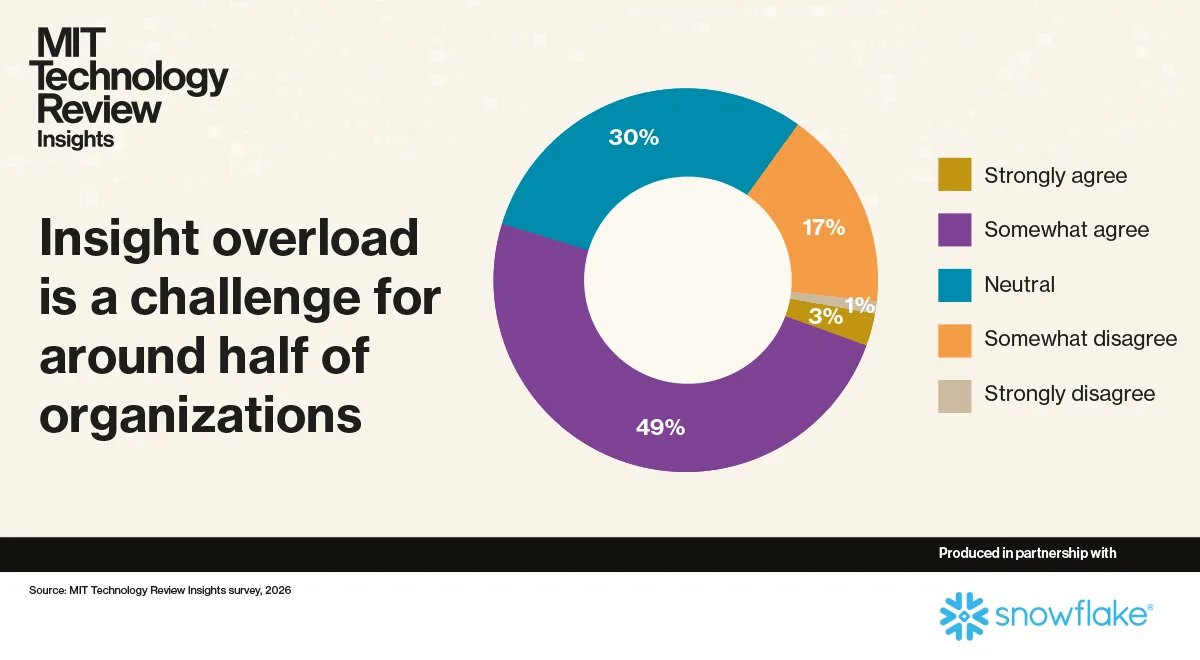
Volume is another bottleneck. At 52% of surveyed organizations, analytics agents generate too many insights to be properly evaluated and acted upon. Only 24% can evaluate all agent insights. Most evaluate them case by case, and the process remains human-intensive. In other words, more generated insights do not automatically mean more useful decisions.
Companies are responding by focusing on governance and semantics. 60% of surveyed companies prioritize initiatives that strengthen AI and data governance to enable better agent insights. 45% are adding a semantic layer to their data architecture. The experts interviewed for the report agree that the semantic layer is crucial to ensure high-performing agents.
Current stage: Early value, uneven reliability
The report was produced by Insights, MIT Technology Review’s custom content arm, not its editorial staff. It was researched and written by humans, with any AI tools limited to production processes under human oversight. The findings place agentic analytics at an early stage: useful actions are emerging, but quality, context and evaluation capacity still determine whether agents help or harm.
The spread between the 48% average and the more than 70% achieved by insight leaders points to the next phase. What to watch is whether stronger governance, semantic layers and better data access can reduce unhelpful insights and lower the human effort needed to review them.
Meta description: MIT Technology Review Insights report finds 48% of agentic analytics insights lead to business-improving actions, while context, data access and overload limit gains.
Tags: agentic analytics, MIT Technology Review, AI governance, semantic layer, data quality
Comments
No comments yet. Be the first to comment.