
Google's Project Suncatcher seeks to orbit AI data centers fueled by solar power
Google is testing AI computing in space through Project Suncatcher. Its MVP satellite, roughly refrigerator-sized and built at Planet Labs, launches October 1 aboard a SpaceX Falcon 9 from Vandenberg. The satellite will process basic AI queries in orbit, providing early data on how chips handle radiation and the space environment. Orbital data centers promise constant sunlight and fewer land and water constraints, but face major hurdles: cooling without air, radiation damage, the need for roughly 10,000 satellites to match one gigawatt-scale facility, and launch costs falling to about $200 per kilogram. Jeff Bezos estimates 20 years before space-based centers undercut terrestrial ones on cost.
Google is preparing to test whether artificial intelligence can run in orbit rather than on the ground. Through its "Suncatcher" project, the company aims to eventually operate AI data centers in space, powered entirely by sunlight. The first experimental step comes on October 1, when a satellite built for the program is scheduled to launch aboard a SpaceX Falcon 9 rocket from Vandenberg Space Force Base in California, as reported by the New York Times.
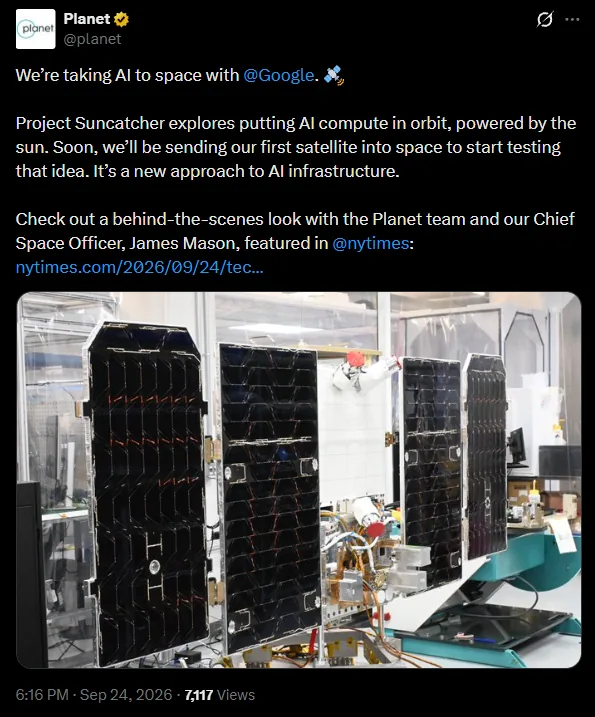
What the MVP satellite will do
The test craft, called "MVP," is roughly the size of a refrigerator. It was assembled and tested at Planet Labs' facilities in San Francisco. According to James Manyika, a Google vice president, the satellite should carry enough computing capability to process basic AI queries from orbit — a modest goal on its face, but a meaningful proof of concept for hardware operating outside Earth's atmosphere.
If the launch and on-orbit demonstrations succeed, they would give Google early real-world data on how chips behave in the space environment, which is central to the Suncatcher vision of solar-powered AI infrastructure above the planet.
Why space data centers are appealing — and hard
The idea behind orbital data centers is straightforward: sunlight is constant and abundant in space, sidestepping the land, water, and grid constraints that increasingly limit terrestrial AI facilities. SpaceX and Blue Origin are also exploring the concept, so Google is not alone in seeing the appeal.
The obstacles, however, are considerable. Google manager Travis Beals has estimated that matching a single 1-gigawatt data center on Earth would require around 10,000 satellites. Space also presents problems ground-based facilities never face: there is no air for cooling, and cosmic radiation can degrade or destroy chips over time.
Cost is the other gating factor. Launch prices would need to fall to roughly $200 per kilogram before the economics of orbital computing make sense at scale.
A long timeline, by Google's own peers' reckoning
Even the most optimistic voices in the industry urge patience. Jeff Bezos has suggested it could take as long as 20 years before orbital data centers undercut ground-based ones on cost. That framing puts Suncatcher in its proper context: the October 1 launch is an early experiment, not the start of a near-term shift.
Where things stand: Google is moving from paper concepts to hardware with the MVP launch, while SpaceX and Blue Origin pursue parallel efforts. What to watch next is whether the satellite's computing systems survive radiation exposure and perform AI inference reliably in orbit — the first hard data point in what is likely a decade-long effort.
Meta description: Google's Suncatcher project launches its MVP satellite October 1 on a SpaceX Falcon 9, testing AI computing in orbit powered by solar energy.
Tags: Google, Suncatcher, orbital data centers, SpaceX, AI infrastructure
Featured image: abstract illustration of a satellite orbiting Earth with solar panels catching sunlight, rendered in a minimalist technology style.
Comments
No comments yet. Be the first to comment.