
Vision-Language Models Struggle to Bind Attributes to Objects When Inputs Are Shuffled.
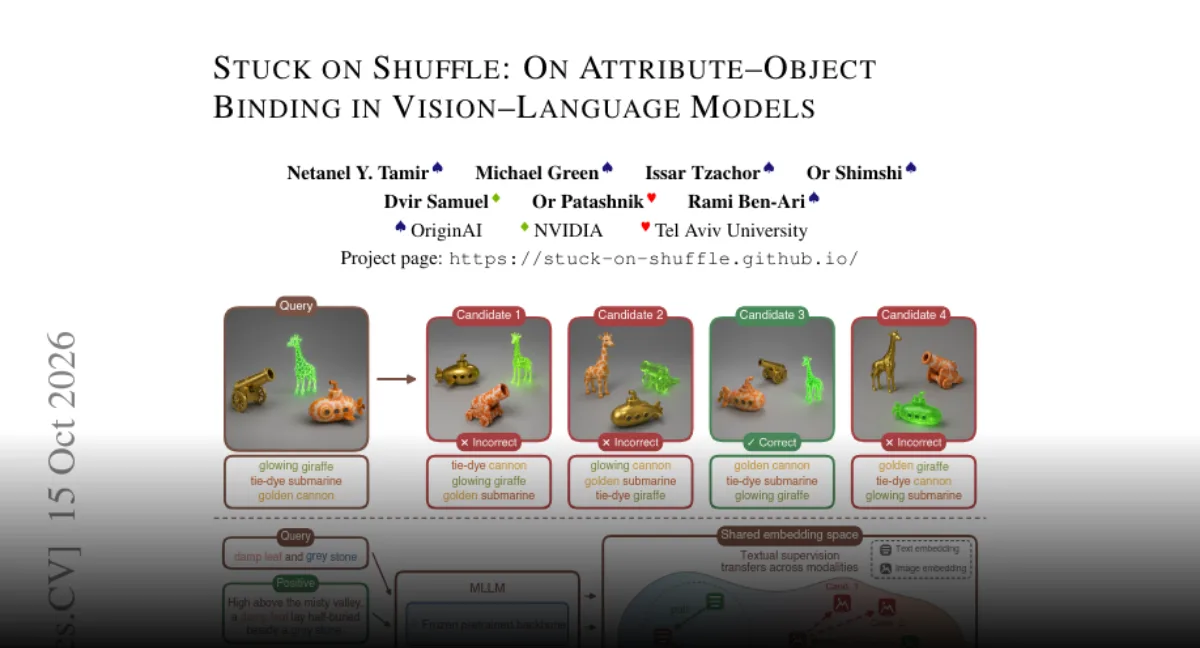
SABER is a controlled benchmark for multimodal retrieval that evaluates attribute-object binding across image and text pairings, including complex scenes. It shows that CLIP-style dual encoders and multimodal embedders can recognize concepts but misassign attributes to objects. By finetuning on synthetic text-only binding examples, the model improves cross-modal and image-image retrieval while preserving general performance.
Key Takeaways
- SABER is a controlled benchmark for testing attribute-object binding in multimodal retrieval across all four image-text pairing types and complex scenes with up to ten objects.
- It shows that CLIP-style dual encoders and multimodal LLM embedders can recognize concepts but often fail to bind attributes to the correct objects.
- The benchmark reframes the retrieval gap: the challenge is not only matching concepts, but preserving correct relational meaning across modalities and crowded scenes.
- The authors train a multimodal LLM embedder only on synthetic attribute-binding text, without image supervision, and still improve cross-modal and image-image retrieval.
- Text-only binding supervision also transfers to related compositional tasks, including negation handling and instance retrieval, suggesting a practical path to stronger multimodal embeddings.
Meta description: SABER tests attribute-object binding across four image-text pairings, exposes CLIP and multimodal embedder failures, and shows text-only retrieval gains.
Tags: multimodal retrieval, attribute-object binding, SABER, CLIP, synthetic text supervision
Featured image: abstract embedding space with connected image and text nodes, no people, no logos, no text
SABER is a controlled benchmark for multimodal retrieval that tests attribute-object binding across all four image and text modality pairings, including scenes with up to ten objects. It matters because shared embeddings can recognize concepts without reliably recording which attribute belongs to which object, a failure mode that earlier tests only partially covered.
Shared Embeddings Need More Than Concepts
Multimodal retrieval systems try to answer a simple question: given an image or a text query, what is the closest relevant item in a large collection? Many systems rely on a shared embedding space, where both modalities are projected into the same vector format. That makes matching possible, but it does not guarantee that the embedding understands composition.
The harder problem is attribute-object binding. An embedding may know that a scene contains "red" and "car," yet still fail to record that the red attribute belongs to that car rather than to another object nearby. Earlier benchmarks showed only part of this issue: they covered limited modality pairings, often used simple two-object swaps, and relied on small attribute sets. As a result, it was unclear whether current models could keep attribute ownership stable across harder scenes and more query-target combinations.
SABER Turns Composition Into a Test
SABER evaluates attribute-object binding across all four image and text modality pairings, and it spans diverse attribute types and scenes with up to ten objects. The design moves the test beyond isolated swaps and toward the kind of compositional pressure that retrieval systems face when multiple objects and attributes are present at once.
The benchmark is diagnostic. By placing the binding task inside retrieval, it asks whether embeddings can preserve relational meaning rather than just matching individual concepts. If a model confuses which object carries an attribute, the retrieval score may suffer even when the concepts themselves are represented.
Existing Models Show Breakable Bindings
Testing on SABER reveals substantial binding failures in two broad model families: CLIP-style dual encoders and recent multimodal large language model embedders. The finding shows that shared representation does not automatically mean shared understanding. A system may be strong at recognizing concepts while still being fragile when asked to bind attributes to the right object across modalities.
The result also reframes the retrieval gap. The issue is not only whether a model can map text to images or images to images, but whether it can maintain correct object-attribute relationships as the scene becomes more crowded and as the query shifts between modalities.
Synthetic Text Becomes the Supervision Layer
If binding is the weakness, training it directly is a natural response. Multimodal supervision could help, but collecting suitable images for controlled binding examples is difficult and costly. Text offers a cheaper path. It can generate a broader range of attributes, and it enables precisely controlled hard negatives.
The work therefore finetunes a multimodal large language model-based embedder exclusively on synthetic attribute-binding text. There is no image supervision in that training step. Despite this limitation, the gains transfer to cross-modal retrieval and image-image retrieval, while preserving general multimodal embedding performance.
Current Stage and Broader Retrieval Gains
The resulting model achieves state-of-the-art results on SABER and also improves on negation and instance-retrieval benchmarks. That suggests the benefit is not confined to one artificial test. Supervision that focuses on binding can strengthen related compositional skills, including handling negated descriptions and retrieving specific instances.
At this stage, SABER marks both a clearer failure mode and a practical mitigation path. The benchmark defines where multimodal embeddings break, while the text-only training result shows that binding can be improved without first collecting a costly image corpus.
Comments
No comments yet. Be the first to comment.