
OpenMobile-2 shows that open-source smartphone agents can compete with proprietary models.
OpenMobile-2 rebuilds 110 apps to train Qwen smartphone agents, improving Android benchmarks and helping open models rival proprietary systems.
Key Takeaways
- OpenMobile-2 releases open-source Qwen-based smartphone agents, a 9B and a 27B model, along with full training environments and data, showing that open models can compete with proprietary smartphone agents.
- The project’s key insight is that training across many diverse apps matters more than simply collecting more raw data; it rebuilds over 110 apps to create reproducible, controllable practice environments.
- The agents learn hybrid actions: normal screen interactions plus direct app commands exposed as tools, which can solve more tasks with fewer steps after targeted training.
- The models achieve strong benchmark gains, especially on real Android devices, with the 27B model reaching the best open-model score on SPA-Bench and trailing only Gemini 3.1 Pro.
Meta description: OpenMobile-2 rebuilds 110 apps and trains Qwen3.5 and Qwen3.6 smartphone agents, lifting AndroidWorld, MobileWorld, and SPA-Bench results for open models.
Tags: AI agents, smartphone automation, OpenMobile-2, Qwen models, Android benchmarks
Featured image: abstract technology style with geometric mobile app windows and neutral blue tones, no real people, no company logos, no text
OpenMobile-2 is a new open smartphone agent project from researchers at Nanjing University, AI company SenseTime, and several other universities. Its central claim is that for smartphone agents, the number of different apps used during training can matter more than the amount of raw training data. The team released two models built on Qwen3.5 with 9 billion parameters and Qwen3.6 with 27 billion parameters, along with the full training environment, data, and instructions to reproduce everything. The authors say the models rank near the top among current smartphone agents, and the project is aimed at a practical problem: agents that operate apps learn mainly through practice, but much of the practice data is held by large companies, leaving open models behind.
Background: Closed Data Slows Open Mobile Agents
Smartphone agents usually learn by repeatedly navigating interfaces, tapping, swiping, and completing tasks. In real life, that kind of practice is difficult to collect at scale because real apps contain logins, real purchases, changing states, and privacy constraints. A real app session may also be impossible to reset, making training expensive and hard to repeat. The researchers say their motivation is to reduce that gap between closed systems and open models.
Their answer is not to gather more screenshots from a few apps. Instead, they created a controlled environment in which the agent can practice across many applications while the underlying state remains predictable and reproducible.
Development Process: Rebuilt Apps Replace Fragile Real-World Training
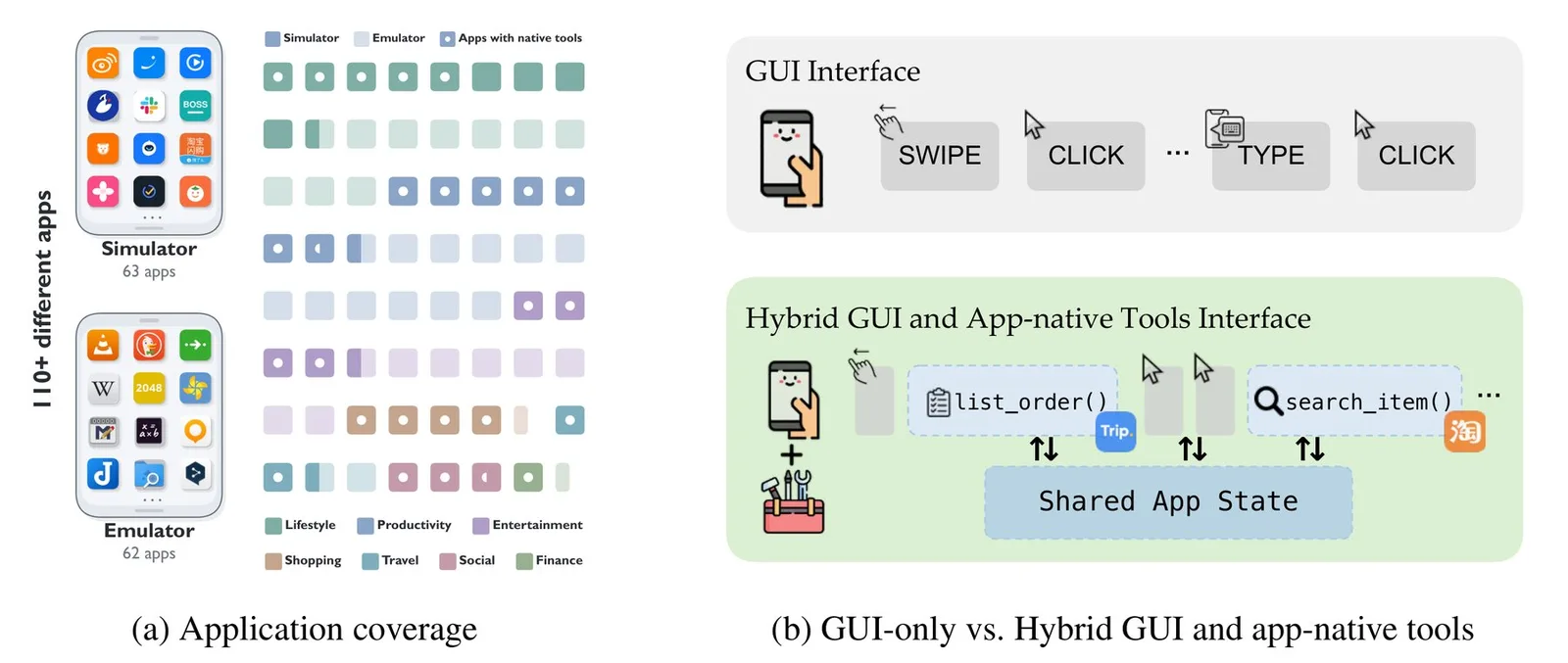
The team rebuilt 35 apps popular mainly in China, including Taobao, JD, DiDi, and Meituan, and added globally used services such as Slack and Google Drive. Combined with existing simulations and apps running in an Android emulator, the practice ground covers more than 110 applications. Human reviewers compared each rebuilt app with the original and refined it until the workflow and interface matched. Orders, budgets, and travel plans persist across sessions, and data can move between apps through the clipboard.
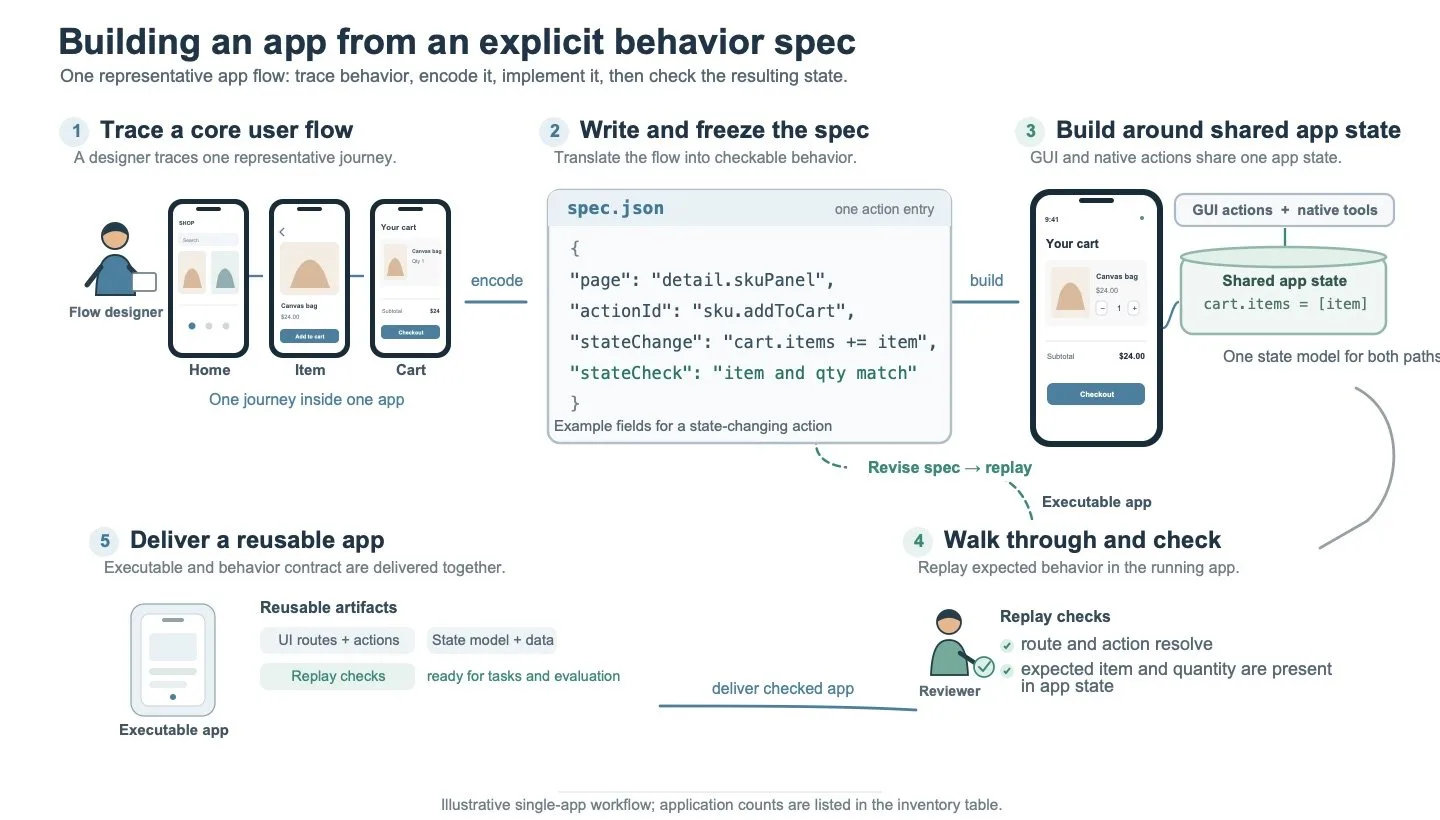
The agent only sees screenshots and cannot access internal app data, mimicking how a person would actually use the apps. At the same time, every simulation can reset to its starting state automatically. For each rebuilt app, the researchers predefine which action changes which state, then verify the result automatically. From this setup, the team generated about 11,600 example workflows and more than 2,000 practice tasks with automated success checks. Google's Gemini 3.1 Pro served as the teacher model that produced the examples, so OpenMobile-2 is effectively learning from a closed system.
A hybrid mode is part of the training. The agent combines ordinary screen actions with functions that the simulated app exposes directly as tools. The experimental part of the study goes beyond tapping and swiping. More than 50 of the simulated apps offer direct commands such as "add to cart", allowing the agent to skip navigating through menus. The agent can switch freely between both approaches depending on what is available.
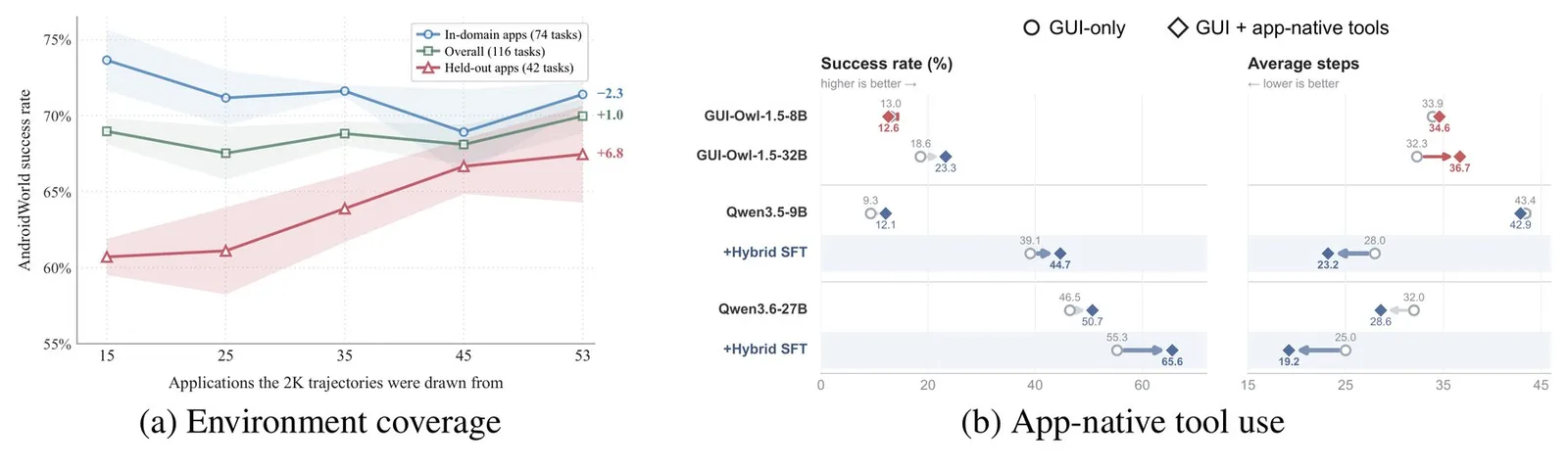
On its own, however, the shortcut does not help much because the models tend to ignore direct commands without targeted training. Once they have been trained on them, the agents use them well, solving up to 10.3 percentage points more tasks while needing about five fewer steps. The researchers say this ability also transfers to tools the models never encountered during training. During the later reinforcement learning phase, tool use received a bonus factor whenever a run included at least one direct command, but the reward still depended on whether the task was actually completed. False success reports were penalized. These interfaces only exist in the simulated apps for now, and the researchers describe the approach as experimental.
Latest Progress: Scores Rise on Benchmarks and Real Phones
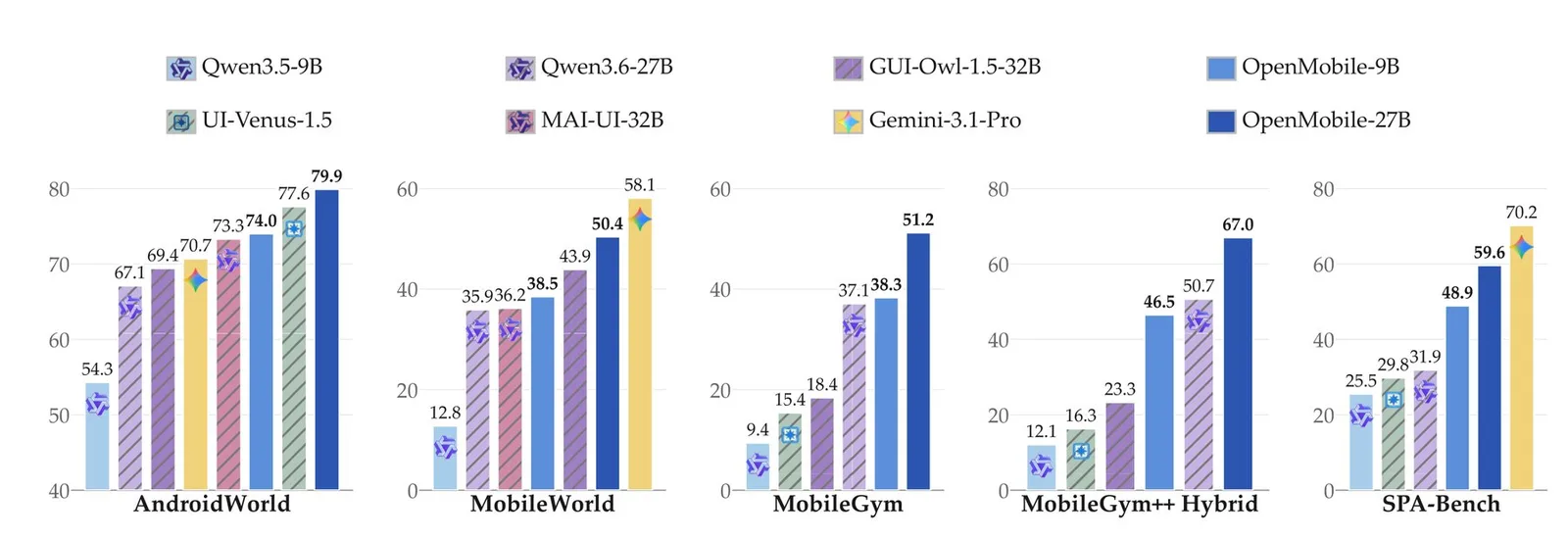
Both models show clear gains on established benchmarks. On AndroidWorld, the larger model jumps from 67.1 to 79.9 points, while the smaller model rises from 54.3 to 74. The predecessor OpenMobile-1 scored 64.7 on the same test. On the harder MobileWorld benchmark, which covers longer tasks spanning multiple apps, the larger model improves from 35.9 to 50.4 points.
The biggest jump shows up on real Android devices. On SPA-Bench, the larger model climbs from 31.9 to 59.6 points. The researchers say that is the best score among open models, and OpenMobile-2-27B trails only Gemini 3.1 Pro on SPA-Bench with real devices.
Training environment diversity matters more than sheer data volume in this setup. The researchers held the amount of data constant and only increased the number of apps the agent practiced on. That pushed the success rate on unseen apps from 60.7 to 67.5 percent. With the same data budget, app variety beats extra examples from a handful of apps. Reinforcement learning on top brought only limited gains, mainly in environments that resembled the training setup. On AndroidWorld, the larger model actually scored slightly worse afterward, landing at 79.9 instead of 80.8 points.
Some results also come from a custom benchmark the team built with 215 tasks, nearly half of which span multiple apps. Task completion is judged not by a language model but by a program that compares the app's stored data before and after each run. The authors also checked for overlap between training and test tasks and found only minor similarities.
What Comes Next for Smartphone Agents
The study sits within a wider shift in agent research. Microsoft Research had already classified API agents as more reliable and graphical user interface agents as more flexible in a 2025 study, pointing to mobile apps as a typical case where external interfaces do not exist. Oppo takes a different route with its open agent X-OmniClaw, which runs on real devices and replays previously shown paths in apps such as Taobao or Meituan through deeplinks instead of clicking through menus again. Among closed models, Google has built smartphone control directly into Gemini 3.5 Flash.
For now, the direct tool interfaces in OpenMobile-2 exist only in simulated apps, and the researchers call that part of the work experimental. The next signal to watch is whether the same combination of rebuilt apps, hybrid action spaces, and diverse practice environments can move from controlled simulations to broader real-device use without losing the reliability that made the benchmark gains possible.
Comments
No comments yet. Be the first to comment.