
Making In-Context Robot Learning Accessible: A Simple Recipe for Manipulation Tasks
A new study clarifies what robots should learn from video demonstrations by defining four semantic targets: action, object, composition, and affordance. It introduces a low-cost data recipe and a minimalist visual-prompt encoder that avoids massive pretraining. Experiments in simulation and on eight real-world tasks show strong zero-shot generalization and robustness. The full data and training pipeline will be open-sourced to support reproducibility and future robot learning research.
Key Points
- The research addresses a key ambiguity in robot in-context learning: what robots should actually imitate from video demonstrations.
- It defines the learning target across four semantic levels: action, object, composition, and affordance.
- A low-cost data recipe and a minimalist visual-prompt encoder are introduced, avoiding massive pretraining and reducing compute needs.
- Experiments in simulation and on eight real-world tasks show strong zero-shot generalization and robustness.
- The data and training pipeline will be fully open-sourced to support reproducibility and future development.
Headline: What Robots Actually Learn From Video Demonstrations: A New Take on In-Context Learning
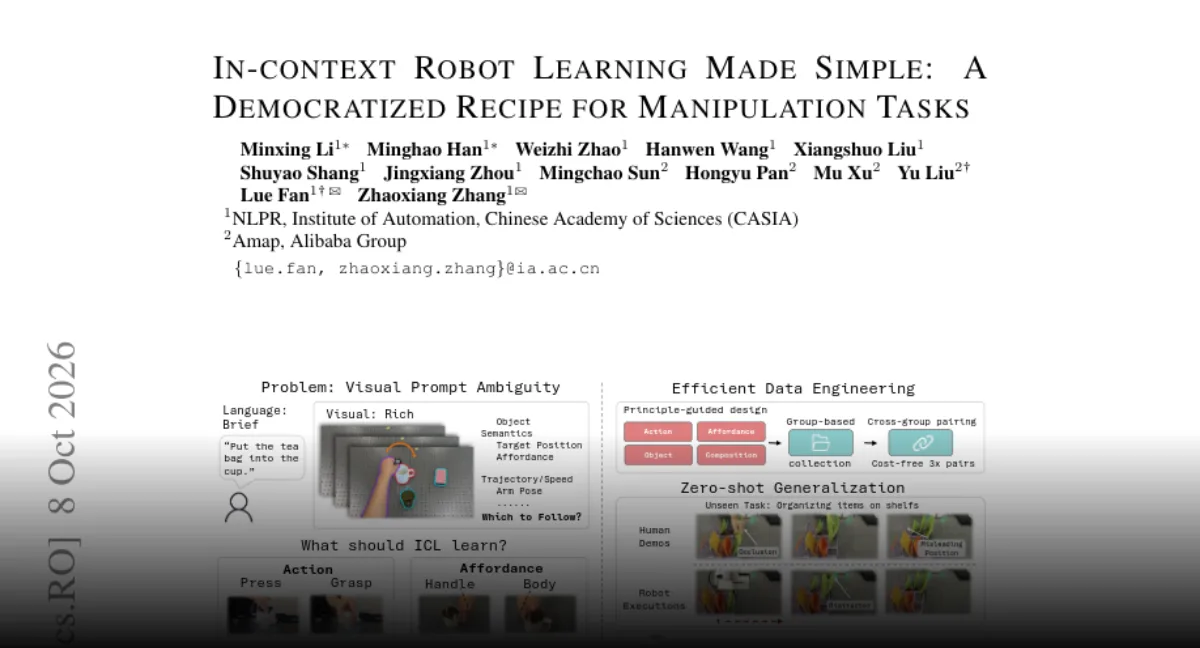
Lead: A new research effort is tackling a core ambiguity in robot in-context learning: when a robot watches a video demonstration, what exactly should it imitate? The work defines the learning target across four semantic levels—action, object, composition, and affordance—and pairs that definition with a low-cost data recipe and a minimalist visual-prompt encoder that avoids massive pretraining. Experiments in simulation and on eight real-world tasks show strong zero-shot generalization and robustness, and the data and training pipeline will be fully open-sourced.
Background: The Ambiguity Holding Back Robot Learning
Robot in-context learning promises a simple interface: show a robot a video, and it performs the task. In practice, video demonstrations contain many signals at once—how the arm moves, which object is manipulated, how parts combine, and what the object affords. Without a clear definition of the learning target, a robot may copy irrelevant details or miss the intent entirely. This ambiguity has made it hard to compare methods and to know what a model has actually learned.
Development: Defining the Target, Then Building for It
The work addresses this by specifying the learning target across action, object, composition, and affordance semantics. Each level captures a different aspect of a demonstration, from low-level motion to functional understanding of objects. To support this target, the authors introduce a low-cost data recipe and a minimalist visual-prompt encoder. The encoder is designed without massive pretraining, lowering the barrier to entry and reducing compute requirements. Experiments span simulation and eight real-world tasks, testing zero-shot generalization and robustness.
Latest Progress: Open-Sourcing the Pipeline
The data and training pipeline will be fully open-sourced. This matters for reproducibility and for teams that want to build on the approach without recreating the dataset or training stack.
What It Means and What to Watch
The key contribution is conceptual clarity plus a practical recipe. By separating action, object, composition, and affordance semantics, the work offers a vocabulary for evaluating what a robot learns from video. The open-sourcing commitment is the next milestone to watch, since it will let others test the approach on new tasks and hardware.
Meta description: New robot in-context learning research defines what robots should learn from video demos across action, object, composition, and affordance, with open-sourced data and training.
Tags: robot learning, in-context learning, video demonstrations, zero-shot generalization, open-source AI
Comments
No comments yet. Be the first to comment.