
YuE2: Integrating Symbolic and Audio Music Generation with State-of-the-Art Quality
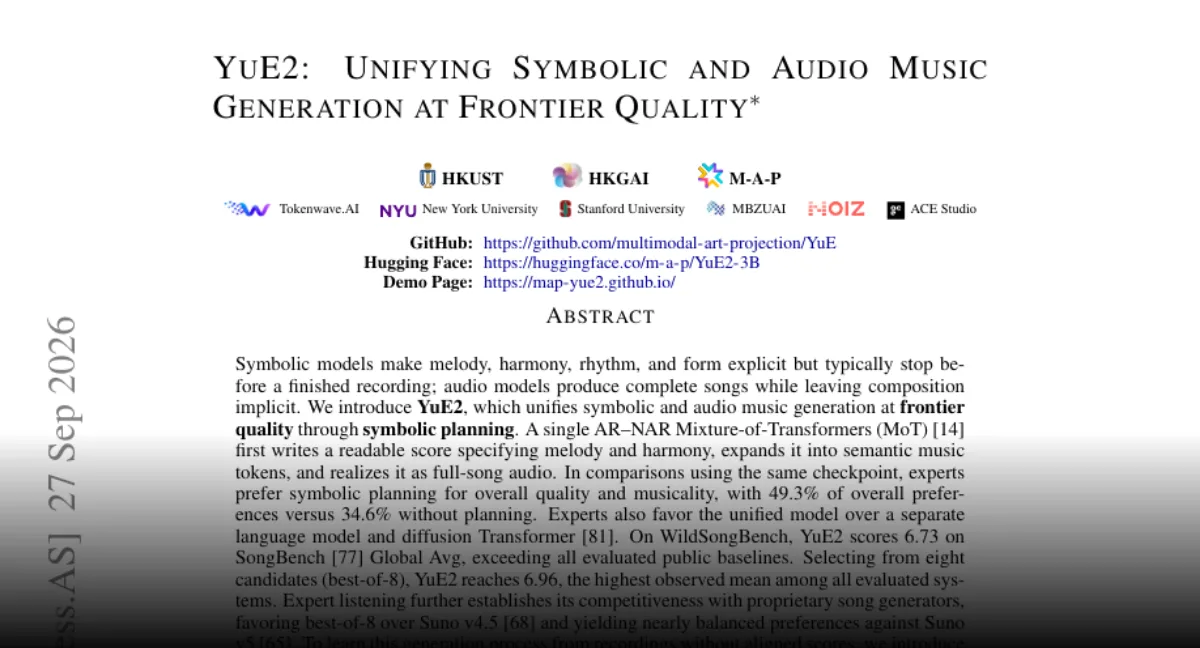
YuE2 is a research release that unifies symbolic music generation and audio synthesis through an editable score as the central bridge. It first plans melody and chords, then renders full songs with vocals and accompaniment. The workflow supports zero-shot covers and score-based editing guided by language-model agents. The release includes YuE2-3B weights, code, demos, and MERT2 and SheetSage2 for music understanding and transcription.
Key Takeaways
- YuE2 connects symbolic and audio music generation in one workflow, using an editable melody-and-chord score as the bridge between musical planning and final sound.
- The model generates a full song with vocals and accompaniment from a score, allowing creators to inspect and revise the musical structure before audio rendering.
- YuE2 supports zero-shot covers and score-based editing, including music editing guided by an external language-model agent.
- It is positioned within a broader stack with MERT2 and SheetSage2 for music understanding and transcription, enabling workflows that move from understanding or transcribing music to creating and rendering audio.
- The release is a research package including YuE2-3B weights, demos, code, and a technical report, with benchmarks and expert listening evaluations mentioned but no detailed numeric results provided.
Meta description: The YuE2 technical report unifies symbolic and audio music generation, supports zero-shot covers, score-based editing, MERT2, SheetSage2, benchmarks, and demos.
Tags: YuE2, music generation, symbolic music, audio synthesis, MERT2
Featured image: abstract technology style artwork merging notation symbols and audio waveforms, with no real people, company logos, or text.
The YuE2 technical report describes a music-generation approach that connects two fields often developed separately: symbolic music and audio music generation. Symbolic music represents ideas as notes, chords, and score-like structures, while audio music generation produces finished sound. YuE2 tries to make those layers part of one workflow, with an editable score as the bridge and a full song with vocals and accompaniment as the output.
Background: Two Music Generation Tracks Needed A Bridge
Music generation has long had two practical paths. Symbolic systems can produce melody-and-chord material that is easy to inspect, revise, and repurpose. Audio systems can create realistic singing, instruments, and mixdowns, but the result is harder to edit once the waveform exists. A unified model matters because it can give creators a musical plan before committing to sound, while still delivering an end-to-end song.
The YuE2 report positions the model as a response to that split. It does not present audio generation alone or notation generation alone as the final answer. Instead, the model writes a score first, then renders audio from that score. That sequence gives a visible intermediate object that users and other tools can work with.
Development: Score First, Audio Second, Then Editable Outputs
The core YuE2 workflow begins with an editable melody-and-chord score. That score is not just a visual artifact; it is the planning layer that guides the later audio rendering stage. From the score, YuE2 renders a full song with vocals and accompaniment.
The same model supports zero-shot covers. In this setting, the system can adapt existing material into a new performance without a task-specific retraining step. The report also describes score-based editing, including music editing guided by an external language-model agent. This places the editable score at the center of the workflow: a language-model agent can interact with a symbolic representation, while the audio model can use that representation to generate or revise the final sound.
The design also suggests a different division of labor. YuE2 handles musical structure and audio realization. MERT2 and SheetSage2, introduced in the report, are aimed at music understanding and transcription. Together, the components form a broader stack: understand or transcribe music, create or modify a symbolic plan, then render audio from that plan.
Latest Progress: Report, YuE2-3B Weights, Demos, And Auxiliary Tools
The public package includes the YuE2-3B model weights, demo pages, source code, and a technical report PDF. The report also introduces MERT2 and SheetSage2 for music understanding and transcription. It includes automatic benchmarks and expert listening evaluations, but the source announcement does not provide numeric scores or detailed results tables.
The available links are the concrete parts of the release:
- Model weights: https://huggingface.co/m-a-p/YuE2-3B
- Demos: https://map-yue2.github.io/
- Code: https://github.com/multimodal-art-projection/YuE
- Technical report PDF: https://github.com/multimodal-art-projection/YuE/blob/main/docs/technical_report.pdf
Current Stage: A Research Release With Inspectable Artifacts
At this stage, YuE2 is best understood as a technical report release with downloadable weights, demos, code, and auxiliary models for understanding and transcription. The key idea is not a single generated song, but a pipeline that moves from editable melody-and-chord structure to full vocal-and-accompaniment audio, while supporting zero-shot covers and score-based editing guided by an external language-model agent.
The next point to watch is how users combine the YuE2-3B audio model with MERT2 and SheetSage2 in real workflows, and whether the automatic benchmarks and expert listening evaluations are published with enough detail to compare the score-first approach with direct audio generation.
Comments
No comments yet. Be the first to comment.