
DroneWAM: An Efficient World-Action Model for Visual Navigation of Drones
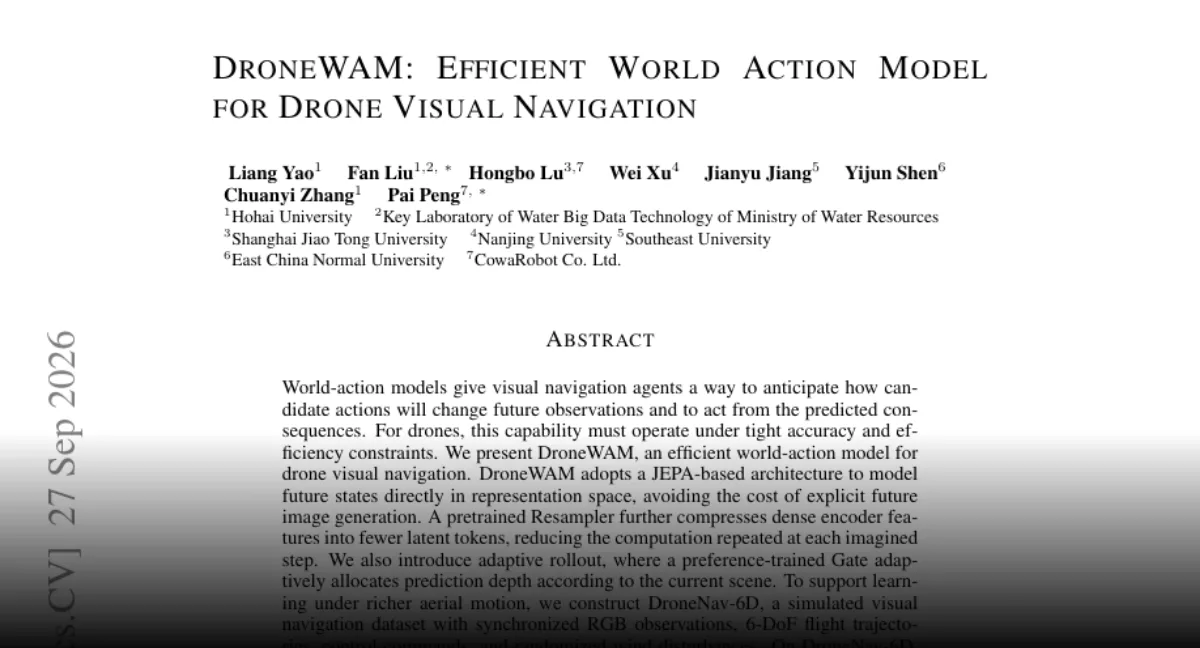
DroneWAM is a world-action model predicting visual drone navigation states in representation space using JEPA, focusing on scene structure and motion cues.
Key Takeaways
- DroneWAM is an efficient world-action model for autonomous drone visual navigation, designed to operate under limited processing and energy resources.
- It predicts future navigation states in representation space using JEPA-based learning, rather than simulating full future frames pixel by pixel.
- The method focuses computation on navigation-critical scene structure and motion cues, such as obstacles, openings, and trajectory-relevant changes.
- This representation-space approach may make onboard decision-making more practical by reducing computation while preserving the signals needed for safe planning.
- DroneWAM is currently a presented design direction; real-world evaluation is still needed on compute savings, cluttered environments, and deployment on actual drone hardware.
Meta description: DroneWAM is an efficient world-action model for drone visual navigation that uses JEPA-based prediction in representation space to guide autonomous flight.
Tags: DroneWAM, drone navigation, world-action model, JEPA, representation learning

DroneWAM is presented as an efficient world-action model for drone visual navigation. The design choice matters because a small drone must decide where to fly next using limited processing and energy resources. Rather than simulating future frames pixel by pixel, DroneWAM applies JEPA-based predictive learning to forecast future states inside representation space, while directing computation toward predictive scene structure and motion cues that carry the most navigation value.
Background: Visual Navigation Pushes Drones Toward Prediction
Autonomous drone movement often depends on cameras because location alone cannot describe a cluttered room, a forest edge, or a narrow corridor. A control system needs more than a current image; it needs an expectation of what the near future may look like if a certain action is taken. That is where world-action models enter. They connect perception, prediction, and action planning. The challenge is that predicting rich visual detail can be expensive, and expensive models can slow response times or drain batteries.
Development: From Raw Observation Forecasting To Compact Internal States
Early drone navigation stacks relied heavily on direct sensing, short-term control, or hand-built rules. As learned models became more common, researchers began using future prediction as a planning aid. A direct form of that prediction is image generation: the model creates a visual picture of what the scene may become. That can be useful, but it also asks the system to render background texture, lighting changes, and objects that may not affect the next action.
DroneWAM fits into a later stage of this trend, one that compresses the problem. The method models future states directly in representation space, meaning it predicts the internal meaning of the scene rather than its full visual surface.
Latest Progress: How DroneWAM Focuses Computation
The central efficiency idea in the DroneWAM description is about allocation. The system focuses computation on predictive scene structure and motion cues that are most relevant to navigation. In practical terms, scene structure can refer to the spatial layout a drone must respect: openings, barriers, surfaces, and safe corridors. Motion cues can refer to how the drone or the environment changes over time, which matters for trajectory planning. By prioritizing these elements, the approach seeks to avoid spending resources on visual information that does not help choose the next action.
What This Means For Drone Autonomy
For readers following drone autonomy, the relevance is less about a benchmark and more about the architecture of prediction. If representation-space forecasting can preserve the signals needed for safe planning while reducing computation, it may make onboard decision-making more feasible on platforms with modest processors. It also suggests a useful evaluation question for future systems: can a compact predictive state keep track of the physical relationships that matter while ignoring irrelevant visual detail? The answer will depend on implementation, testing, and deployment conditions, not on the model name alone.
Current Stage: A Design Direction Under Evaluation
At this stage, DroneWAM is best read as a presented approach rather than a confirmed field-deployed product. The source material defines its role as an efficient world-action model for drone visual navigation and its method as JEPA-based predictive learning in representation space. The next meaningful signals will be whether published evaluations show compute savings without losing navigation reliability, how the representation space handles cluttered real-world environments, and whether the model can support action planning on actual drone hardware. For now, the contribution is a clearer design path: move prediction closer to the state space that matters, and let the scene structure and motion cues guide the drone’s next move.
Comments
No comments yet. Be the first to comment.