
Google says fully automated cyberattacks are already here and will worsen rapidly.
Google's GTIG observed an AI framework called exploit_agent automating vulnerability discovery, exploit development, and execution with minimal human input. The case marks Level 5 activity, where attacks are fast but noisy and detectable. Russian-language clues suggest targeting French sites, while more sophisticated, evasive automated attacks are expected soon.
Key Takeaways
- Google’s GTIG reports the first observed end-to-end automated cyberattack chain in which AI discovers vulnerabilities, develops exploits, and launches attacks with no human in the loop.
- The exposed AI framework “exploit_agent” connects multiple language models to compare pre- and post-patch code, identify flaws, generate exploit logic, and execute attacks automatically.
- Google rates the activity as Level 5, meaning AI handles several attack stages with minimal human involvement, though current attacks trade stealth for speed and can leave detectable traces.
- Russian-language server comments and targeting data suggest a Russian-speaking operator focused on French media, entertainment, and education websites, but attribution remains limited.
- The threat is no longer theoretical: automated attacks are already occurring on real exposed servers and are expected to become more evasive, targeted, and dangerous in the coming months.
GTIG observed attackers fully automating vulnerability discovery and exploitation for the first time, with no human in the loop. This shortens the distance between a public software fix and an attack generated, tested, and launched.
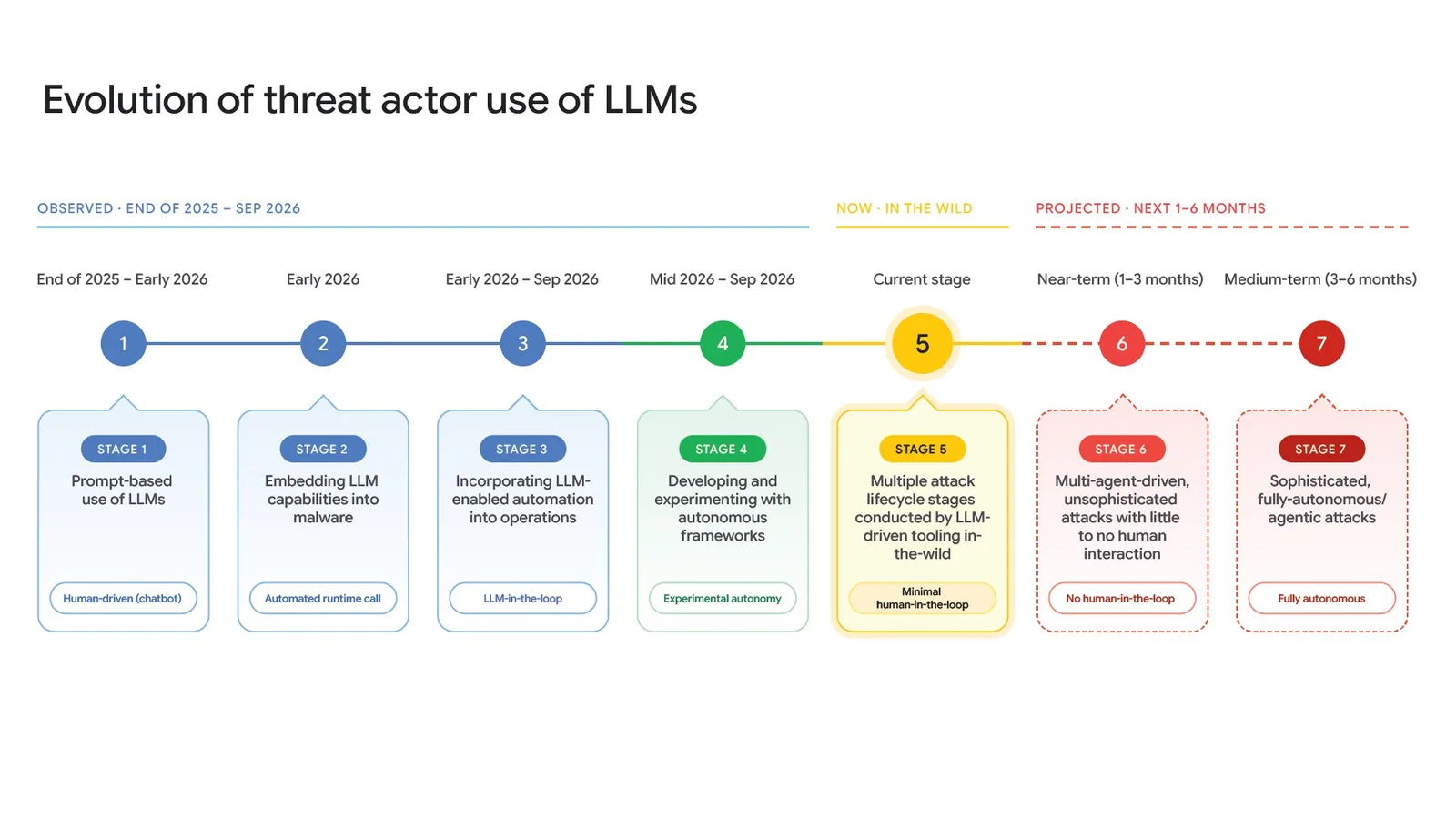
Background: The Human Bottleneck in Exploit Development
A patch can reveal a flaw by comparing pre- and post-patch code, but building exploits usually required humans to interpret changes, adapt exploit logic, choose targets, and evade detection. AI tools assisted parts, but the chain remained fragmented; GTIG says the full sequence—from vulnerability identification to automatic execution—appears automated end to end.
Development: Exploit_agent Links Models, Patch Analysis, and Execution
The GTIG AI Threat Tracker found an exposed server running "exploit_agent," an AI framework connecting multiple language models that compares pre- and post-patch code, identifies vulnerabilities, develops exploits, and runs them automatically. Machines handle each step, from patch-comparison signal to attack logic to execution.
Server config files had Russian-language comments, so GTIG suggests the operator speaks Russian. Data also suggests targeting French websites in media, entertainment, and education. The report gives no broader attribution, but the clues make the incident more specific than a generic proof of concept.
Latest Status: Google Calls the Activity Level 5
Google rates the activity Level 5: AI tools carry out several attack stages with minimal human involvement. GTIG calls this a critical turning point but notes current attacks sacrifice stealth for speed. This is a defensive bright spot: a fast fixed pipeline may leave forensic traces and predictable artifacts, whereas humans might pause, probe, and adapt to evade monitoring. GTIG says more powerful attacks are months away; not every current exploit is sophisticated, but early automation may quickly become more resilient, evasive, or targeted as tools and workflows improve.
Current Stage: Early Automation With Clear Escalation Risk
The incident is early but consequential: the fully automated chain was observed on a real exposed server, not only theorized. Its weakness is detectability: noisy machine-driven exploitation can leave traces. The development is not invisibility, but operational practice.
Comments
No comments yet. Be the first to comment.