
AI at AIG
AIG scales agentic AI into underwriting, cutting triage time, improving extraction accuracy, and using ontologies for portfolio analysis and growth.
Key Takeaways
- AIG has moved agentic AI from pilots into production underwriting workflows, seeking faster submission triage and portfolio analysis to support a $4 billion new-business premium goal for its excess and surplus lines unit by 2030.
- AIG Assist, including its patent-pending Auto Extract capability, uses large language models to extract and assess data from complex commercial submissions, cutting turnaround from three to four weeks to under one day in early deployments.
- AIG’s portfolio AI strategy relies on Palantir Foundry-based ontologies that integrate risks, exposures, limits, losses, and underwriting rules, enabling AI-driven evaluation of acquisitions, syndicates, and large insurance datasets.
- Reported operational gains include more than 370,000 Lexington submissions in 2025, a 35% improvement in submit-to-bind ratio, and claimed gains in quoting speed and bound submissions, though these figures are company-reported and not independently validated.
- The 2030 targets remain ambitions rather than achieved results, and AIG’s broader multi-agent underwriting system is still described as under development rather than fully deployed.
AIG has moved agentic AI from pilot projects into production underwriting workflows, reporting measurable gains in submission triage and portfolio analysis while pursuing a $4 billion new-business premium ambition for its excess and surplus lines unit by 2030. The New York-based insurer, which employed approximately 22,100 people across 45 countries as of December 31, 2025, disclosed the progress in its 2025 Annual Report and subsequent earnings calls.
Background: A $3.1 Billion Profit Base and a Triage Bottleneck
AIG reported $3.1 billion in net income for full-year 2025. General Insurance recorded $23.7 billion in net premiums written, and its combined ratio improved 1.7 percentage points year over year, from 91.8% to 90.1%. Global Commercial net premiums written rose 4% on a reported basis to $17.4 billion, supported by 9% growth in new business.
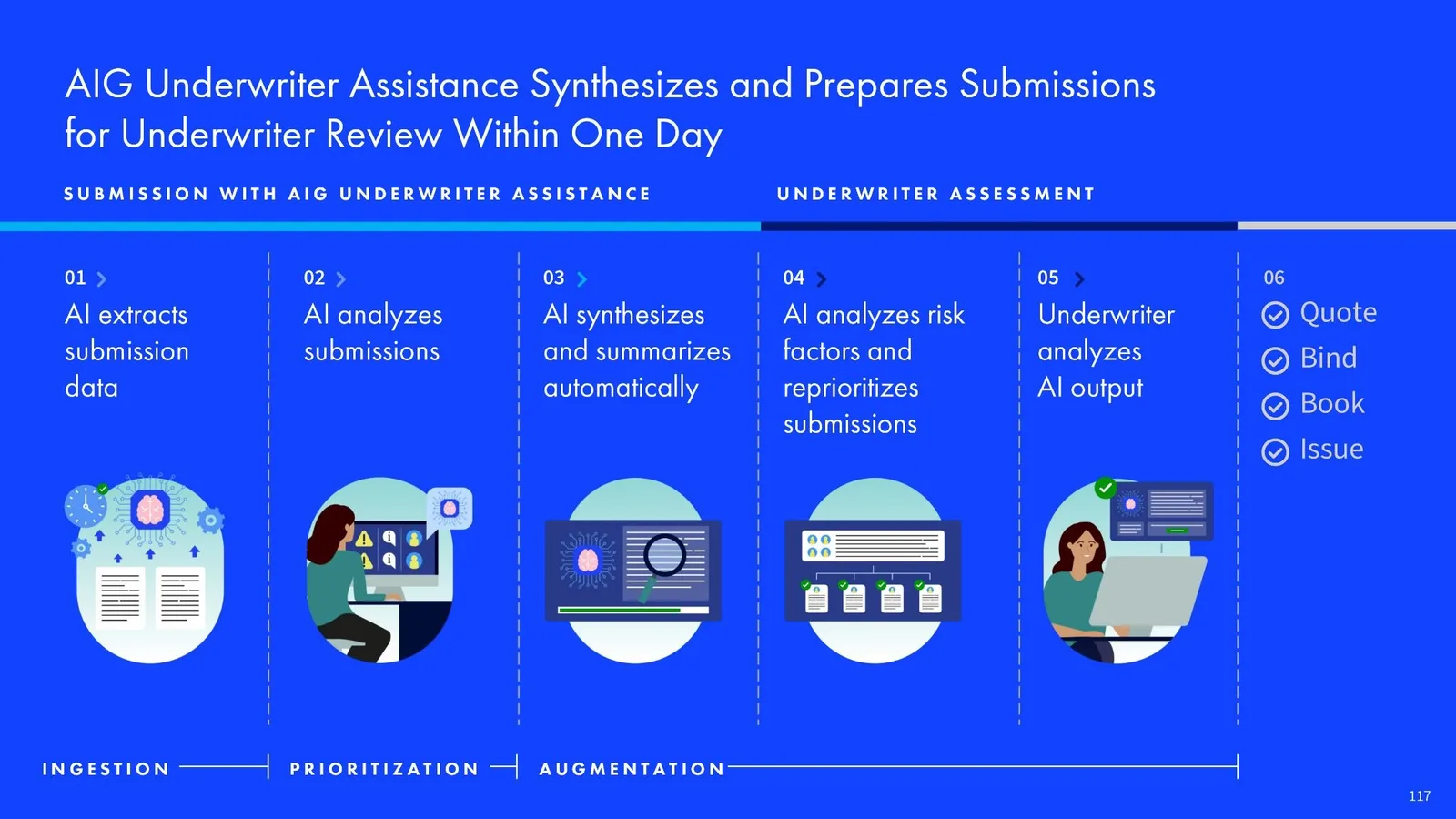
The operational problem the company targeted was manual review time. AIG's investor materials state that manually reviewing a complex commercial submission can take three to four weeks. Lexington, AIG's excess and surplus lines business, received roughly 300,000 new-business submissions in 2024 but bound policies for only about 2% of them — approximately 6,700 policies and about $1 billion in new-business premium.
AIG Assist: From Three Weeks to Under One Day
AIG Assist includes a patent-pending capability called Auto Extract, which uses large language models to pull structured data from unstructured broker cover letters, statements of value, loss runs, and supplemental applications. The tool assesses submissions against the relevant business's stated risk appetite, prioritizes them, and produces curated summaries for underwriters.
Deployment has been staged rather than simultaneous. AIG Assist entered production in Financial Lines, including Private Not-for-Profit, where the company later reported the system was reviewing 100% of applicable submissions. AIG then extended it across Lexington's middle-market property and casualty operations, and said in November 2025 it expected to complete deployment across Lexington's remaining wholesale business by year-end. The company also accelerated planned deployment across North American, U.K., and EMEA commercial lines by six months.
In an early deployment, AIG's investor materials state that submission turnaround fell from three to four weeks to less than one day. CEO Peter Zaffino reported that data-extraction accuracy improved from approximately 75% to more than 90%.
Portfolio Ontologies and the Capacity-Deployment Push
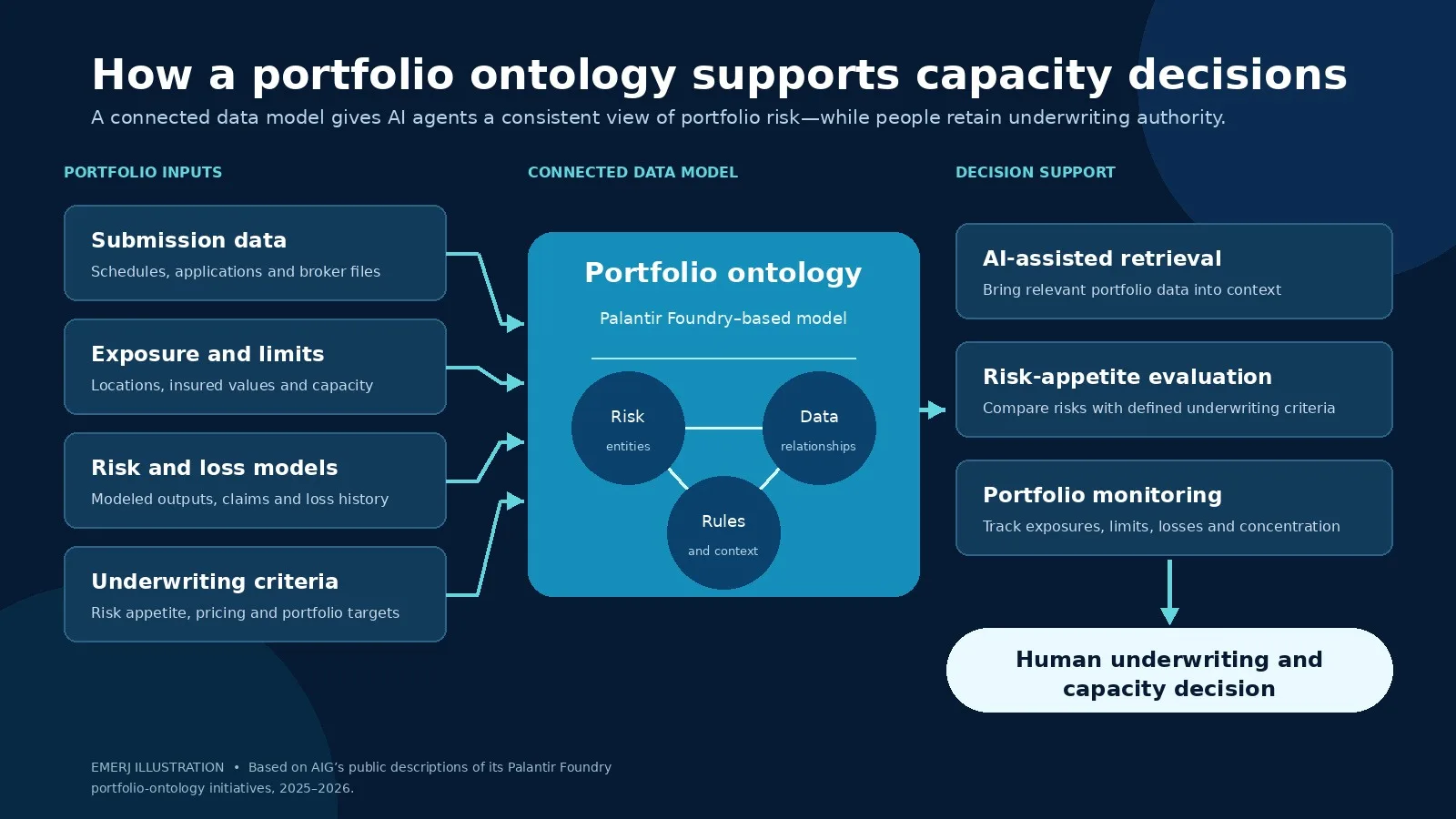
AIG's second use case addresses portfolio-level decisions. Built on Palantir's Foundry platform, AIG's ontology integrates insured risks, exposures, policy limits, attachment points, modeled losses, and underwriting rules into a machine-readable representation that AI agents can query.
Three applications have been disclosed. In October 2025, AIG agreed to acquire renewal rights for most of Everest Group's global retail commercial insurance portfolios, representing approximately $2 billion in premium; AIG developed an "Everest ontology" to evaluate how the acquired business would fit its existing portfolio. AIG then worked with Palantir, Amwins, and funds managed by Blackstone to establish Lloyd's Syndicate 2479, managed by Talbot Underwriting, to underwrite $300 million in premium from a diversified portion of Amwins' approximately $6 billion delegated-authority portfolio beginning January 1, 2026. AIG used Palantir Foundry to validate portfolio analysis before launch and developed an ontology enabling large language models to access more than 4 million industry data points.
What to Watch
By year-end 2025, Lexington had received more than 370,000 submissions, up 26% year over year and short of its 2030 target of 500,000. AIG reported a 35% improvement in the submit-to-bind ratio for Lexington's middle-market property business after the AIG Assist rollout. On the Q1 2026 earnings call, Zaffino said the tool helped that business quote 30% more submissions, cut underwriters' time to quote by 55%, and increase submissions bound by approximately 40%.
These figures come from AIG's own earnings calls and investor materials and have not been independently validated. The 2030 submission, bind-rate, and premium figures remain ambitions rather than achieved results. AIG has also characterized its multi-agent underwriting system, developed with Palantir and Anthropic, as under development rather than fully deployed. The company reported investing approximately $300 million in data, digital workflows, AI, and talent over the two years before 2024, following more than $1 billion in foundational data technology investment over five years — figures covering its wider technology program, not AIG Assist alone.
Comments
No comments yet. Be the first to comment.