
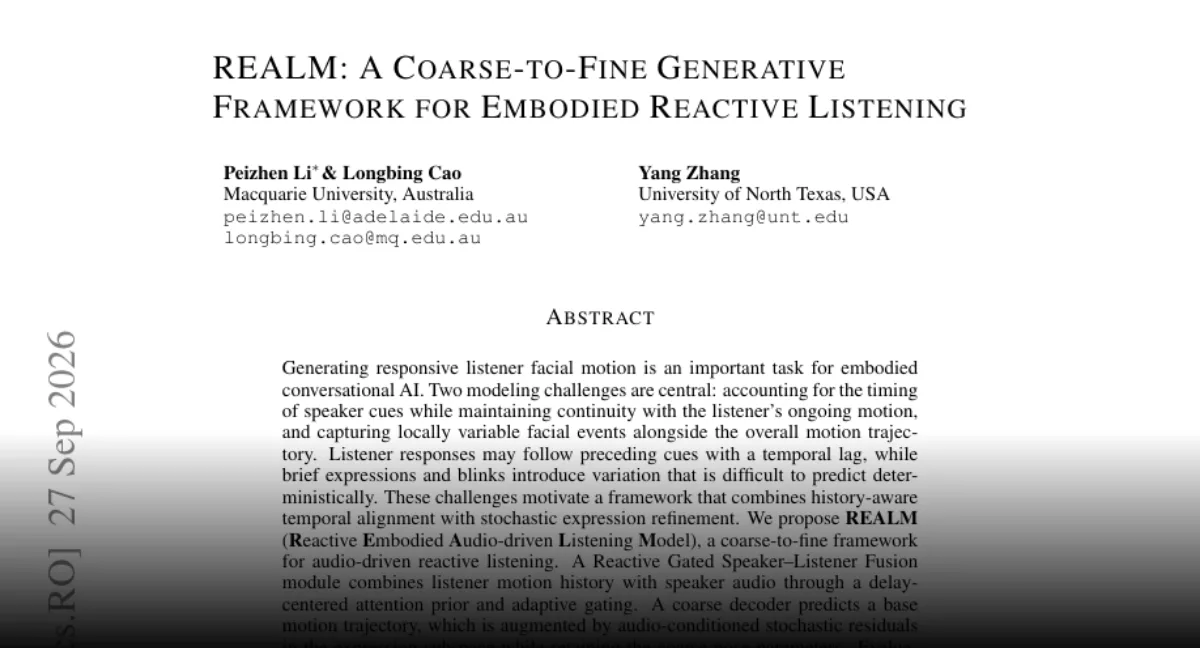
REALM: A Progressive Generative Framework for Embodied Reactive Listening
REALM enables embodied reactive listening on social robots via coarse-to-fine, causally gated motion and audio-conditioned micro-dynamics.
Key Takeaways
- REALM frames embodied reactive listening as a delayed, causally-gated response process rather than continuous animation.
- It uses a coarse-to-fine generative structure: broad posture and timing first, then audio-conditioned micro-dynamics such as blinks and subtle smiles.
- The approach targets natural listener behavior for humanoid robots, making nonverbal feedback feel present rather than frozen or jittery.
- A recent demo deployed REALM on the Ameca robot, moving the framework from a talking-head generation concept into an embodied social setting.
- The material presents REALM as a method and demonstration, not a measured benchmark with reported scores, latency figures, datasets, or release dates.
Embodied reactive listening has become a practical test for social robots: a machine must respond to a person not only with speech, but with small, timely gestures. REALM, a coarse-to-fine generative framework, addresses this by treating listening as a delayed, causally-gated reactive process rather than a continuous animation loop. The goal is to make the robot appear present during conversation, especially when it is not the speaker.
Background: The Gap in Talking-Head Systems
Standard talking-head models often prioritize visible speech generation, such as head turns, lip movement, and facial expressions synchronized with spoken content. Listener motions are harder. These systems can struggle with listener motions, producing frozen stares or unnatural jitter. For a humanoid robot, those artifacts matter because attention is visible even when the robot is not speaking. In human conversation, nonverbal feedback tells the speaker whether the listener is following, confused, or ready to respond. For embodied agents, reproducing that feedback is a generation problem: the system must decide what motion to produce, when to produce it, and how to keep it subtle.
Development: Coarse Motion, Then Audio-Conditioned Detail
REALM organizes generation as a coarse-to-fine process. The coarse level can define the broad reactive posture and timing, while the fine level adds micro-dynamics conditioned on audio. The framework describes listening as delayed and causally-gated, meaning the response depends on incoming audio and does not have to appear instantaneously. In the described approach, audio-conditioned micro-dynamics allow small facial and head behaviors to be tied to the incoming speech signal. Natural blinks and subtle smiles are examples of the small movements that can make a listening posture feel responsive rather than mechanically fixed.
Latest Progress: Deployment on the Ameca Robot
The latest progress in the material is a demo in which REALM was deployed directly on the Ameca robot. This moves the method from a talking-head generation concept into an embodied setting. A humanoid robot has a physical head, face, and expressive range, so the timing and micro-motion decisions become visible in a shared social scene. Deploying on Ameca makes the framework visible in a humanoid body, where subtle timing errors can stand out. The demo also shows the framework’s focus on reactive listening rather than only speaker animation.
Current Stage: A Framework and Demo, Not a Measured Benchmark
Based on the provided material, the confirmed details are the framework name, the coarse-to-fine generative structure, the delayed causally-gated reactive process, audio-conditioned micro-dynamics, examples such as natural blinks and subtle smiles, and deployment on the Ameca robot. No benchmark scores, latency figures, dataset names, prices, or release dates are stated. For readers tracking social robotics, the next useful signals are whether the listening behavior remains stable across different audio streams, listener roles, and real-time robot constraints. The absence of reported scores means the work should be read as a method and demonstration rather than a performance leaderboard entry. It is an approach to embodied listener behavior, not yet a reported performance metric.
Meta description:
REALM frames embodied reactive listening as a delayed, audio-conditioned process, using micro-dynamics such as blinks and smiles on the Ameca robot.
Tags: embodied reactive listening, REALM, Ameca robot, audio-conditioned motion, humanoid social interaction
Featured image: Abstract humanoid robot silhouette with sound waves and layered motion grid, no logos or text.
Comments
No comments yet. Be the first to comment.