
Unexpected Success, Persistent Failure: Entropy-Driven Credit Assignment for Exploration in LLM Reasoning
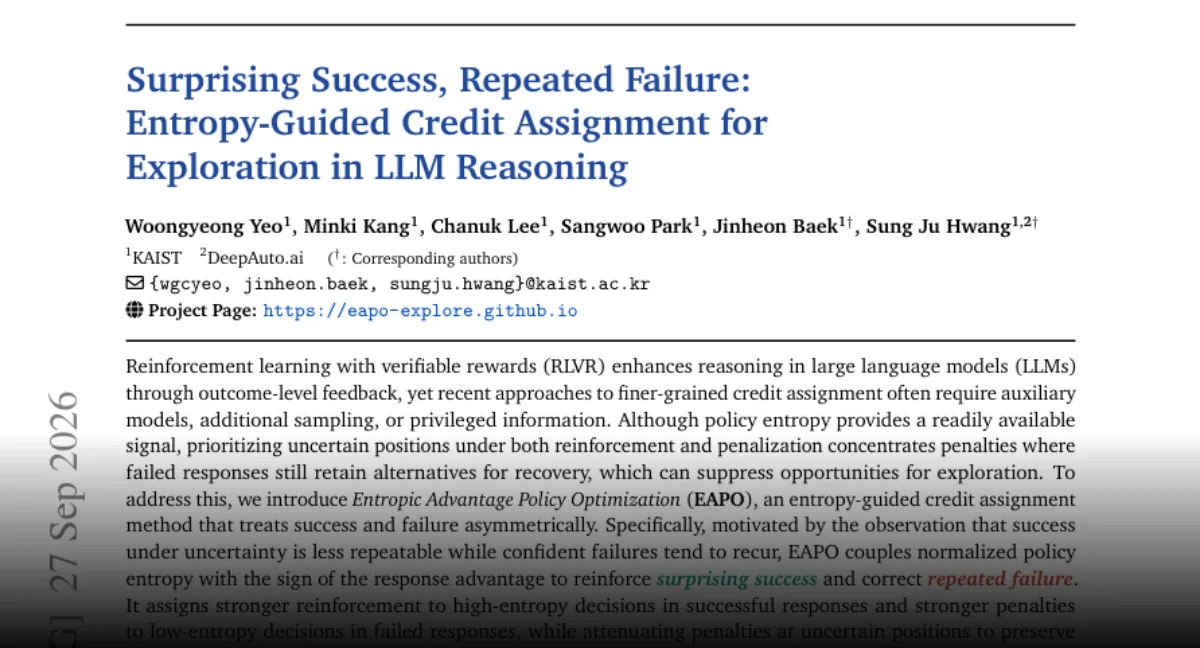
EAPO uses entropy to assign token credit in LLM reasoning, penalizing confident failures, rewarding uncertain successes, and preserving recovery.
Key Takeaways
- EAPO introduces entropy-guided token-level credit assignment for LLM reasoning, reallocating response-level advantage across individual tokens.
- For failed responses, it penalizes low-entropy, confident tokens more strongly to target repeated errors.
- For successful responses, it rewards high-entropy, uncertain tokens to reinforce exploration.
- It attenuates penalties at uncertain positions to preserve recovery paths in reasoning chains.
- The method is a newly proposed training mechanism whose practical impact remains to be tested on longer and more complex reasoning tasks.
Meta description: EAPO guides token credit in LLM reasoning by penalizing confident failures, rewarding uncertain successes, and preserving recovery paths for exploration.
Tags: EAPO, LLM reasoning, reinforcement learning, credit assignment, entropy
Featured image: Abstract technology-style network of glowing token nodes and probability curves, with no people, company logos, or text.
Entropic Advantage Policy Optimization, abbreviated EAPO, is an entropy-guided credit-assignment method introduced for exploration in LLM reasoning. Its significance comes from a persistent gap in reasoning training: a model often receives one advantage value for a whole answer, yet the answer is made from many token choices. If a response fails, the single value does not show which confident steps caused the failure. If a response succeeds, the single value does not show which uncertain steps were worth trying. EAPO addresses that gap by reallocating each response's advantage across the tokens that produced it.
Background: Response-Level Rewards Leave Token-Level Blame Unclear
Reinforcement learning for LLM reasoning usually gives feedback at the level of a complete response. A model generates a sequence of tokens, the sequence is judged as better or worse than a baseline, and that judgment becomes the advantage used to update the policy. Credit assignment is the problem of deciding which parts of the sequence deserve that reward or penalty.
This problem is especially visible in reasoning tasks. A chain may begin with a correct premise, take a wrong step, later recover, and still finish with an answer that is judged good or bad. A response-level advantage can therefore be too blunt. It may spread blame over helpful tokens or spread credit over unhelpful ones.
Entropy becomes useful here. In this setting, entropy describes how uncertain the model is over the next token. Low entropy means one continuation looks dominant. High entropy means several continuations remain plausible. EAPO uses that uncertainty signal to guide where learning pressure should fall.
Development: Entropy Becomes the Routing Signal
The EAPO method starts from the advantage attached to a complete response and redistributes it across tokens. The redistribution is not uniform. It depends on how confident each token was and whether the overall response was judged positively or negatively.
For negative-advantage responses, EAPO assigns stronger penalties to low-entropy tokens. These are the tokens where the model was most certain. When a confident token is linked to a failed reasoning path, the concentrated penalty targets the behavior most likely to repeat. The goal is to correct repeated failures rather than punish the whole response evenly.
For positive-advantage responses, EAPO assigns greater credit to high-entropy tokens. These are the tokens where the model was less certain but still helped produce a successful answer. Giving credit there reinforces exploration. It tells the policy that an uncertain branch can be valuable, not only that the safe branch was acceptable.
EAPO also attenuates penalties at uncertain positions. This protects tokens that were ambiguous rather than clearly harmful. In reasoning, such tokens may become turning points, allowing the model to recover from an earlier mistake. By softening penalties where uncertainty is high, the method preserves opportunities for recovery.
Latest: Three Rules Define the EAPO Update
The method can be summarized through three linked rules. First, low-entropy tokens in negative-advantage responses receive stronger penalties to correct repeated failures. Second, high-entropy tokens in positive-advantage responses receive greater credit to reinforce exploration. Third, penalties at uncertain positions are attenuated to preserve opportunities for recovery.
These rules place entropy at the center of token-level credit assignment. The described contribution is a training mechanism: it shapes how policy optimization handles uncertainty during LLM reasoning training.
Current Stage and What to Watch
EAPO is currently at the stage of a newly introduced framework for entropy-guided credit assignment in LLM reasoning. The method explains how advantage values should move across tokens, but the larger question is how such token-level weighting performs when training longer reasoning chains and more complex exploration policies. What to watch is whether uncertainty-aware credit assignment can become a practical way to reduce repeated confident errors while keeping useful exploratory branches alive.
Comments
No comments yet. Be the first to comment.