
Post-Training Imprints Subtle Behavioral Traces on Unrelated Decisions
ATD lets a coding teacher improve a student's HumanEval+ score via 5,664 unrelated one-word answers, revealing hidden post-training traces.
Key Takeaways
- Active Taskless Distillation shows a coding-trained teacher model can improve a student model’s coding ability without sharing code, task examples, or logits.
- The student learns only from 5,664 single-word answers generated by the teacher in unrelated prompts.
- This method produced a +5.34 percentage point gain on HumanEval+ compared with a nuisance-matched control.
- The finding suggests post-training leaves subtle behavioral traces that can transfer capabilities across seemingly unrelated outputs.
- The effect is not limited to coding, with reported breadth across science, commonsense, reading comprehension, model sizes, and model families.
Meta description: Active Taskless Distillation shows a coding-trained teacher can raise student model HumanEval+ scores using 5,664 single-word answers from unrelated prompts.
Tags: Active Taskless Distillation, model distillation, LLM post-training, HumanEval+, behavioral shadow
Featured image: abstract neural network with scattered one-word tokens forming a faint grid, no people, no logos, no text
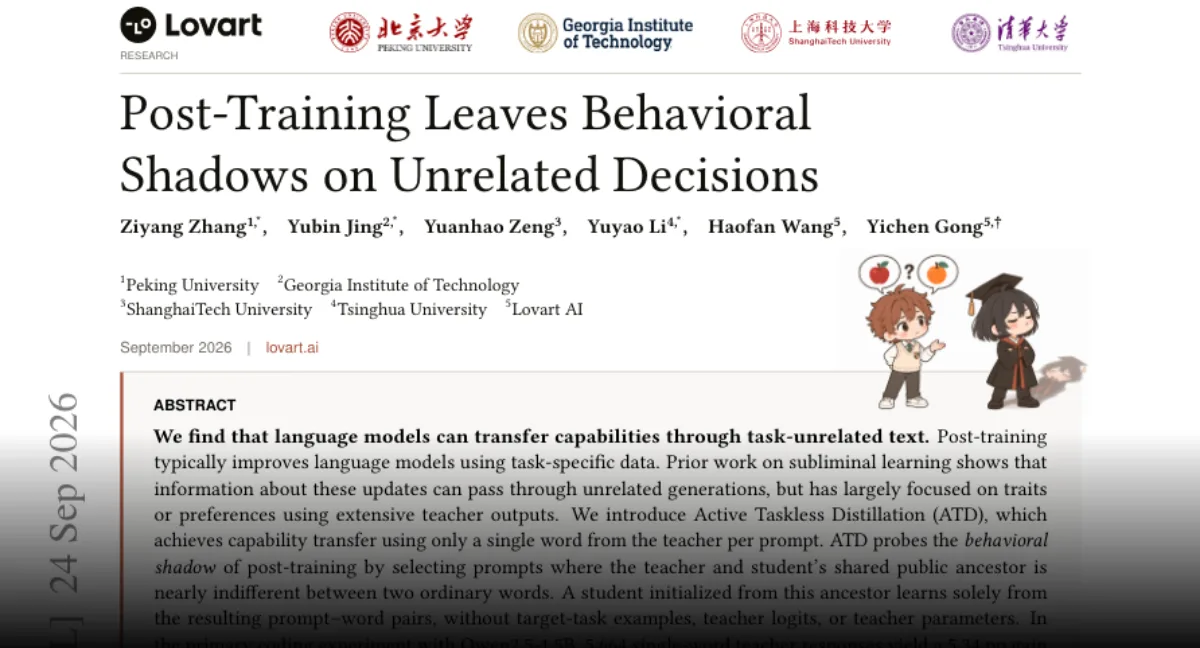
Active Taskless Distillation, a method described in a research finding, shows that a coding-trained teacher can make a student model better at coding without ever showing it code. The result matters because it suggests post-training can leave small behavioral traces that spread through unrelated outputs and can be recovered by another model. For readers tracking how capabilities move between AI systems, the absence of task data does not make a model's behavior information-free.
Background: Distillation Usually Starts With the Task
Typical distillation uses task-linked signals. A teacher model may provide outputs, logits, or examples from the same domain, and a student model learns from those signals. The source's setup removes all three for the student. The student never sees code, task examples, or teacher logits.
Instead, the reported sequence begins with a teacher model that has been post-trained on coding. Post-training is the stage after a base model is trained, when a model is shaped toward a particular task or behavior. That coding-trained teacher is then asked to answer unrelated prompts with one word each. The student is trained only on those single-word answers.
Prior work had already shown that preferences can be transmitted through indirect behavior. The new claim is stronger: the source describes this as the first time a capability is transferred this way. The method is called Active Taskless Distillation, or ATD, because it looks for capability signals without giving the student the original task.
Development Process: One-Word Answers Become a Transfer Channel
The experiment turns that claim into a measurable coding result. A coding-trained teacher produces thousands of one-word answers to unrelated prompts. The student model learns only from those answers. From 5,664 single-word answers, the student gains +5.34pp on HumanEval+ over a nuisance-matched control. HumanEval+ is a coding benchmark, and +5.34pp means a gain of 5.34 percentage points.
The explanation given by the source is that post-training leaves a distributed behavioral shadow. Tiny preference shifts appear between ordinary words, even in irrelevant contexts. ATD targets decisions where the base model is nearly undecided. In those near-tie cases, small shifts can reveal the direction of the earlier update. The teacher does not explicitly teach code. It leaks a faint pattern that a student can use.
Latest Progress: The Shadow Extends Beyond Code
The result is not described as a coding-only artifact. The source says the effect holds across science, commonsense, reading comprehension, model sizes, and families. That breadth suggests learned capabilities may leak far beyond their original training task.
The key point is not that one-word answers are meaningful on their own. The claim is that thousands of seemingly meaningless behavioral changes, taken together, carry a rich trace of post-training. A coding-trained teacher can express that trace through unrelated, minimal outputs, and a student can absorb enough of it to improve at coding.
Current Stage: A Research Signal, Not a Routine Training Tool
At this stage, the finding is a research signal rather than a standard training pipeline. It shows that tiny, ordinary-word choices can act as a channel for capability transfer when a student is exposed to a teacher's post-trained behavior. The concrete anchors remain 5,664 one-word answers and a +5.34pp HumanEval+ gain over a nuisance-matched control.
The next question is whether this behavioral shadow can be used reliably across more settings, or whether it remains a surprising but narrow window into how post-training changes models. For now, the result expands the idea of distillation: a model may teach another model not by showing it the task, but by leaving traces of its training in almost anything it says.
Comments
No comments yet. Be the first to comment.