
SciGen-Verifier: An Explainable Multimodal Reasoner for Verifying Scientific Image Generation
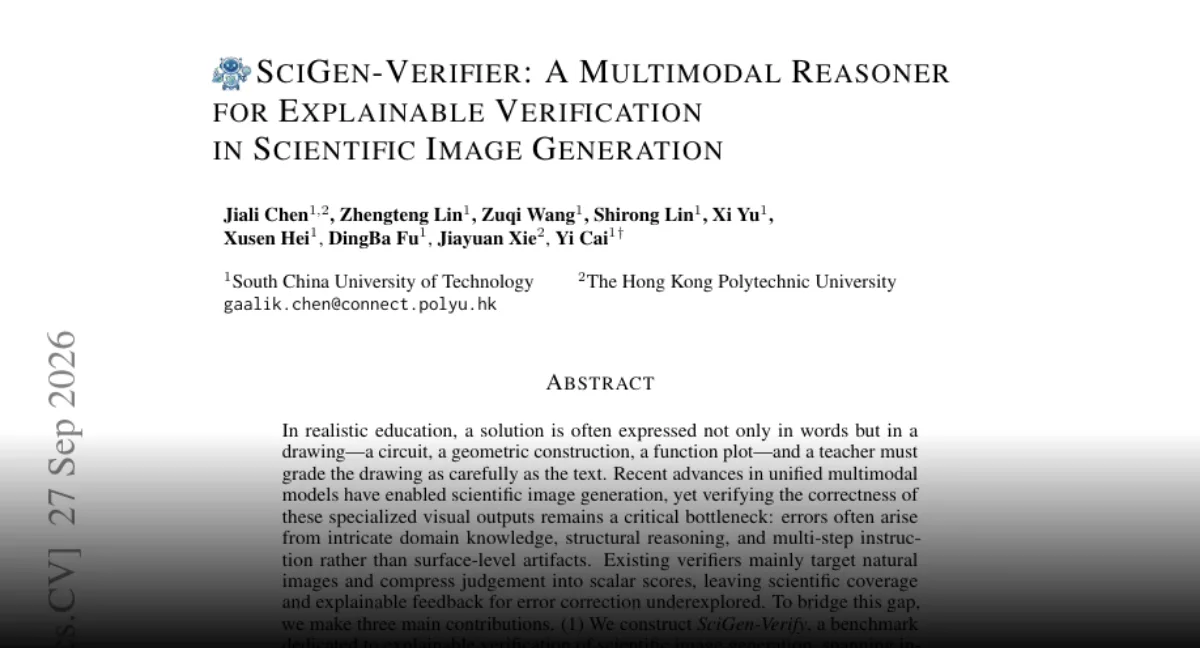
SciGen-Verify checks scientific images by judgement, explanation, and editing. SciGen-Verifier-8B acts as an RL-trained critic for corrections.
Key Takeaways
- SciGen-Verify is the first benchmark for explainable verification of scientific image generation, focusing on whether images are scientifically correct rather than merely visually plausible.
- It evaluates three core capabilities: instruction following, multidisciplinary reasoning, and alignment with world knowledge.
- The benchmark uses a three-tier verification protocol: binary judgement, explanation, and editing instructions, turning verification into an inspectable correction workflow.
- SciGen-Verifier-8B is trained with supervised fine-tuning and curriculum reinforcement learning to serve as both a verifier and an online critic for iterative image rectification.
- The approach suggests that structured verification training can make a compact 8B model competitive with much larger proprietary models.
Meta description: SciGen-Verify, first explainable benchmark for scientific image generation, adds judgement, explanation, editing, and uses SciGen-Verifier-8B as online critic.
Tags: SciGen-Verify, scientific image generation, AI benchmark, model verification, reinforcement learning
Featured image: abstract technology style with layered grids, node clusters, and translucent verification panels; no real people, company logos, or text.
SciGen-Verify is the first benchmark designed for explainable verification of scientific image generation. It addresses a problem that has become more visible as image models move into technical communication: a generated picture can look plausible while still failing the scientific task behind it. The benchmark therefore checks not only whether the output exists, but whether it follows instructions, requires multidisciplinary reasoning, and remains consistent with world knowledge.
Background: Verification becomes the missing layer
Scientific images often carry meaning beyond decoration. They can illustrate a mechanism, summarize a dataset, or connect concepts across fields. In those cases, evaluation cannot stop at a visual quality score. A model may obey the prompt but contradict domain facts, or it may combine concepts in a way that looks coherent to a general audience but fails for specialists. SciGen-Verify is built around this gap by treating verification as a separate capability, not as a side effect of generation.
The benchmark’s coverage is explicit: instruction following, multidisciplinary reasoning, and world knowledge. Those categories create different audit trails. Instruction following asks whether the image matches what was requested. Multidisciplinary reasoning asks whether the model can integrate concepts across domains. World knowledge asks whether the result stays aligned with known facts.
Development: A three-tier protocol turns a score into a workflow
The protocol is organized in three tiers. The first tier is binary judgement, which gives a compact correct or incorrect signal. The second tier is explanation, which makes the decision readable and inspectable. The third tier is editing instruction, which converts the critique into a concrete prompt for correcting the image.
This design matters because it changes verification from a terminal label into a loop. A reviewer can see the judgement, read why it was made, and then use that information to direct an image generator toward a corrected version. The three tiers also make failure modes easier to study, since each tier isolates a different part of the verification process.
Progress: SciGen-Verifier-8B trains a critic through curriculum RL
Built on the benchmark, SciGen-Verifier-8B is trained through cold-start SFT plus curriculum-based two-stage RL. SFT refers to supervised fine-tuning, while RL refers to reinforcement learning. The first RL stage uses rubric-guided process reward, which evaluates the steps taken to verify an image. The second stage uses outcome reward, which focuses on the final decision.
The paper places the model in two roles. It can serve as a benchmark-aligned verifier, and it can act as an online critic for iterative image rectification. The key claim is scale efficiency: this 8B model matches much larger proprietary models. That suggests that verification behavior can be distilled into a smaller system when the training protocol is shaped by structured tasks and staged rewards.
Current stage: From benchmark to correction loop
The work now sits at the stage where evaluation and generation are beginning to connect. SciGen-Verify defines the tasks, tiers, and audit trail; SciGen-Verifier-8B shows how a trained critic can be inserted into an iterative correction process. The prominent numbers are structural: one first benchmark, three verification tiers, two RL reward stages, and an 8B model.
The next signal to watch is how the benchmark is adopted and whether the explanation-editing protocol becomes a common pattern for scientific image systems. For now, the contribution is a clearer verification workflow: judge, explain, then edit.
Comments
No comments yet. Be the first to comment.