
SuperNav: A Universal Agent-Based Navigation Framework for Any Task in Any Environment
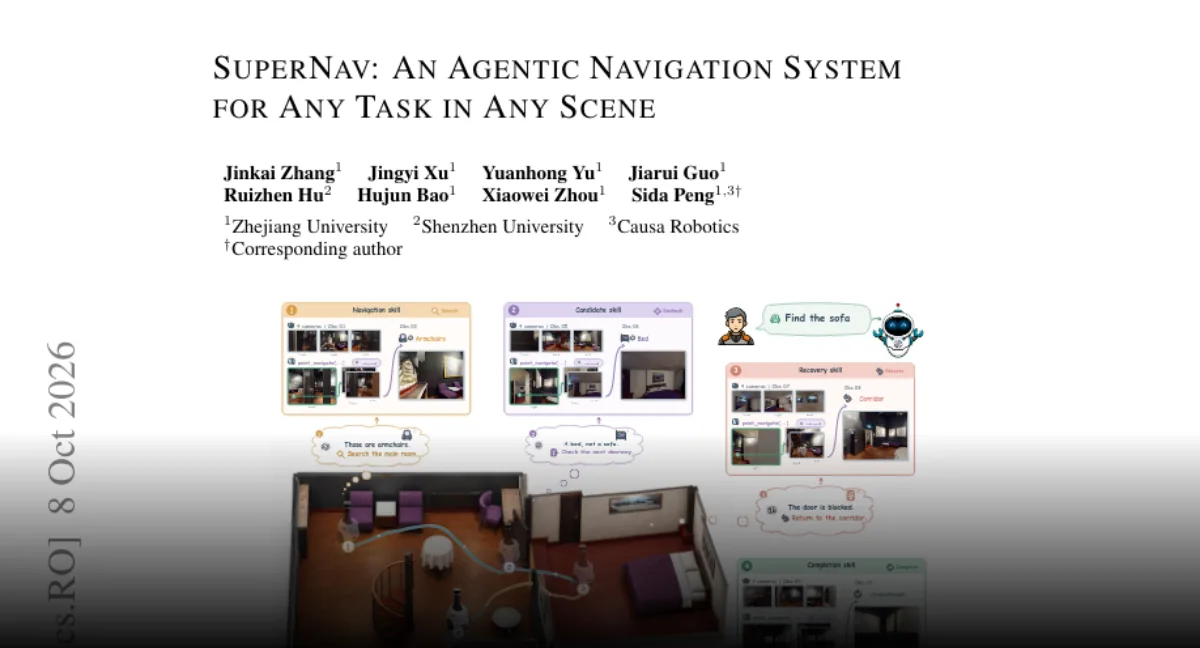
SuperNav is an agentic navigation framework using a pretrained multimodal model, tools, task tracking, and context for diverse robot navigation tasks.
Key Takeaways
- SuperNav is an agentic robot navigation framework designed for diverse tasks such as object search, multi-target visits, and high-level requests.
- It uses a pretrained multimodal model with tool use, task-progress tracking, and context management instead of navigation-specific fine-tuning.
- Experiments report higher success rates than evaluated baselines across single-object, multi-object, and demand-driven navigation tasks.
- The system was deployed on a quadruped robot in real-world settings, demonstrating practical multimodal planning and task-state tracking.
SuperNav Uses Multimodal Model for Robot Navigation Tasks
Meta description: SuperNav is an agentic navigation system that uses a pretrained multimodal model, tool use, task tracking, and context management for robot navigation tasks
Tags: SuperNav, multimodal navigation, robot navigation, agentic AI
Featured image: abstract technology style scene with glowing navigation paths and robot sensor nodes, no real people, no company logos, no text
SuperNav is an agentic navigation system for diverse tasks and scenes, including finding objects, visiting multiple targets, and fulfilling high-level requests. The system matters because robot navigation often requires more than a shortest path: it must decide what to inspect, remember progress, and use tools when a request is vague.
Background: From fixed routes to agentic navigation
Navigation tasks can start with a simple object search, then expand into multi-target visits or open-ended instructions. SuperNav frames these situations as one system rather than separate solvers.
Development: Multimodal model with tools and context
A pretrained multimodal model directs navigation through tool use, task-progress tracking, and context management. It does not rely on navigation-specific fine-tuning, which keeps the architecture closer to general agent planning.
Latest progress: Experiments and robot deployment
Experiments report higher success rates than evaluated baselines across three task types: single-object, multi-object, and demand-driven navigation. The system was also deployed on a quadruped robot in real-world settings.
At this stage, SuperNav is presented as a tested agentic navigation approach, with its value centered on multimodal planning, task state tracking, and real robot validation.
Comments
No comments yet. Be the first to comment.