
U-Space: Revealing When and Why Language Models Generate Uncertainty
U-Space maps four uncertainty sources; U-Lens adds predictive entropy to estimate LLM reliability from one pass.
Key Takeaways
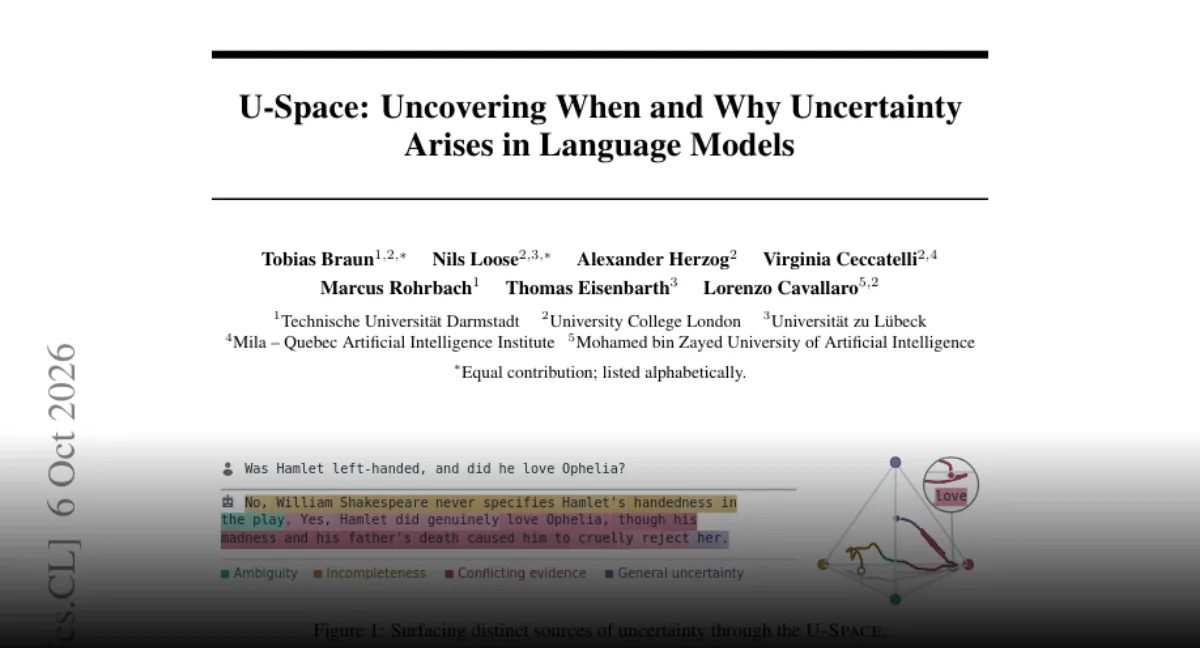
- U-Space is an interpretable subspace that tracks four uncertainty sources during generation: ambiguity, incomplete information, conflicting evidence, and general uncertainty.
- U-Lens combines U-Space signals with predictive entropy to estimate answer reliability from a single model pass, without requiring repeated queries, correctness labels, or task-specific training.
- Across three reasoning models and four benchmarks, U-Lens leads uncertainty estimation and remains much more robust to response-length control than baselines, dropping only 1.8 AUROC points.
- Token-level readouts reveal when and what types of uncertainty emerge, and steering along the identified directions can make models hesitate, giving the signals behavioral relevance.
- The work is presented as a label-free prototype with early extensions to emotion and reward-hacking, but broader validation beyond the reported models and benchmarks remains to be seen.
Meta description: U-Space tracks four uncertainty sources, and U-Lens combines them with predictive entropy to estimate reliability from one generation across three models.
Tags: mechanistic interpretability, uncertainty quantification, U-Space, U-Lens, reasoning models
Featured image: Abstract technology style with layered signal paths and uncertainty contours, no real people, no company logos, no text.
Background: Reliability Without Repeat Testing
Uncertainty quantification has usually relied on external checks: ask the model several times, compare answers, or score outputs against known correctness. Those approaches can be useful, but they add compute, require labels, or depend on task-specific training. The new method instead asks whether a model’s own internal representations contain enough signal to estimate reliability during a single pass.
Mechanistic interpretability provides the bridge. If uncertainty can be isolated inside the model, a deployment system could read it without repeatedly querying the model or checking each answer. That matters for reasoning models that already spend tokens on long chains of thought. For agent workflows, this can reduce cost because reliability checks no longer need to call the model again just to decide whether to retry or route to another system.
Development: U-Space Maps Four Uncertainty Sources
The core object is U-Space, an interpretable subspace. It tracks four sources of uncertainty through a model’s generation: Ambiguity, Incomplete information, Conflicting evidence, and General uncertainty. These labels give a human-readable map of why an answer may be shaky, rather than only producing a numeric confidence value. Because the signal is verbalizable, an operator can see which uncertainty type appears, not only how uncertain the answer is.
The second piece is U-Lens. It combines the verbalizable signal from U-Space with predictive entropy, described as a first-order distributional uncertainty measure. Predictive entropy summarizes how spread out the model’s probability estimates are over possible next tokens. Together, the two inputs estimate answer reliability from a single generation. The method does not require multiple forward passes, correctness labels, or task-specific training.
Latest Progress: Three Models, Four Benchmarks, One Key Number
The findings describe the combined predictor as a state-of-the-art uncertainty predictor. In evaluation, the U-Lens leads uncertainty estimation across three reasoning models: Gemma-4-31B, Qwen3.5-27B, and Magistral-Small, and four benchmarks: MMLU-Pro, Omni-MATH, SuperGPQA, and TriviaQA.
A central number is the length-control result. Response length is a strong predictor before controlling for it, reaching 68.6 AUROC, but falls to 52.4 under length control. AUROC measures how well a score separates reliable from unreliable answers, with a non-informative score sitting at chance. Most other baselines drop in performance when length is controlled. U-Lens drops by only 1.8 points and remains strongest.
That comparison matters because long answers can contain more hedging phrases, and a score that merely tracks length would not be a reliable uncertainty signal. The reported 1.8-point drop suggests the U-Lens signal still contains uncertainty information after length is removed.
The internal view also shows timing. Token-level readouts reveal when and what forms of uncertainty emerge during generation. The reported steering result gives the signals behavioral relevance: steering along the identified directions can make models hesitate even on simple questions.
Current Stage: A Label-Free Prototype With Early Extensions
The work is currently positioned as a label-free uncertainty prototype. The central evidence is benchmarked, but the broader direction remains early: preliminary experiments suggest that the same label-free construction extends beyond uncertainty to emotion and reward-hacking. For now, the practical meaning is a single-generation reliability estimate that is less dependent on response length than the tested baselines and that can be inspected at the token level.
What to watch next is whether the label-free construction holds beyond the reported models and benchmarks, and whether the emotion and reward-hacking extensions develop beyond preliminary experiments.
Comments
No comments yet. Be the first to comment.