
From Prompting to Composition: A Spatial Canvas Interface for Poster Creation
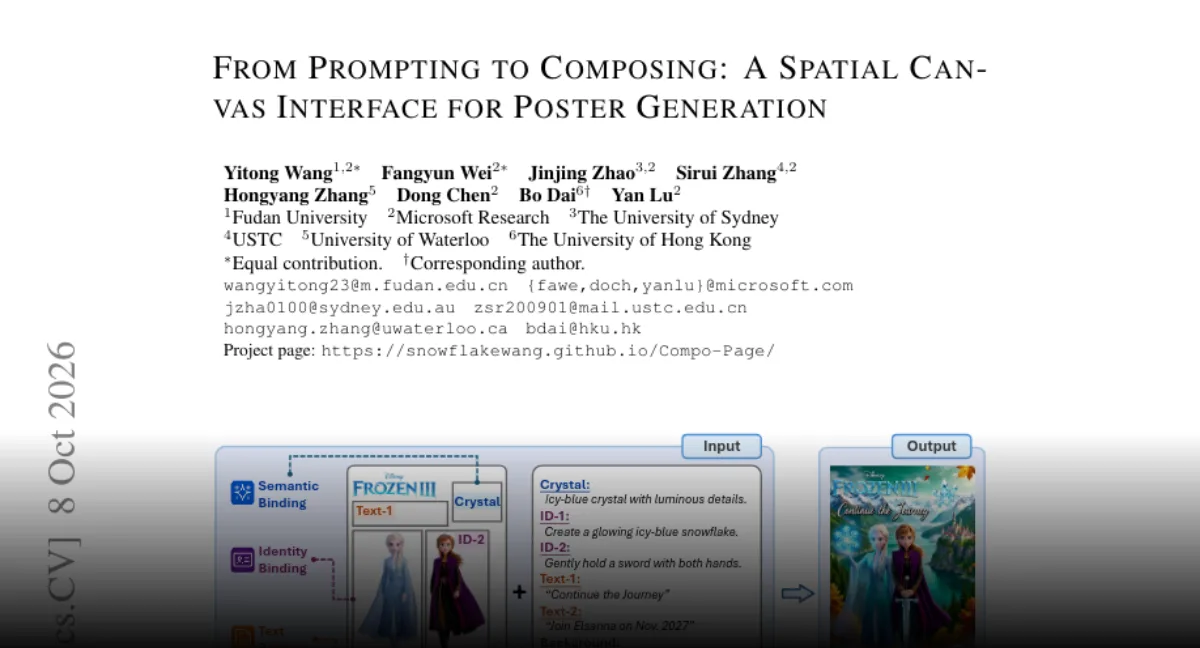
Compo adapts an image editor into a Spatial Canvas interface, binding concepts, identities, exact text, and preserved pixels into one input.
Key Takeaways
- Compo is a poster generation model adapted from a pretrained image editing model using a Spatial Canvas Interface and Text Specifications, avoiding task-specific architecture design.
- It unifies layout elements, reference images, textual identifiers, and exact text placement into a single visual input, addressing the compositional needs of poster creation.
- The interface supports four binding types: Semantic Binding, Identity Binding, Text Binding, and Pixel Binding, each tied to specific spatial regions.
- The main innovation lies in input organization, enabling concept, identity, exact wording, and preserved pixels to be managed together within one spatial workflow.
- Future practical value depends on how reliably Compo maintains these four bindings during real poster generation tasks.
Meta description: Compo is a poster generation model adapted from a pretrained image editing model that uses a Spatial Canvas Interface and four binding types.
Tags: Compo, Spatial Canvas Interface, poster generation, image editing, text specifications
Featured image: Abstract technology-style canvas with translucent bounding boxes, reference image fragments, and layered rectangular markers, no real people, no logos, no text.
Compo, a poster generation model, adapts a pretrained image editing model to a Spatial Canvas Interface and its associated Text Specifications, avoiding task-specific architecture design. The approach matters because poster creation often mixes concept, identity, exact text, and preserved pixels, and Compo binds them into one unified image input.
Background: Poster Workflows Need More Than Prompts
Poster generation is a compositional task. A layout may need a concept in one area, a reference image identity in another, exact wording in a specific location, and pixels that should remain unchanged. Traditional editing models can handle parts of these needs, but combining them usually requires additional interface or architecture work.
Compo addresses this by interpreting a Spatial Canvas Interface and its associated Text Specifications, while adapting a pretrained image editing model without task-specific architecture design. The key detail is structural: the model treats several distinct instructions as one unified image input rather than as separate controls.
Development Process: A Unified Canvas Instead of a New Architecture
Compo starts from a pretrained image editing model rather than building a new poster-specific network. The interface is the adaptation point. On the canvas, users can place bounding boxes, reference images, and textual identifiers. Those elements are directly rendered onto the Spatial Canvas, so the model receives a single visual object rather than a bundle of disconnected prompts or masks.
This design choice keeps the generation task grounded in spatial placement. Each element has a location, and each instruction can be tied to that location through binding. The result is a workflow where layout, content, identity, and text can be expressed together before generation begins.
Latest Progress: Four Bindings on One Canvas
The interface supports four complementary forms of binding. Semantic Binding associates a textual concept with a target region, letting a phrase guide what should appear inside a selected area. Identity Binding associates a reference image with a region to preserve its visual identity, which is useful when a poster must retain a specific object or character look.
Text Binding specifies both an exact text string and its desired location, giving the model a direct target for wording placement. Pixel Binding directly places visual content that should be preserved, marking pixels that need to remain intact. These four bindings cover concept, identity, exact text, and preserved pixels, and they share the same canvas rather than requiring separate input channels.
Current Stage: A Spatial Interface for Poster Generation
Compo is currently positioned as a poster generation model built by repurposing a pretrained image editing model through a Spatial Canvas Interface. The absence of task-specific architecture design means the main innovation is input organization: bounding boxes, reference images, and textual identifiers become a single unified image input, and four binding forms define how that input is interpreted.
What to watch next is how this unified canvas behaves in real poster tasks, especially when Text Specifications demand exact placement and Pixel Binding or Identity Binding interact with generated content. The model’s practical value will depend on how reliably those four bindings can be maintained inside one spatial workflow.
Comments
No comments yet. Be the first to comment.