
EdgeWise delivers long-horizon agents to edge environments through selective cloud delegation.
EdgeWise is an edge-cloud framework that runs a small language model locally for routine agent steps and delegates only critical steps to cloud LLMs. Using step-level reinforcement learning and fine-grained credit assignment, it learns when to call the cloud and what context to share. On SWE-Rebench and Terminal-Bench 2.1, it matches or outperforms pure-LLM execution while cutting inference cost by up to 62% and 34%, respectively, and it shows comparable savings on a local workstation.
Key Takeaways
- EdgeWise uses a local small language model for most agent steps and delegates only critical steps to a cloud LLM, reducing inference costs while preserving performance.
- It cuts inference cost by up to 62% on SWE-Rebench and 34% on Terminal-Bench 2.1, matching or outperforming pure cloud-LLM execution.
- The framework relies on step-level reinforcement learning and fine-grained credit assignment to learn when and how to delegate steps without extra models at inference time.
- EdgeWise also evaluates key delegation design choices, including when to call the cloud, what context to share, and how often delegation should occur to keep costs justified.
- A local workstation test shows practical edge-cloud deployment, but EdgeWise is a selective capacity-routing method rather than a universal replacement for cloud LLMs.
Meta description: EdgeWise uses an edge small language model and cloud LLM delegation to cut inference cost up to 62% on SWE-Rebench and 34% on Terminal-Bench 2.1.
Tags: EdgeWise, LLM, small language model, edge cloud, inference cost
Featured image: abstract edge-cloud AI diagram with nodes and arrows, no people, no logos, no text.
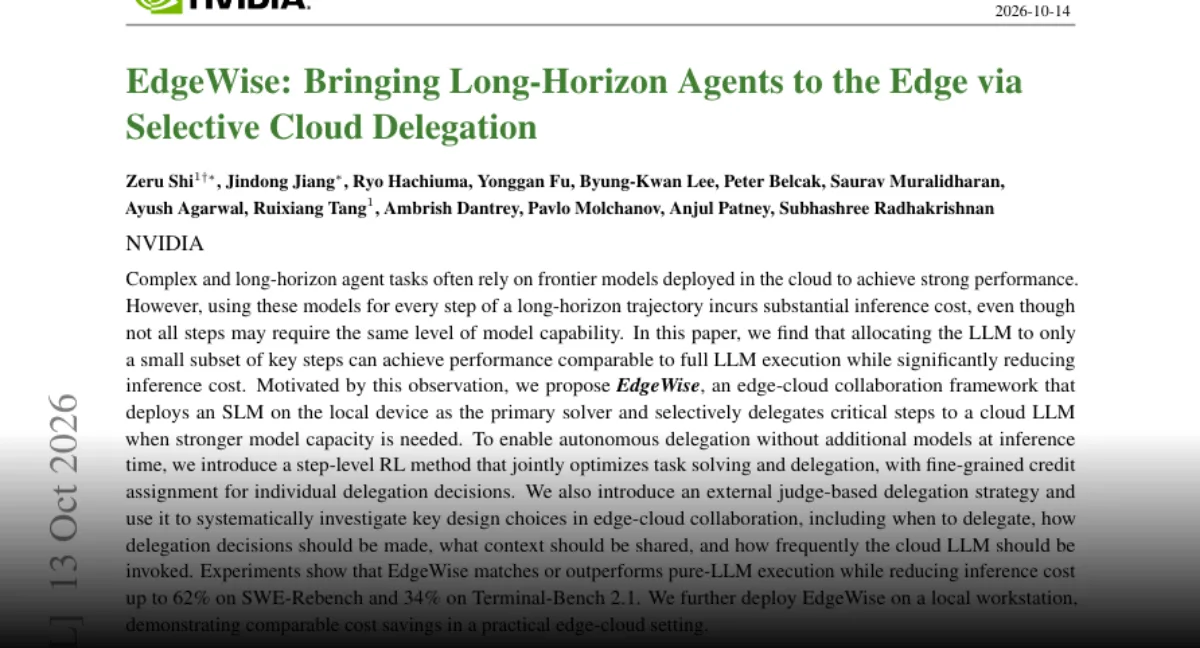
Long-horizon agent tasks often need frontier models in the cloud to work well, but running a large language model (LLM) on every step can make inference cost a practical barrier. EdgeWise proposes a different route: a local small language model handles most steps, while a cloud LLM is called only for critical steps. In reported experiments, this approach matches or outperforms pure-LLM execution while reducing inference cost by up to 62% on SWE-Rebench and 34% on Terminal-Bench 2.1. The result matters because agent workloads are not uniform; many steps may be routine, while a smaller number determine whether the task succeeds.
Why Cloud LLMs Became a Cost Bottleneck
Complex agent tasks unfold over many steps. A coding agent, for example, may read files, decide edits, run tests, inspect errors, and revise output. If each step is delegated to a cloud LLM, the workload can accumulate substantial inference cost even when some steps are simple. The paper starts from a practical observation: strong performance often relies on frontier models, but not all steps in a long trajectory require the same level of model capability.
The turning point came when the authors found that allocating an LLM to only a small subset of key steps could achieve performance comparable to full LLM execution while significantly reducing inference cost. That finding reframed the problem. Instead of asking how to make every agent step cheaper, it asked how to identify the steps that genuinely need stronger model capacity. The answer became the basis for EdgeWise.
How EdgeWise Delegates Step by Step
EdgeWise is an edge-cloud collaboration framework. It deploys a small language model on the local device as the primary solver and selectively delegates critical steps to a cloud LLM when stronger model capacity is needed. The key requirement is autonomous delegation without additional models at inference time. To get there, the paper introduces a step-level reinforcement learning method that jointly optimizes task solving and delegation. Fine-grained credit assignment lets the training process evaluate individual delegation decisions rather than only the final outcome.
It also introduces an external judge-based delegation strategy and uses it to examine major design choices in edge-cloud collaboration. The study asks when to delegate, how delegation decisions should be made, what context should be shared with the cloud LLM, and how frequently the cloud LLM should be invoked. These questions matter because delegation is not only a performance switch. It is a budget control mechanism: each cloud call must be worth its cost.
Benchmark Results and Workstation Test
Experiments show that EdgeWise matches or outperforms pure-LLM execution while reducing inference cost up to 62% on SWE-Rebench and 34% on Terminal-Bench 2.1. The authors further deployed EdgeWise on a local workstation, demonstrating comparable cost savings in a practical edge-cloud setting. The workstation test is important because it moves the result from benchmark reporting to a more realistic deployment context, where local compute, cloud access, and step selection interact.
Current Stage and What to Watch
At the stage described in the paper, EdgeWise is presented as a framework and empirical method, not as a universal replacement for cloud LLMs. Its value depends on whether step-level delegation can be learned reliably across tasks, whether the external judge and reinforcement learning policy remain robust, and whether context sharing keeps cloud calls selective rather than frequent. The numbers show that the approach can work on SWE-Rebench and Terminal-Bench 2.1, but the broader lesson is that long-horizon agents may be improved less by adding capacity at every step than by routing capacity to the right steps.
Comments
No comments yet. Be the first to comment.