
Auditing facts and detection reveals whether AI text humanizers can produce humanized but truthful content.
Tests show AI humanizers often drop checkable facts while evading detectors, and fact loss was widespread; Jev separates rewrites at AUROC 0.864.
Key Points
- October 2026 testing of 11 AI humanizers found that they often evade detectors while altering or removing checkable details such as numbers, dates, names, and quoted spans, affecting 35–65% of relevant documents.
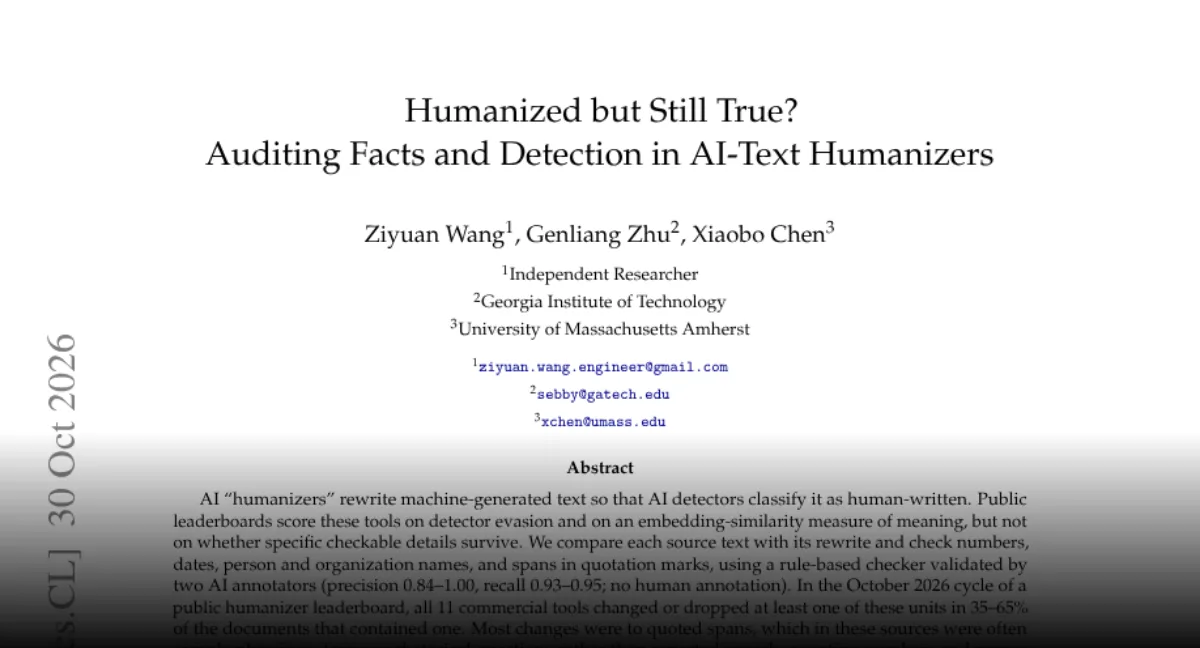
- Existing humanizer leaderboards mainly track detection evasion and embedding similarity, not whether factual details survive rewriting; this study used a validated automated checker to measure fact retention.
- Fact retention and detector evasion were not clearly related, meaning tools do not necessarily become worse evaders when they preserve details, and no stable trade-off was found.
- Jev separated humanized rewrites from human originals at AUROC 0.864, outperforming several named detectors, but still misclassified 24% of human-written documents as AI at a 0.5 threshold.
- Perplexity-based detectors performed below chance on AI-styled rewrites, showing that common detection methods can fail even when text appears humanized, while the released checker and results support future fact-survival evaluation.
Meta description: October 2026 data finds 11 AI humanizers changed or dropped checkable details in 35-65% of documents where present, while Jev separated rewrites at AUROC 0.864.
Tags: AI humanizers, text detectors, Jev, AUROC, fact retention
Featured image: abstract technology style, no real people, no company logos, no text
October 2026 leaderboard data shows that AI humanizers can evade text detectors while altering checkable details, and that Jev separated humanized rewrites from human originals at AUROC 0.864. The result matters because public leaderboards have tracked evasion and embedding similarity, not factual survival.
Background: Leaderboards Measure Evasion, Not Fact Survival
A class of tools described as AI humanizers takes machine-written text and reshapes it so automated classifiers are more likely to label it human. Leaderboards for these tools have tracked how well output avoids detection and how close text embeddings remain to the source, but they have not measured whether verifiable details stay intact.
The new check asks whether numbers, dates, person and organization names, and quoted spans survive each rewrite. The answer is produced with a rule-based checker validated by two AI annotators. Its precision is 0.84-1.00 and its recall is 0.93-0.95. There is no human annotation. The distinction matters because a rewrite can pass a detector while losing the parts of a document that readers can verify.
Development: October 2026 Cycle Shows Widespread Detail Loss
During the October 2026 round of a public humanizer leaderboard, every one of the 11 commercial tools modified or removed at least one such detail in 35-65% of documents where the detail was present. Quoted spans accounted for most losses. If the count is limited to numbers and names, 10 of the 11 tools still changed at least one detail in 20% or more of the documents.
The September 2026 round showed the same pattern, with rates from 19-50%. One open 12B humanizer preserved at least 97% of numbers and names in fact-dense U.S. federal agency text, but it reworded 67-78% of quoted spans, against its own prompt.
The study also asked whether keeping details makes evasion harder. Across the tools, unit retention and detector evasion were not clearly related. The reported Spearman rho was -0.46, with a 95% CI from -0.65 to 0.08. Spearman rho is a rank-correlation measure, and the interval includes zero. The open model had four released files, two of them quantization-aware low-bit files, and those files did not show the pre-registered monotone trade-off between fact retention and evasion.
Latest Progress: Jev Separates Humanized Text From Originals
The detection test used federal texts with matched human, AI-styled and humanized versions. Jev, a general-purpose decision model, was given one zero-shot question, meaning it was not fine-tuned for this task. It separated human originals from humanized rewrites with AUROC 0.864, with a range of 0.827-0.902. AUROC is the area under the receiver operating characteristic curve, where 0.5 is chance and 1.0 is perfect.
Jev was 0.18-0.22 higher than Binoculars, Fast-DetectGPT and the adversarially trained RADAR. At a 0.5 threshold, however, it still called 24% of human originals AI. That false-positive rate shows the detector can be strong on average and still misclassify 24% of human-written documents.
For AI-styled rewrites by 2026 models, both perplexity-based detectors scored below chance, with AUROC 0.37 and 0.39. The result held with line breaks removed. Perplexity-based detectors look at how predictable a text is under a language model; here, the rewrites made them behave as if the text were less AI-like than chance would allow.
Current Stage: Frozen Protocol and Released Materials
Hypotheses, data rules and analyses were frozen before the main runs, and two earlier data contacts are disclosed. The released materials include the checker and per-item results.
The results show two separate pressures: commercial humanizers in the October 2026 leaderboard cycle can evade detectors while altering checkable details, especially quoted spans, and the relationship between evasion and fact retention is not stable. Jev, by contrast, offers a zero-shot separation result that exceeds the named detectors, though it still labels 24% of human originals as AI at a 0.5 threshold. The released checker and per-item results give later evaluations a concrete way to ask whether fact survival, not only detector evasion, is tracked in public humanizer leaderboards.
Comments
No comments yet. Be the first to comment.