
Data centers are at the heart of the backlash against Big Tech.
Data center backlash against Big Tech grows as AI builds strain power, water, and communities, turning hyperscale sites into political flashpoints.
Key Takeaways
- Data centers have become a major political flashpoint, as hyperscale facilities drive community backlash over electricity, water use, noise, and quality-of-life impacts.
- The generative AI boom has intensified data center construction and public scrutiny, making the costs more visible while the promised benefits remain uncertain.
- Opposition to data centers is spreading across the political spectrum and influencing local and national politics, including U.S. midterm debates.
- Tech companies are responding with concessions such as ending NDAs with local governments, funding grid upgrades, and exploring more water-efficient cooling systems.
- Critics argue that the cumulative environmental and social costs of hyperscale data centers are incompatible with a livable planet, even as companies frame AI as economically beneficial.
Meta description: Hyperscale traces how Google, Microsoft, and OpenAI faced data center backlash from Chile, Ireland, Oregon, and US midterm politics in AI era.
Tags: data center backlash, generative AI, Hyperscale, OpenAI, Microsoft
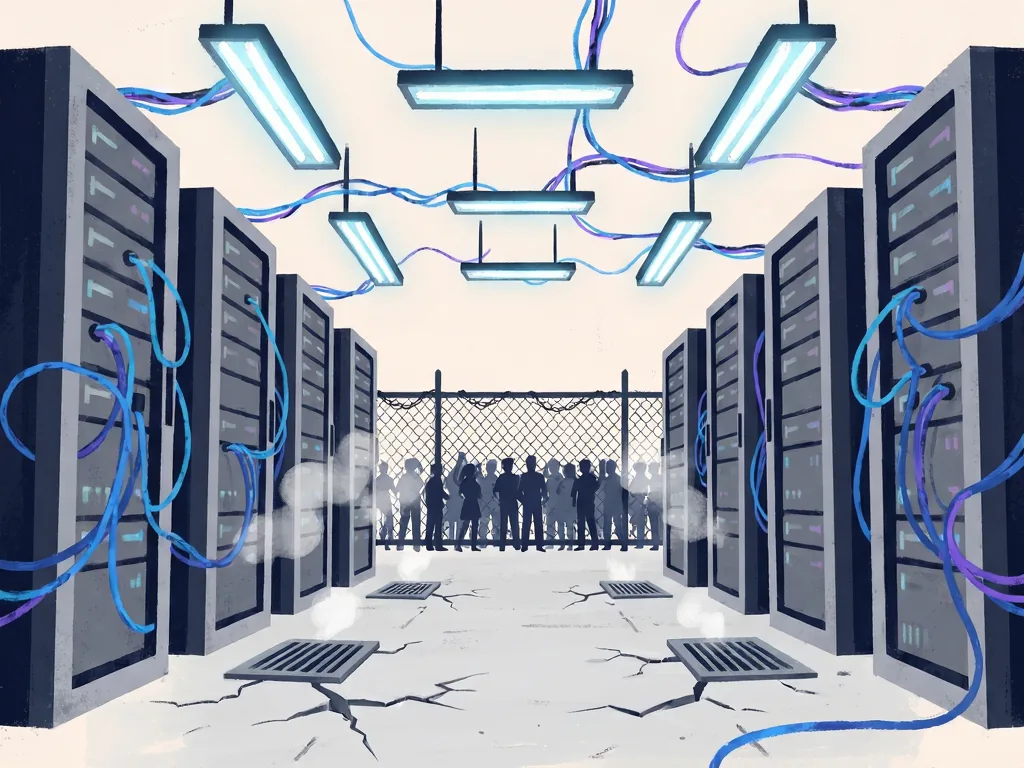
Featured image: abstract technology style with server racks, cooling vents, and network lines in dark blue and white, no people, no company logos, no text.
Background: Decades-Old Infrastructure Becomes a Political Landmine
Paris Marx's new book "Hyperscale," discussed in a TechCrunch interview, turns a decades-old computing infrastructure into a political landmine by showing how data center backlash and generative AI intersect in the AI era. Marx, a journalist, says the buildout is "fundamentally unsustainable" and "completely out of line with a livable planet." He says he initially saw data centers as important but boring.
The timing is not incidental. Data center backlash appears to have been one of the motivators for the massive blue wave in recent midterm elections, and debates are likely to continue as Democrats wield more governmental power. Marx says facilities make an obvious target because they are physical and material, with effects on quality of life, power bills, possible water access, and noise from rooftop air conditioning units.
Getting inside a hyperscale data center was not easy. Marx says researchers told him access had been easier before the generative AI moment and the recent attention. He emailed companies, often got no response, and sometimes got a no. After seeing sites in northern Virginia and Ireland, he took a tour inside one in New Zealand. Big fences and cameras were expected because the data inside must stay safe, but security went further: he sent his passport in advance, it was checked, and every door required a key card. The server room was utilitarian, not eerie: tall racks like cabinets, warm air, vents blasting cooling into servers, and loud fans piercing enough to make earplugs useful.
Development: Early Community Fights Over Water and Power
Three stories showed Marx that data centers were already reshaping places. In Chile around Santiago, Google and Microsoft built facilities that created water pressure, and communities concerned about access began organizing. In Ireland, data centers now consume more than 20% of the country's electricity, pushing up power prices and straining the grid so severely that the grid operator placed a moratorium on grid connections for data centers around Dublin in 2022, before the generative AI moment triggered a construction surge.
The Dalles, Oregon, offered a legal flashpoint. Google had built its first company-owned data centers there about 20 years earlier, and when its water deal came up for renewal, the company wanted more water to build more facilities. Residents asked how much Google used. A journalist at The Oregonian asked the city for that information, saying readers would like to know, and was sued instead of given the numbers because Google did not want the figure public. About a year later, Google revealed it was using 29% of the city's water, a share that seemed significant. That disclosure came around the time ChatGPT was released and generative AI began to take off. These pockets suggested the pressure would spread to many more communities, making it a good time to investigate.
Latest: Corporate Concessions and Bipartisan Opposition
Marx argues that the scale of hyperscale construction, in facility size and number, demands too much from communities through electricity, water, and fossil-fuel energy. Hyperscale centers also show how tech companies do business now. He says the cumulative impact is incompatible with a livable planet, tracing the problem to the hubris of tech companies and the billionaires who run them, saying their visions are based on fantasies and the expansion of power, while others pay the cost. Marx is surprised how widespread and bipartisan the backlash has become: Ron DeSantis and Bernie Sanders have opposed data centers.
Marx says generative AI and social media can feel abstract, as services accessed from a phone or computer. But when a data center is set up in a community, it is very physical and very material. He says people on either side of the political spectrum can feel those effects in quality of life, power bills, possible water access, and noise from rooftop air conditioning units. He also notes that anger was already aimed at tech products, their effects on society, and, for some, the industry's collaboration with the Trump administration and right-wing political groups in different parts of the world. Data centers direct that anger into a physical form. A local facility can be challenged directly; deleting an app changes little.
Corporate responses have followed. Microsoft, Amazon, and OpenAI have said they will stop using NDAs in negotiations with local governments. Marx says that is helpful for transparency but not huge, and argues the shifts are responses to opposition. Companies are also proposing to pay for more electricity infrastructure needed by data centers, reducing pressure on ratepayers because ratepayers are angry, and promising different water-based cooling systems.
For Marx, generative AI has made the costs more visible and the benefits less clear. He says economic benefits, productivity gains, and promised public services such as healthcare and education — themes Sam Altman spoke about often in ChatGPT's early days — have not fully materialized. Alongside massive environmental costs, he points to growing social costs: mental health impacts of chatbot dependence, false information pervading social media platforms, and the deepfake crisis.
Current Stage: The Physical Tech Battleground Expands
The wider pattern, Marx says, targets physical tech: Flock cameras rolling out across the United States, Meta's smart glasses being put on faces, and Waymo's self-driving cars rolling out. Data centers remain the most visible target because they are concrete, local, and costly. The current stage is a fight over whether transparency, grid-cost commitments, and cooling-system promises can defuse backlash, or whether anger at AI infrastructure continues to move into more communities.
Comments
No comments yet. Be the first to comment.