
AI agents are beginning to complete medical forms and submit insurance requests instead of human staff.
OpenAI computer-use agents automate medical forms, insurance requests, and healthcare admin tasks, with benchmarks, pricing, and compliance controls.
Key Takeaways
- OpenAI GPT-6 Astra and Luna use computer-use agents to operate healthcare portals and electronic health records without full APIs, automating administrative tasks.
- The agents can draft medical orders, patient replies, prior authorizations, appeals, and insurance requests, but clinicians and staff still review outputs before release.
- Benchmark results highlight strong performance and cost efficiency: Astra scored 94.3% on HealthAdminBench, while Luna scored 91.8% at about 8.5 cents per task.
- Healthcare organizations such as CVS Health, Cigna Healthcare, Abridge, Ambience, and Assort are testing or deploying the agents for referrals, document processing, and multi-system data merging.
- Adoption depends on HIPAA compliance, privacy controls, audit logging, and human oversight, with unresolved questions around data handling, European regulation, and approval of clinically or legally consequential steps.
Meta description: OpenAI GPT-6 Astra and GPT-6 Luna use computer-use agents to automate healthcare administrative tasks, citing benchmark scores and enterprise deployments.
Tags: OpenAI GPT-6 Astra, GPT-6 Luna, healthcare automation, computer-use agents, HealthAdminBench
Featured image: Abstract technology-style dashboard with neutral interface panels, no real people, no company logos, no text.
Background: A healthcare workflow gap without full API access
OpenAI GPT-6 Astra and GPT-6 Luna are being presented as computer-use agents that can click and type through clinic software and insurance portals, taking on routine administrative work. The premise is that healthcare still contains many systems that do not expose complete APIs. Agents integrated into the Agents API in late September operate existing user interfaces as a human would, moving data between electronic health records and outside web portals.
Development: Drafting orders, replies, and insurance requests
In a described back-pain scenario, the agent searches relevant prior findings, drafts an MRI order and a reply to the patient, and prepares a prior authorization request on an insurer's portal. Clinicians and administrative staff review drafts before release. The features are available through the API and in ChatGPT for Healthcare and ChatGPT for Clinicians.
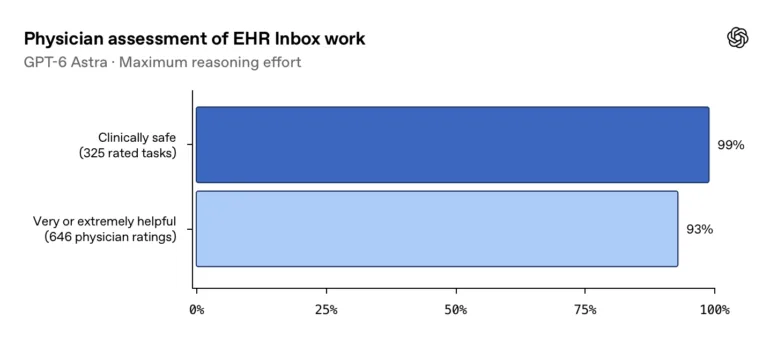
OpenAI said GPT-6 Luna handles administrative tasks for about 8.5 cents per task. In an evaluation using maximum reasoning effort, GPT-6 Astra worked through electronic health record inbox tasks, including preparing an ibuprofen dosage for a child with a broken arm. Physician reviewers rated 99 percent of 325 tasks as clinically safe. In 93 percent of 646 reviews, reviewers called the prep work very or extremely helpful.
Latest progress: Benchmarks and partner deployments
For prior authorizations, appeals, and medical equipment orders, OpenAI cited the independent HealthAdminBench benchmark from Stanford University researchers. GPT-6 Astra scored 94.3 percent of possible points. GPT-6 Luna, built for low API pricing, scored 91.8 percent and cost about 8.5 cents per task, 98 percent less than Astra. Both ran at maximum reasoning effort.
Several US healthcare organizations are testing or deploying the agents. CVS Health uses them to process referrals and specialist consultations across separate systems. One agent cleared a months-long backlog of outgoing documents in one weekend, while another handles steps for tens of thousands of consultations daily. CVS Health published its software architecture as Agent Kit on GitHub. Cigna Healthcare uses the models to merge patient information from more than 10 separate systems. Abridge is developing agents for planned clinical discharge planning. Ambience has shown safety mechanisms where an agent stops if a patient record is unclear and asks a physician. Assort uses the feature in Codex to complete referrals in practice management software whose APIs do not support the final click.
Privacy and compliance shape current adoption
Because agents work directly in electronic health records, data protection is central. OpenAI says it does not use organizational data to train base models. ChatGPT for Healthcare provides role-based access controls and audit logs, and organizations can limit each agent to records and actions needed for a task.
For HIPAA-compliant workflows involving protected health information, organizations must sign a Business Associate Agreement with OpenAI, use covered services, and apply required security and retention settings. Facilities remain responsible for proper use, while OpenAI, as a contracting party, also has obligations under HIPAA. Verified medical professionals in the US using ChatGPT for Clinicians, a free individual plan, may sign a Business Associate Agreement, though it applies only to features the agreement covers.
In the CVS Health deployment, data stays within infrastructure CVS controls. CVS reviews agent work steps through screenshots and action logs. The announcement does not specify where screenshots are processed or how long they are stored, and it does not address the European General Data Protection Regulation. The offering so far targets the US market.
Current stage: Promise depends on integration and oversight
OpenAI frames the technology as a way to reduce administrative friction in a fragmented healthcare system. The accuracy figures and the 8.5 cents per task price are notable, but wider use will depend on how reliably agents connect to existing systems and how dependably they can be monitored. A further open question is whether a human must approve steps with clinical or legal consequences.
Comments
No comments yet. Be the first to comment.