
Anthropic says AI is undermining Nvidia's lead built on Compute Unified Device Architecture, cutting the time needed to switch to an Advanced Micro Devices chip from months to three days.
Anthropic says Mythos ported Claude to Advanced Micro Devices GPUs in 3 days, easing Nvidia lock-in via a multi-chip strategy; claims unverified.
Key Takeaways
- Anthropic says its model Mythos ported Claude to AMD GPUs in about three days, with almost no human intervention, sharply reducing the time normally needed to switch away from Nvidia.
- The claim targets Nvidia’s major moat: CUDA lock-in, which has made moving AI models to other chip architectures difficult, costly, and time-consuming for many companies.
- Anthropic says it uses a multi-chip strategy across AWS Trainium, Google TPUs, Nvidia GPUs, and AMD GPUs, treating them as one interchangeable compute pool to improve price-performance and flexibility.
- The figures come from Anthropic’s investor presentation and have not been independently verified; the key test is whether outside users can reproduce the fast AMD port.
- Both Nvidia and AMD have significant financial ties to Anthropic, including large investment commitments and planned AMD GPU deployments, which may influence the real economics of multi-vendor AI compute.
Meta description: Anthropic says it ported Claude to AMD GPUs in three days with Mythos, easing Nvidia CUDA lock-in through a multi-chip strategy, though claims remain unverified.
Tags: Anthropic, Nvidia, AMD, Claude, multi-chip strategy
Featured image: abstract technology style image showing interchangeable compute nodes and GPU-like blocks, no real people, no company logos, no text.
Anthropic told investors that a multi-chip strategy has loosened its dependence on Nvidia by spreading Claude across several accelerator families. Its own frontier model, Mythos, moved Claude onto AMD GPUs in only three days with almost no human intervention, according to the company. If the claim holds, it could make the software barrier around Nvidia hardware easier to cross.
Background: CUDA lock-in shaped the chip market
Nvidia's edge has depended on both accelerator hardware and CUDA, the software ecosystem that makes developers stay on Nvidia chips. Anthropic says moving AI models to other architectures is so difficult that many companies do not attempt it.
Tom Brown, co-founder and Chief Compute Officer, says Anthropic made an unconventional bet on a multi-chip strategy early, when most of the industry considered the work not worth the cost. Each chip family needs its own custom software and inference stack, the code path used to run the model, which is expensive and time-consuming. Brown says the company has invested in this work for years and has become incredibly good at it.
Development: Mythos compressed Claude's port to three days
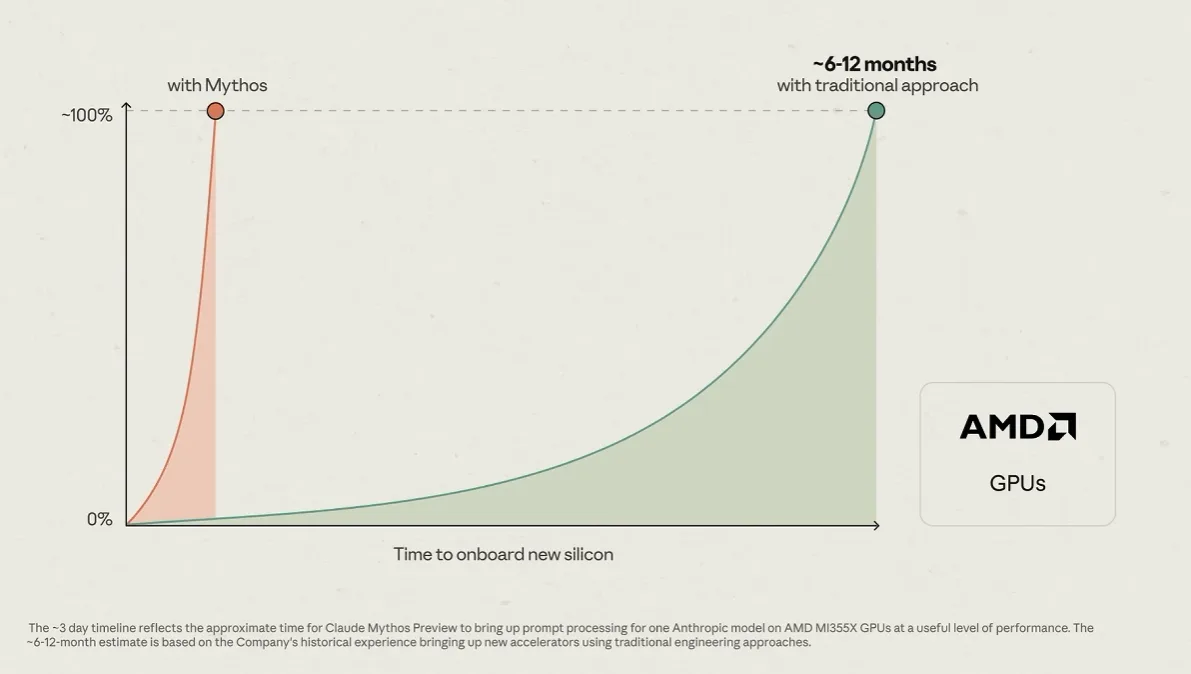
AMD GPUs provided the clearest test. Anthropic says standing up a new chip platform used to require dozens of engineers working for months. This year, the company used AMD GPUs for the first time and assigned the porting work to Mythos. Anthropic says Claude was running on AMD after just three days, with almost no human intervention, and that the model ported or wrote nearly 100 percent of the kernels itself. Kernels are the low-level code that runs on the GPU.
Anthropic says Mythos can bring new hardware to usable performance in about three days, compared with the six to twelve months that traditional engineering needs for new accelerators. The figures refer to prompt processing of an Anthropic model on AMD MI355X GPUs. If the numbers are correct, the software overhead that has been seen as Nvidia's strongest advantage would become much smaller. Buyers could move between chip suppliers more easily and pick the cheaper or more available option.
Expansion: Four chip families and one compute pool
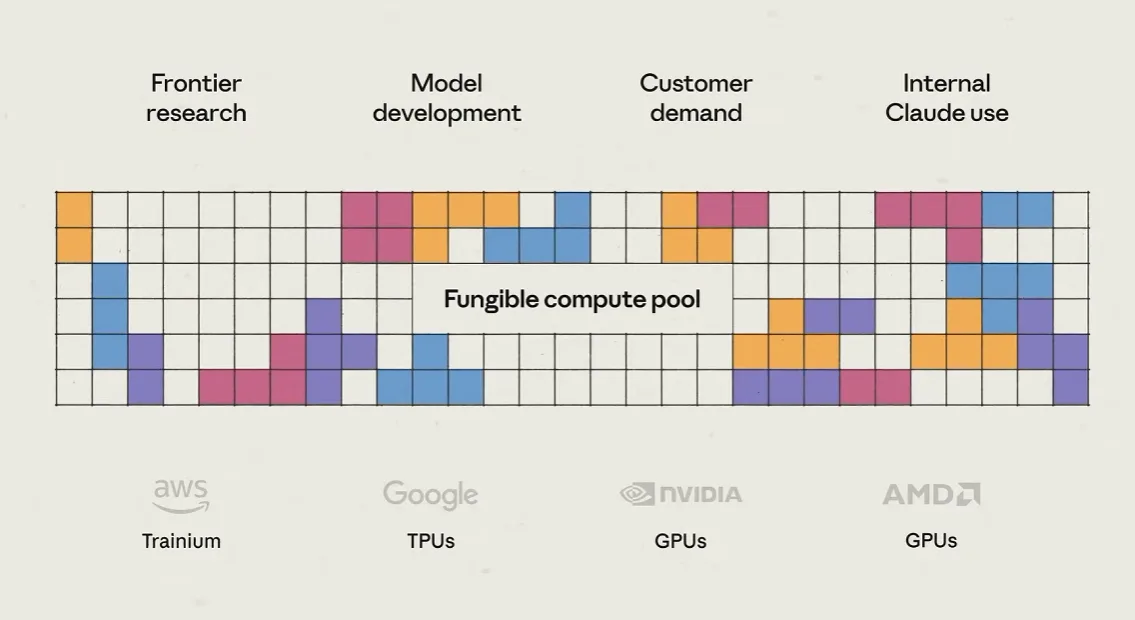
Anthropic says it trains and runs Claude on all four major chip families. In a tight compute market, the company argues that this lets it choose the best price-performance ratio no matter who makes the chip. Some accelerators suit training, while others suit inference. Nvidia's dominance in AI chips currently supports a margin of more than 70 percent, a very high level for hardware.
The company says it draws compute from a fungible pool across AWS Trainium, Google tensor processing units, Nvidia GPUs, and AMD GPUs. It uses that pool for research, model development, customer demand, and internal Claude usage. Anthropic says it treats compute from different vendors, chip architectures, and locations as one interchangeable pool, and that it gets more value from every dollar of compute than any other frontier AI lab.
Anthropic also relies on compute multipliers, research advances that extract more performance from the same physical computing capacity. The company says the multipliers compound, with each breakthrough amplifying the previous one. In the long run, Claude could find such multipliers by itself. That would be recursive self-improvement, a debated but unproven idea in AI research.
The company is also building its own data center capacity through Anthropic Direct. Rather than buying compute only from cloud services, it leases chips and runs them in purpose-built data centers, aiming to lower total cost of ownership.
Latest: Financial ties and unverified claims
The figures come from Anthropic's investor presentation and have not been independently verified. They still show that at least one major AI lab does not see CUDA dominance as impossible to overcome, and that AI models themselves could become tools for reducing hardware dependence.
Both major GPU makers have financial ties to Anthropic. In November 2025, as part of a $45 billion deal with Microsoft, Nvidia committed to investing up to $10 billion in Anthropic. According to Anthropic's S-1/A registration statement filed with the SEC on November 10, 2026, Nvidia is also participating in a conditional private placement totaling $26 billion, where seven technology companies are subscribing to shares at the IPO price. AMD announced a strategic investment of up to $5 billion in July 2026. In return, Anthropic plans to deploy up to two gigawatts of AMD Instinct MI455X GPUs in Helios rack-scale systems, with the first gigawatt phase beginning in the first half of 2027.
The next test is whether independent users can reproduce the three-day AMD port, and whether the $10 billion Nvidia investment, the $26 billion conditional private placement, and the $5 billion AMD investment change the real cost of running Claude on AMD hardware.
Comments
No comments yet. Be the first to comment.