
OpenAI to Begin Adding Watermarks to ChatGPT Text in EU
OpenAI adds invisible EU ChatGPT/Codex watermarks via textGrain for AI Act compliance; editing can weaken detection and access is limited.
Key Points Summary
- OpenAI will add invisible textGrain watermarks to ChatGPT and Codex outputs in the EU to comply with the EU AI Act’s transparency rules, while API developers can enable it for select models globally.
- The watermark subtly shapes word choices using a secret key, creating statistical patterns that detectors can identify without being visible to readers or identifying individual users.
- Detection remains limited: editing, synonym replacement, short passages, math answers, and translations can weaken watermark reliability, and a missing watermark does not prove human authorship.
- OpenAI is initially limiting detector access to approved researchers and expert organizations while evaluating reliability and responsible use.
- The move follows broader EU commitments on AI-generated content and comes after Anthropic began watermarking Claude worldwide, suggesting provenance signals may spread but remain probabilistic and region-limited for now.
OpenAI Adds Invisible Watermarks to ChatGPT and Codex Text in the EU
OpenAI announced Monday it will embed invisible watermarks in text generated by ChatGPT and Codex within the European Union, a direct response to the EU AI Act's transparency requirements that took effect on August 2. The rules obligate AI providers to mark machine-generated content so other systems can identify it. The watermark will reach eligible ChatGPT and Codex users on all plans over the coming weeks, but only inside the EU. Developers worldwide using OpenAI's API can enable it for select models starting today; it remains off by default, and OpenAI is not making text watermarking a global default at launch.
How the textGrain Method Works
Rather than stamping a visible symbol, the watermark subtly shapes the model's word choices, creating a statistical pattern that readers cannot perceive but a detector can extract. Because the signal lives in the words themselves, it survives copying and pasting. OpenAI says the mark does not identify individual users and that its models showed no meaningful performance change with the feature active. Alongside the rollout, OpenAI published a technical report for its method, called textGrain, co-written with researchers from the University of Pennsylvania and Yale. The report describes using a secret key to sort next-word predictions when completing a sentence; aggregating hundreds of these small nudges lets a detector flag AI-generated content from the text and key alone.
Detection Limits and Durability
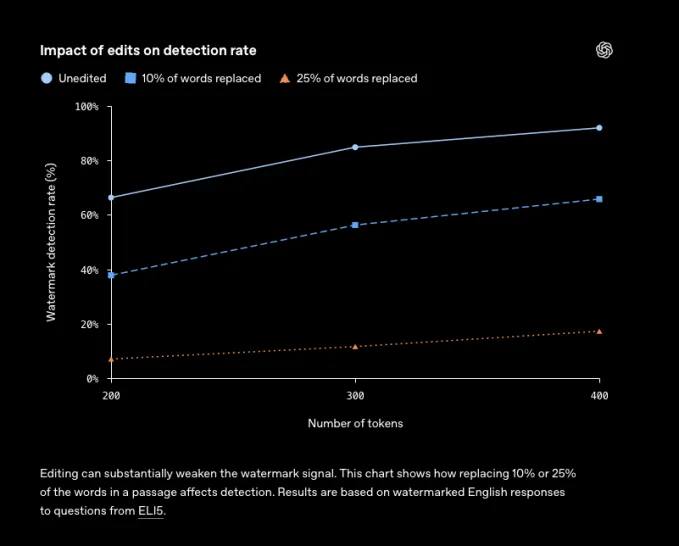
OpenAI's own tests indicate the watermark is fragile under editing. In one trial, swapping 10% of words for synonyms cut detection from roughly 92% to 66%. Short passages, math answers, and translated text also prove harder to detect. "These limitations contribute to our decision to provide initial detector access only to approved researchers and expert organizations, who can help us evaluate reliability and responsible uses," the company said. OpenAI further cautioned that a missing watermark "does not prove human authorship"—the text may be too brief, heavily edited, or produced by a rival's AI. Watermarks "can indicate that an OpenAI system generated or processed part of a passage, but not how much human judgment, editing, or creativity went into it," the company noted.
Why Now, and What Comes Next
The move lands two months after Anthropic said it would watermark Claude's output worldwide, a decision that drew backlash from some Claude users who argued they supplied "the instructions, context, decisions" while Claude was merely "the tool." OpenAI had previously built a text watermark but withheld it, partly fearing users would defect to competitors that did not watermark, according to a 2024 Wall Street Journal report. Anthropic, Google, Meta, Microsoft, and OpenAI have all committed to the EU's code of practice on AI-generated content. For readers, the practical takeaway is that provenance signals are becoming standard in regulated markets, but they remain probabilistic, editable, and currently limited to EU users. Watch whether OpenAI extends watermarking globally and whether detector access widens beyond approved researchers.
Comments
No comments yet. Be the first to comment.