
Tencent's Gander is designed to keep conversations going while operating in the background
Tencent's Hunyuan Speech team introduced Gander, an AI model that sustains natural, real-time conversations while managing complex agent tasks in the background. Using a cerebellum-brain architecture, it processes speech, images, and text simultaneously, with a swappable reasoning module. Gander leads competitors like GPT-Realtime and Gemini Live on conversational timing but trails on task accuracy, and Tencent plans to open-source the model.
Tencent's research team has unveiled Gander, an AI model built to hold natural, real-time conversations while simultaneously handling complex agent tasks in the background. The system matters because today's voice assistants operate on a strict turn-taking basis, while Gander is designed to mimic the fluid, interruptible rhythm of human conversation. The tradeoff: it leads rivals on conversational timing but lags slightly on task accuracy.
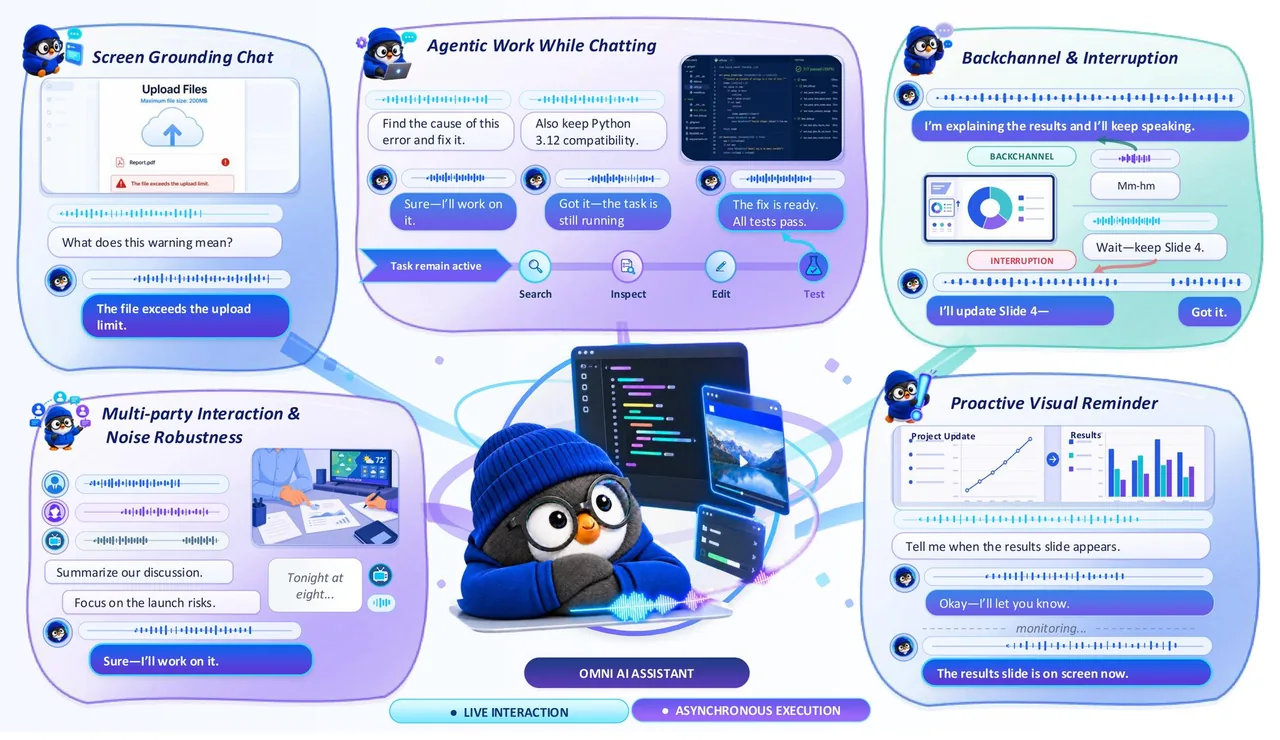
The project comes from Tencent's Hunyuan Speech team working with researchers at several universities. According to the technical report, the model processes speech, images, and text at the same time rather than waiting for each input in sequence.
A "Cerebellum" Talks While a Swappable "Brain" Works
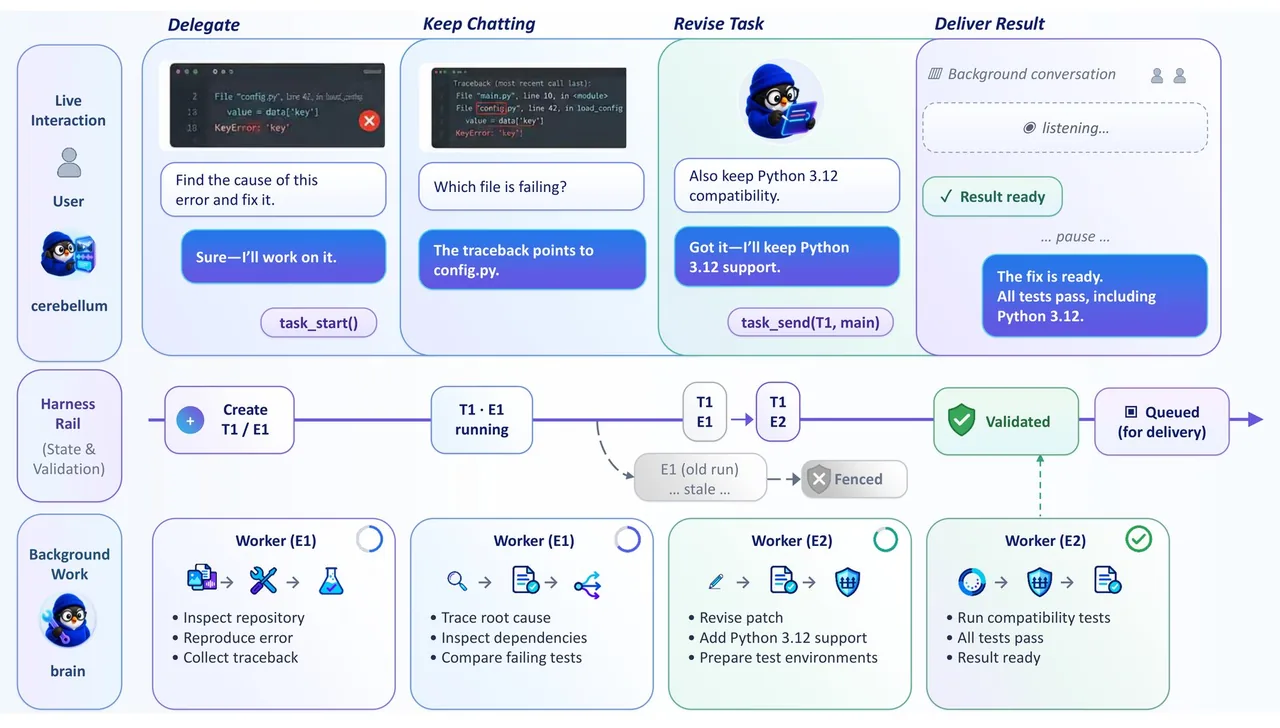
The researchers argue that conversation demands fast responses, but tasks like searching files or writing code require slower, deliberate planning. Forcing a single model to do both means trading speed against reasoning ability. Their solution splits the workload into two roles borrowed from human anatomy: a "cerebellum" manages live conversation, while a "brain" handles reasoning and complex work in the background.
The brain component is modular. It can be replaced with agent systems such as Codex or Claude Code without retraining the conversation model. In tests, an unspecified model from OpenAI's GPT-5.6 family filled that role, meaning the whole system improves automatically as underlying models advance.
The model breaks conversations into one-second segments, letting the cerebellum decide when to listen, speak, or stop when the user cuts in. It makes these decisions without a separate speech-detection module, relying on roughly the last two minutes of conversation as memory. Users can jump in at any point, and the model can ask follow-up questions or volunteer progress updates unprompted—for example, reporting on a bug fix while the user adds new requirements.
Strong Timing, Weaker Task Accuracy
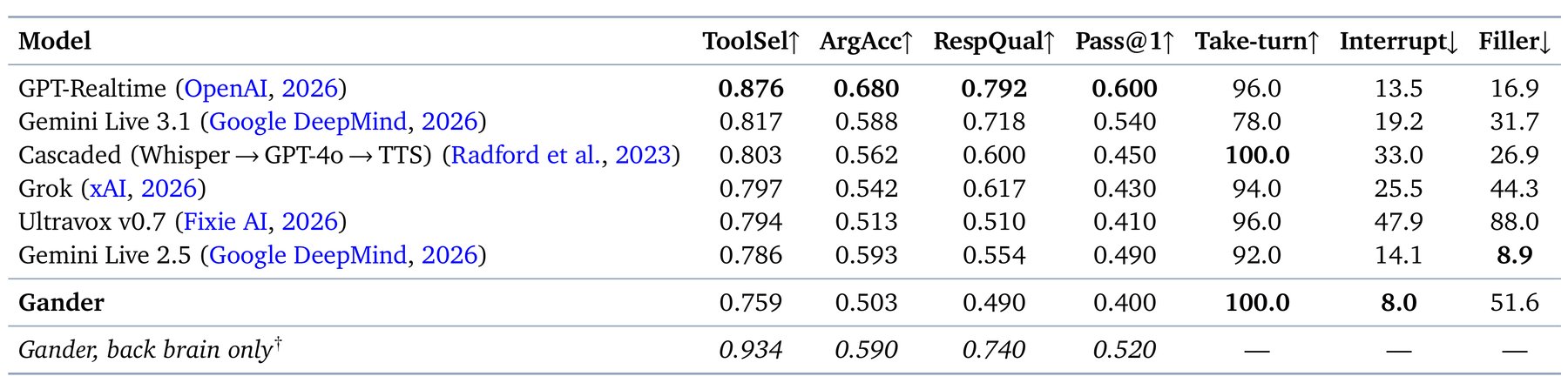
With no dedicated benchmark for this type of system, the team evaluated Gander on existing tests. The report says it achieved the best timing performance on Full-Duplex-Bench v3, which measures voice assistants across task scenarios. Gander began speaking at the right moment in all 100 scenarios and interrupted users in just 8 percent of cases, compared with 13.5 percent for GPT-Realtime and nearly 48 percent for the weakest competitor. Notably, Gander uses a relatively small model to compete against commercial systems including GPT-Realtime, Gemini Live, and Grok.
Task accuracy tells a different story: Gander fell slightly below even the weakest competitor. The researchers attribute this partly to how the tests score the entire system, meaning speech recognition and output errors drag down results—the brain component scores much better when fed text directly. Video and audio understanding also suffered, with Gander performing worse than its base model on tasks like counting and locating objects in images, a gap the researchers blame on training that prioritized fluid conversation over precise perception.
Open-Source Plans and a Crowded Field
Gander was trained on roughly 2.7 million examples, including some designed to teach it when to stay quiet amid background noise or during group conversations not directed at it. The team acknowledges the work is early-stage: scaling remains an open question, and no standard evaluation method exists for systems of this kind. The company plans to publish the model's weights and training data once it completes "the open source release process." A GitHub repository already exists, with demos available on the project page.
Gander builds on momentum from Tencent's July release of Hy3, an open language model that reportedly narrowed the gap with rivals, particularly on agent tasks. Hy3 already runs in WorkBuddy, Yuanbao, and WeChat. Tencent is also negotiating to take the largest stake in agent startup Manus after Beijing blocked Meta's acquisition, viewing the deal as complementary to plans including an agent embedded in WeChat.
The broader industry is moving in a similar direction. OpenAI's GPT-Live separates conversation from reasoning, delegating web searches and agent tasks to a background model while the chat continues. Sakana AI's Fugu is a standalone language model that calls on others from an expandable pool, and OpenAI is testing proactive agents that create follow-up tasks and contact users unprompted.
Practical challenges persist, however. An Anthropic analysis found experienced users interrupt Claude Code in about 9 percent of work steps, versus roughly 5 percent for newcomers, and a survey found teams building conversational voice and chat agents report latency problems especially often.
What to watch next: Whether Tencent follows through on releasing Gander's weights and training data, and whether an evaluation standard emerges for full-duplex agent systems, could shape how quickly this conversational-agent hybrid approach matures.
Meta description: Tencent's Gander AI splits real-time conversation and agent work between a "cerebellum" and a swappable "brain," leading on timing but trailing on accuracy.
Tags: Tencent, Gander, AI voice assistants, full-duplex conversation, AI agents
Featured image: Abstract technology style illustration of two interconnected neural processing streams—one fast and fluid, one deep and deliberate—flowing through a split computational architecture. No real people, no logos, no text.
Comments
No comments yet. Be the first to comment.