
Anthropic co-founder Jack Clark now predicts that self-improving AI will emerge by 2027.
TasteVal measures research taste via compute efficiency. Anthropic Opus 5.5 leads, moving Jack Clark's self-improvement estimate to as early as 2027.
Key Takeaways
- Anthropic co-founder Jack Clark now says recursive self-improving AI could emerge as early as 2027, moving his earlier 2028 estimate forward after new benchmark results.
- P-Zero Research’s TasteVal benchmark measures “research taste” by testing how efficiently AI models design experiments and interpret results, rather than only judging raw model performance.
- Anthropic’s Opus 5.5 performed best on TasteVal, reaching expert-level scores with less than half the compute, though the authors caution that the benchmark may overstate broader progress.
- TasteVal challenges the view that current models lack key research skills, but it still does not test the harder human-like ability to choose valuable long-term research directions.
- The debate over AI self-improvement remains cautious: major labs say fully autonomous recursive self-improvement has not yet been achieved and emphasize oversight, slow-downs, and unresolved gaps.
Meta description: P-Zero Research's TasteVal benchmark tests Anthropic Opus 5.5 research taste and shifts the debate on when recursive self-improvement may arrive.
Tags: P-Zero Research, TasteVal, Anthropic, Opus 5.5, recursive self-improvement
Featured image: Abstract blue and violet network nodes above a glowing circuit-like grid, with no people, logos, or text.
P-Zero Research's TasteVal benchmark reframes the race toward recursive self-improvement by measuring how efficiently Anthropic's Opus 5.5 and other models conduct AI research tasks, and that shift has pushed Clark, an Anthropic co-founder, to see the capability arriving as early as 2027.
Background: Clark moves the recursive self-improvement timeline
Clark, who co-founded Anthropic and writes the Import AI newsletter, previously expected recursive self-improvement could emerge in 2028. Based on the numbers now circulating, he now places a possible date as early as 2027. Recursive self-improvement, in this debate, means AI systems developing their own successors. The benchmark does not show that this loop has already begun. It instead captures a limited part of scientific work and redirects attention from raw model performance to how much independent research work language models can carry out.
Development: TasteVal measures research taste as compute efficiency
P-Zero Research defines research taste through three abilities: choosing worthwhile research questions, designing experiments to answer them, and interpreting results correctly. TasteVal tests only the last two. Each of its eight tasks gives a model a fixed research goal from AI model development, together with a measurable score. The tasks include selecting training data, pretraining and fine-tuning language models, training on human preferences, and defending against adversarial prompts.
The model chooses the next experiment and uses its outcome to plan the following step. A fixed coding agent runs every experiment on a single Nvidia H100 GPU, limiting coding skill from distorting results. Each run stops after 40 GPU-hours of compute or 120 hours of wall-clock time. Human reference scores came from 24 experts who had recently worked at OpenAI, Google DeepMind, Nvidia, and Microsoft Research. At least two experts worked on each task, and the best human attempt per task became the benchmark.
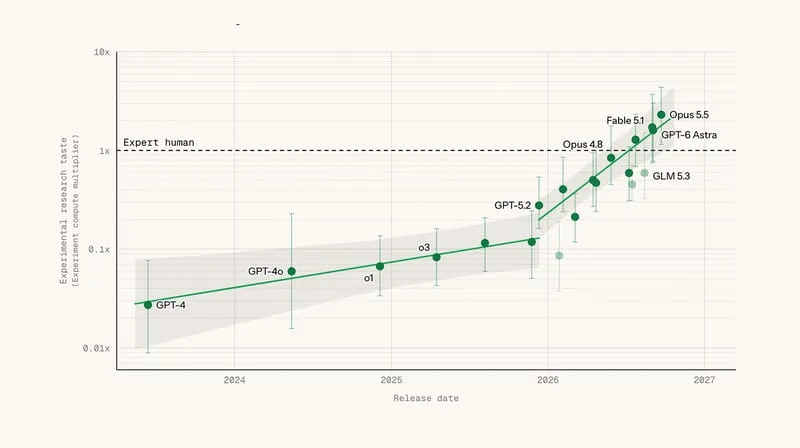
The lab converts research taste into compute efficiency because experiment compute is scarce in AI research. Its AI Futures Model predicts that experiment compute becomes the biggest bottleneck once coding is automated. TasteVal therefore asks how much compute a model needs to match expert scores. A model that reaches expert performance with half the compute has twice the research taste under this definition, a ratio P-Zero Research calls the compute multiplier.
Anthropic's Opus 5.5 was the top model, with a compute multiplier of 2.3, reaching expert-level scores with less than half the compute. The reported statistical range is 1.15 to 4.37. At the low end, the model would barely lead. A single run cost roughly one-thirtieth of the average cost of an expert attempt. Across several model generations, the compute multiplier has roughly doubled every three months since December 2025, though the reported doubling time ranges from 1.7 to 5.0 months. In prior years, growth was much slower, and the curve steepened around the turn of 2025 into 2026. The authors say this single benchmark cannot prove a lasting trend and may overstate how quickly research taste is improving, because the tasks can be checked quickly and cheaply, a format AI labs find easiest to optimize. The comparison group also did not include any top-tier researchers.
Latest: The benchmark narrows the debate but not the gap
Clark has long treated creativity as the key factor in how fast AI systems can improve themselves. Earlier this year, he wrote that models had not shown this ability at any groundbreaking scale. He now points to progress in mathematical breakthroughs and benchmarks such as TasteVal as signs that the situation is changing. In a long essay in May, he had offered more cautious numbers: he put the odds of a system independently training a stronger successor at roughly 60 percent by the end of 2028 and 30 percent by 2027. That forecast comes from a co-founder of the company whose model tops the benchmark, adding a layer of bias to the prediction.
The benchmark matters because it tests the exact capability critics had flagged as a barrier to a major AI breakthrough. AI researcher Herbie Bradley pushed back on Clark's May essay, arguing that models could plausibly take over junior researcher work, but skills such as research taste, creativity, and coherent long-term research planning were not visible. TasteVal challenges that assessment for experiment planning and evaluation, yet it says nothing about choosing a long-term research agenda.
The practical gap remains visible in a study on AI development using AI agents led by a team at Fudan University. The researchers analyzed development of their own model and found that AI agents contributed up to 55 percent of methodology proposals, while humans still made over 85 percent of final decisions. The authors said it is unclear how AI can generate diverse research directions and assess their value before results are in, which is exactly the decision TasteVal removes from the model's plate.
The benchmark arrives amid a debate major AI labs started. In June, Anthropic wrote that recursive self-improvement has not been achieved yet but could come sooner than most institutions are prepared for. Anthropic CEO Dario Amodei now calls for a controlled slowdown in AI development. OpenAI acknowledges that fully autonomous recursive self-improvement is not happening yet and says it should only be pursued if human oversight is guaranteed.
TasteVal changes what counts as progress. For years, the focus was on how well models solve well-defined tasks like math problems or coding challenges. The question now is increasingly whether models can make the decisions that push research forward. If the trend P-Zero Research measured holds up in other tests, the implications cut both ways: AI development could become faster and cheaper, but a growing share of the research could also become harder for humans to verify, because models would be planning and evaluating their own experiments. What to watch next is whether other tests reproduce that trend and whether models can eventually be assessed on the one ability TasteVal leaves out: choosing the research agenda itself.
Comments
No comments yet. Be the first to comment.