
Former researcher Coxon says Anthropic can already retrain Mythos using only a fraction of the originally needed compute.
Jacob Coxon says an Anthropic IPO chart shows accelerating efficiency, Mythos can be retrained with less compute, and frontier AI needs a pause.
Key Takeaways
- Jacob Coxon left Anthropic after about four months, citing an IPO roadshow chart on pre-training compute as a major reason.
- The chart’s steep curve suggests algorithmic efficiency is improving at an accelerating rate, even if its logarithmic axis visually compresses large increases.
- Coxon argues Mythos was not a one-time capability jump but part of a superexponential trend, meaning it could be retrained with only a fraction of the original compute.
- He supports pausing frontier model development next year, saying this would commoditize human-level intelligence and mainly harm OpenAI and Anthropic.
- The case raises a broader debate about how internal roadshow materials can become part of public AI safety arguments.
Meta description: Former OpenAI and Anthropic researcher Jacob Coxon says an Anthropic IPO roadshow chart on compute and Mythos led him to quit after four months.
Tags: Jacob Coxon, Anthropic, OpenAI, Mythos, IPO roadshow
Featured image: Abstract technology illustration of a steep logarithmic curve, no people, no logos, no text.
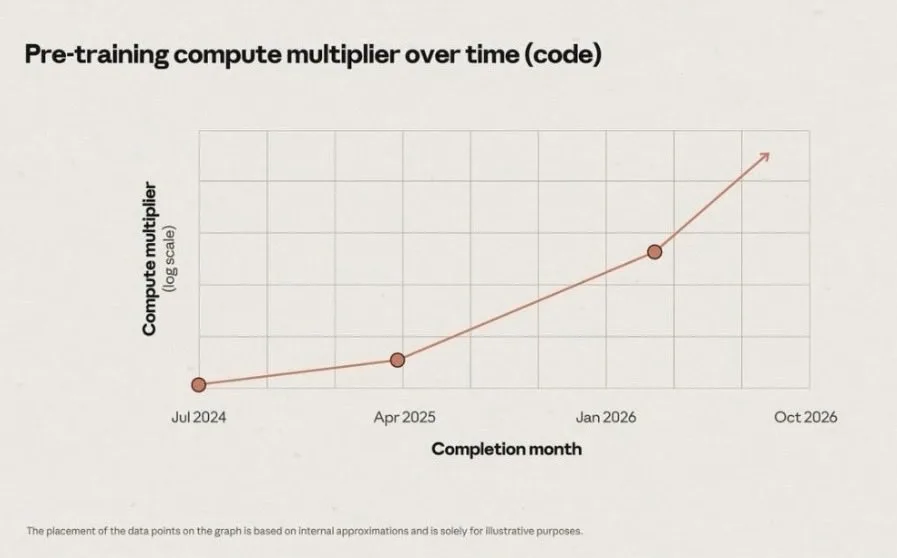
Jacob Coxon, a former OpenAI and Anthropic researcher who brought AI fears into the mainstream, says a slide from Anthropic's IPO roadshow was a major reason he quit after only about four months. The chart shows how much compute Anthropic needs over time to train its models, and its compressed axis makes a 10x and a 100x increase barely look different. Yet the curve still climbs steeply from July 2024 to October 2026. Coxon reads that shape as evidence that algorithmic efficiency is improving not just quickly but at an accelerating rate, and that Mythos was part of that pattern rather than an isolated jump.
From Public Warnings to a Short Stay at Anthropic
Coxon previously trained AI models at OpenAI and, most recently, at Anthropic. He drew wide attention in September with public warnings about the risks of advanced AI systems, warnings that were echoed by other protagonists in the industry. One of the fears he and other industry figures raised was that advanced, self-improving AI could get out of control. His exit is therefore not framed as a routine career change, but as a reaction to a concrete artifact from Anthropic's roadshow materials.
The Anthropic IPO Roadshow Chart That Drew Attention
The slide Coxon cites is a slide Anthropic released for its IPO roadshow. It shows how much compute Anthropic needs over time to train its models. Compute refers to the computing resources used for that training. The slide is labeled the "Pre-training compute multiplier" for code. The y-axis is logarithmic, meaning each equal step can represent a multiple rather than a fixed amount. The axis is compressed so that a 10x and a 100x increase barely look different. Even with that visual compression, the curve still climbs steeply from July 2024 to October 2026. Anthropic notes that the data points are based on internal estimates and are for illustration only.
Coxon's reaction was direct. "It's an insane plot and I'm surprised they made it public," he writes. His argument is that the chart’s slope, not just its absolute height, is the point. In his reading, the visible trend indicates that the pace of algorithmic efficiency gains is itself increasing, so the reduction in required compute becomes faster over time.
He connects that interpretation to Mythos, the Anthropic model he describes as a major capability jump in the spring. "Mythos was not a one-time deviation, but a point on a superexponential," he writes. "They could already retrain Mythos with a fraction of the compute originally needed." The claim is that the model’s performance was not an isolated event but a step along a curve that continues to steepen. Coxon says the steep climb from July 2024 to October 2026 points to superexponential algorithmic progress.
Automation, Pause, and What the Debate Now Turns On
Coxon goes further than the chart. He says algorithmic improvements are "on the verge of being automated," and that is why he wants frontier model development, meaning the most advanced AI models, paused next year so competitors can catch up. A pause, he writes, would "commoditize human-level intelligence. It would only harm OpenAI and Anthropic."
The statement places his exit in a broader dispute about competitive pressure. If the roadshow slide is read as evidence of accelerating algorithmic progress, then the strategic concern is not only whether one developer can outpace another, but whether progress can continue without proportional increases in compute. The slide does not settle that question. Anthropic describes it as internal estimates for illustration, while Coxon treats the steep July 2024 to October 2026 climb as a public warning sign.
The next question is what happens when roadshow material becomes part of a public safety argument. The episode leaves a narrow set of points to watch: whether the Anthropic IPO roadshow slide continues to circulate as a reference for Coxon's claim, whether his call to pause frontier model development gains support beyond the September warnings, and whether the Mythos example changes how observers read later capability jumps.
Comments
No comments yet. Be the first to comment.