
ZooWork-ShopRanker: An Open, Preference-Aligned Reranker for E-Commerce
ZooWork-ShopRanker 0.6B/4B/8B align e-commerce rerankers with LLM judge preferences, ShopRank-Bench, and distillation, beating open baselines.
Key Takeaways
- ZooWork-ShopRanker releases 0.6B, 4B, and 8B e-commerce rerankers aligned to shopping preferences rather than generic web relevance.
- Training supervision comes from multi-family LLM judge panels with position debiasing and agreement tiers, followed by distillation from the 8B flagship to smaller models.
- The team introduces ShopRank-Bench, a contamination-limited benchmark of about 10,000 private-traffic preference pairs to evaluate comparative product ranking.
- The aligned models significantly outperform strong open reranker baselines, their unaligned bases, and the 0.6B model beats its size peer, with gains across text formats and MTEB.
- The release establishes an open preference-aligned reranker package for shopping search, pairing model sizes, training method, and benchmark.
ZooWork-ShopRanker 0.6B, 4B, and 8B Align E-Commerce Rerankers
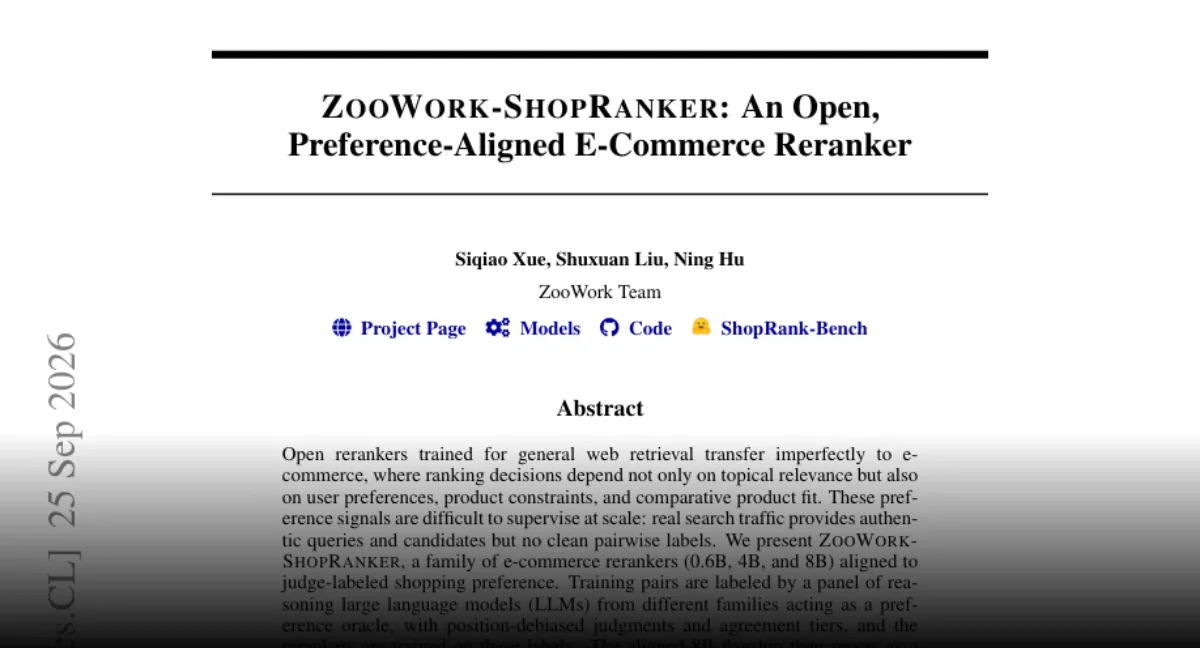
Meta description: ZooWork-ShopRanker 0.6B, 4B, and 8B use judge-labeled shopping preference and ShopRank-Bench to improve e-commerce reranking beyond open reranker baselines.
Tags: e-commerce search, reranking models, LLM judges, ShopRank-Bench, knowledge distillation
Featured image: Abstract technology-style visual of ranked shopping results, multiple reasoning LLM judge panels, agreement tiers, and distillation arrows; no real people, no company logos, no text.
ZooWork-ShopRanker introduces a family of e-commerce rerankers sized at 0.6B, 4B, and 8B, built to address a recurring mismatch in retrieval systems: rerankers trained mainly on general web relevance often struggle when the task shifts to shopping. A reranker is a second-stage model that reorders retrieved candidates, and in commerce that ordering must reflect not only whether a product matches the query, but also user preference, product constraints, and comparative fit among similar items.
Background: Where General Web Rerankers Run Out of Fit
The problem begins with supervision. Real search traffic is valuable because it contains authentic queries and candidate products, but it rarely provides clean pairwise labels that show which result should rank above another. In web retrieval, topical relevance can often be enough to create useful training signals. In shopping, the decision is more layered. A buyer may prefer a product because of brand, price band, feature fit, or how it compares with nearby alternatives, and those signals are hard to collect at scale.
That gap is what ZooWork-ShopRanker is designed to close. The family is aligned to judge-labeled shopping preference, using labeled comparisons to teach the models what matters in commerce ranking rather than relying only on surface-level relevance.
Development: Building Shopping Preference Supervision from Judge Panels
The training pipeline starts with a preference oracle made from a panel of reasoning large language models, or LLMs, drawn from different families. These judges are not treated as a single monolithic labeler. Their judgments are position-debiased, and labels are grouped into agreement tiers, so the training data can reflect both preference and confidence.
From those judged pairs, ZooWork-ShopRanker-8B becomes the aligned flagship. It is then used as a distillation teacher for the smaller ZooWork-ShopRanker-4B and ZooWork-ShopRanker-0.6B models. The efficient models are fit to the flagship’s scores and sharpened on judged pairs, creating a family that shares the same preference target across three parameter scales.
Latest Progress: A Private-traffic Benchmark and Three Released Model Sizes
To evaluate the work, the team introduces ShopRank-Bench, a contamination-limited benchmark containing about 10,000 private-traffic preference pairs in both text formats. The benchmark is tiered by how many judge families committed to each label, which makes it possible to compare model behavior across easier and harder preference cases.
The reported results are centered on three comparisons. ZooWork-ShopRanker-8B and ZooWork-ShopRanker-4B significantly outperform the strongest open reranker baseline. Every model in the family significantly beats its own un-aligned base. The ZooWork-ShopRanker-0.6B model also beats its size peer. The gains hold in both text formats and extend to common MTEB benchmarks, a widely used text evaluation benchmark family. The aligned models and ShopRank-Bench are released together.
Current Stage: What the ZooWork-ShopRanker Release Establishes
The current stage is a preference-aligned open reranker package for shopping, not a single model result. The release pairs three model sizes with a judge-labeled training method and a private-traffic benchmark designed to test the same hard case that generic web rerankers miss: ranking products by comparative fit rather than topical match alone.
Comments
No comments yet. Be the first to comment.