
InternW0-Δ: A World Action Model Linking Predictive Dynamics and Actions Using 20K+ Hours of Open Data
InternW0-Δ unifies video dynamics, 4D geometry, semantics, and actions in MoT, trained on 20K+ hours of open robot data; open-source plan.
Key Points
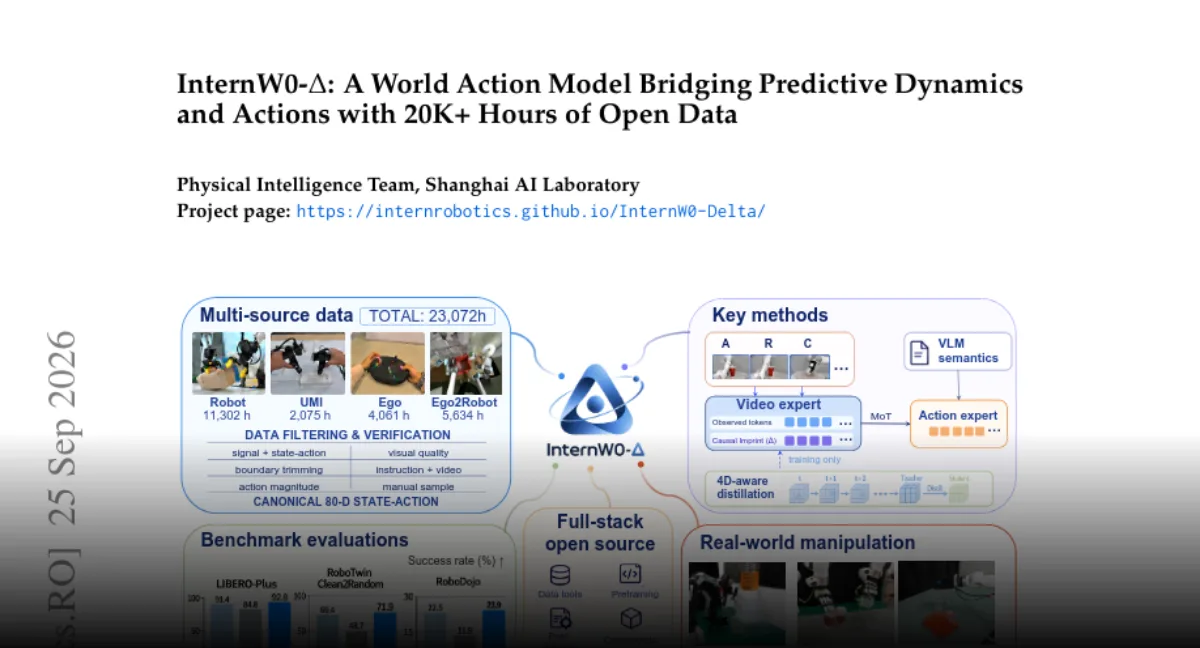
- InternW0-Δ is a unified World Action Model that connects video dynamics, 4D geometry, semantic understanding, and robot action generation.
- It uses a Mixture-of-Transformers framework with a frozen vision-language model for guidance and training-only 4D distillation for geometric and motion priors.
- Its Causal Imprint module provides future-relevant predictive representations to the action expert without requiring future-video rollout at inference.
- The model is pretrained on a heterogeneous 20K+ hour robot and human demonstration corpus, described as one of the largest open-source datasets of its kind.
- The team plans to open-source code, weights, infrastructure, and processed data where licenses permit, while performance and data reuse still need independent validation.
Meta description: InternW0-Δ unifies video dynamics, 4D geometry and action generation in a Mixture-of-Transformers trained on over 20K hours of robot manipulation data.
Tags: InternW0-Δ, World Action Models, Robot Learning, Mixture-of-Transformers, Open Source Robotics
Featured image: Abstract 3D point cloud, transformer layers, and robot gripper schematic in blue and orange tones, no text, no real people, no company logos.
InternW0-Δ is introduced as a unified World Action Model, or WAM, for generalist robot manipulation. The central problem it targets is integration: large pretrained models now carry useful priors from visual dynamics, scene semantics, geometry, and motion, but those priors have not always fit into one action-generation framework. The project reports that InternW0-Δ, pretrained on a heterogeneous corpus, outperforms prior methods across simulation benchmarks and real-robot platforms.
Background: The missing link between video priors and robot actions
World Action Models, or WAMs, jointly model visual dynamics and action generation for generalist robot manipulation. That framing matters because robot control needs more than recognizing a scene. A system must connect what is visible, what a language model understands about task intent, and how geometry and motion constrain future interaction. In practice, these ingredients often come from separate pretrained sources. Without a common state-action representation, a robot can predict visual change without translating that prediction into an executable action.
Development: MoT, Causal Imprint, and training-only guidance
InternW0-Δ combines pretrained visual dynamics, scene-level semantics, 4D geometric and motion priors, and action generation within a Mixture-of-Transformers, or MoT, framework. A pretrained video expert and an action expert interact under semantic guidance from a frozen vision-language model, or VLM. A pretrained 4D foundation model injects geometric and motion priors through training-only distillation, so the 4D teacher informs the unified model during training rather than requiring a separate inference path.
The second key addition is Causal Imprint. It learns future-relevant scene changes from training-only future supervision and provides predictive representations directly to the action expert without future-video rollout at inference. This keeps the inference path focused on action generation rather than full future-video synthesis.
Latest progress: A 20K-hour corpus and open-source plan
For large-scale joint training, the team constructed a heterogeneous corpus of robot demonstrations, UMI data, egocentric human demonstrations, and Ego2Robot data. The sources were curated and aligned under a common state-action representation, allowing robot and human demonstration videos to contribute to the same training objective. The resulting corpus contains over 20K hours of processed training data, which the team describes as, to their knowledge, the largest open-source corpus of its kind. InternW0-Δ is pretrained on this corpus and demonstrates strong performance across simulation benchmarks and real-robot platforms.
The team states it will open source the training code, model weights, infrastructure, data-processing pipeline, and processed data where licenses permit. The project page is https://internrobotics.github.io/InternW0-Delta/.
Current stage: From paper claim to shared training substrate
The current stage is a research release that aims to become a shared training substrate for WAM development. For readers, the 20K-hour figure is the most concrete signal: it suggests the project is positioned to reduce the data-alignment burden that often blocks cross-embodiment robot learning. The open-source items could let other researchers reproduce the MoT and Causal Imprint design, but the license caveat marks a practical limit on how much processed data and tooling can be freely reused. The next meaningful checks are independent reproduction of simulation and real-robot performance, clarification of license coverage, and evaluation beyond the reported benchmarks.
Comments
No comments yet. Be the first to comment.