
AI Reviews Show Bias Toward the Appendix
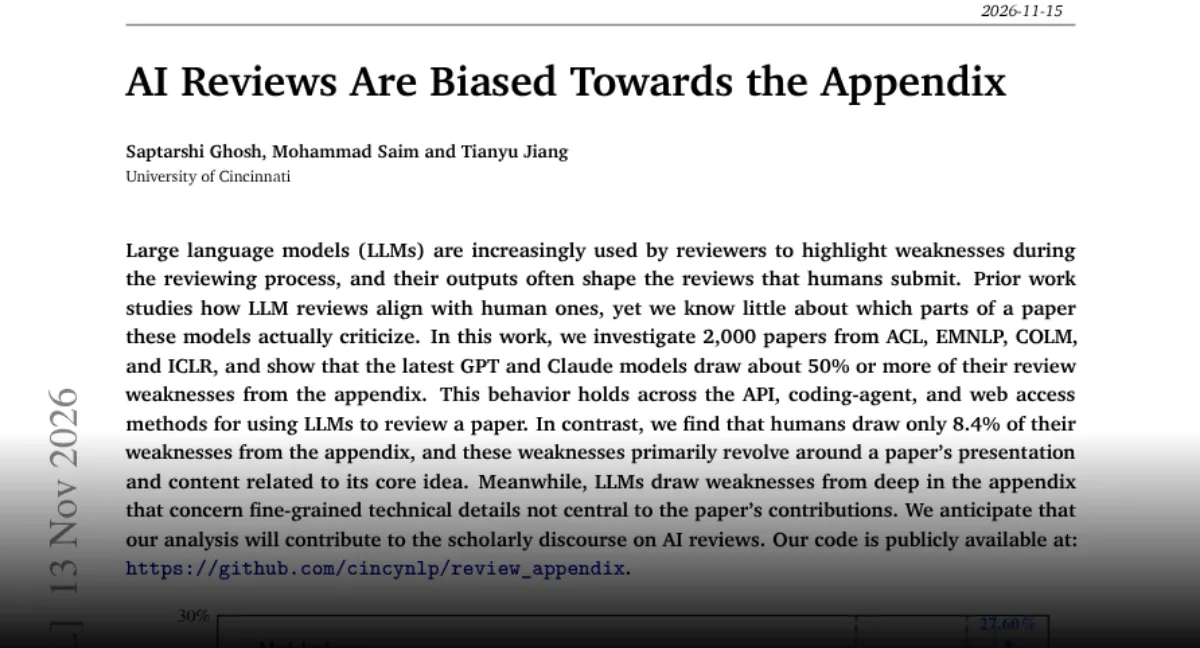
GPT and Claude reviews draw over 50% of weaknesses from appendices, versus 8.4% for humans, across API, agent, and web workflows.
Key Takeaways
- A study of 2,000 papers found that latest GPT and Claude models take about 50% or more of their review weaknesses from the appendix.
- The appendix bias appears across API, coding-agent, and web access methods, suggesting it is a consistent LLM behavior rather than a tool-specific artifact.
- The model-selected appendix criticisms often focus on fine-grained technical details deep in the appendix, not the paper’s central contributions.
- Human reviewers draw only 8.4% of weaknesses from the appendix and tend to connect appendix issues to presentation or the paper’s main argument.
- The gap matters because LLM-generated review drafts may shift reviewers’ attention away from core contribution issues toward appendix-level technical objections.
GPT and Claude Appendix Weaknesses Shape LLM Paper Reviews
Background: LLMs enter review drafting
Large language models (LLMs) are increasingly used by reviewers to highlight weaknesses during the reviewing process, and their outputs often shape the reviews that humans submit. Prior work has mainly studied whether LLM reviews align with human reviews. This analysis asks a more concrete question: which parts of a paper do these models actually criticize?
Development: Comparing 2,000 papers across access methods
The study investigates 2,000 papers from ACL, EMNLP, COLM, and ICLR. It compares where weaknesses come from when latest GPT and Claude models generate review comments and when human reviewers do. It also tracks the behavior across three ways of using LLMs to review a paper: API, coding-agent, and web access.
That comparison matters because review outputs can be produced through different workflows. A model accessed through an API, a coding-agent tool, or a web interface may be used in different review settings. The study reports the same appendix pattern across all three, suggesting the behavior is not limited to one access route.
Latest findings: Appendix weaknesses dominate LLM reviews
The central result is that the latest GPT and Claude models draw about 50% or more of their review weaknesses from the appendix. The pattern holds across the API, coding-agent, and web access methods.
The appendix material selected by the models is described as coming from deep in the appendix. These weaknesses concern fine-grained technical details that are not central to the paper's contributions. This creates a different emphasis from human reviews. A draft generated by a model may surface many detailed technical points, while those points may not be the details a human reviewer would prioritize when judging the paper's core contribution.
Current state: Human and model reviews diverge
Human reviewers draw only 8.4% of weaknesses from the appendix. Their appendix-related weaknesses primarily revolve around a paper's presentation and content related to its core idea. When human reviewers use the appendix, they appear to connect it back to the main argument rather than treating it as a source of isolated technical objections.
For readers, the gap between about 50% or more and 8.4% is a practical signal about where LLM-generated review weaknesses tend to come from. It does not say whether a paper is good or bad. It shows that the section being criticized can differ sharply between model drafts and human review patterns.
What to watch next
The analysis anticipates contributing to scholarly discourse on AI reviews. It identifies appendix selection as a concrete difference between LLM-generated review weaknesses and human review weaknesses. The next question is how appendix-focused model comments may affect the use of LLM outputs when reviewers draft or shape submitted reviews.
Comments
No comments yet. Be the first to comment.