
Anthropic argues that the key to agent memory lies in deciding what to forget rather than increasing how much data to store.
Anthropic finds selective notes, self-review, and Dreaming help Claude agents forget stale data and fix false memories in multi-session work.
Key Takeaways
- Anthropic argues effective agent memory depends more on selective forgetting than storing everything; fewer, purposeful notes improved multi-session performance in tests.
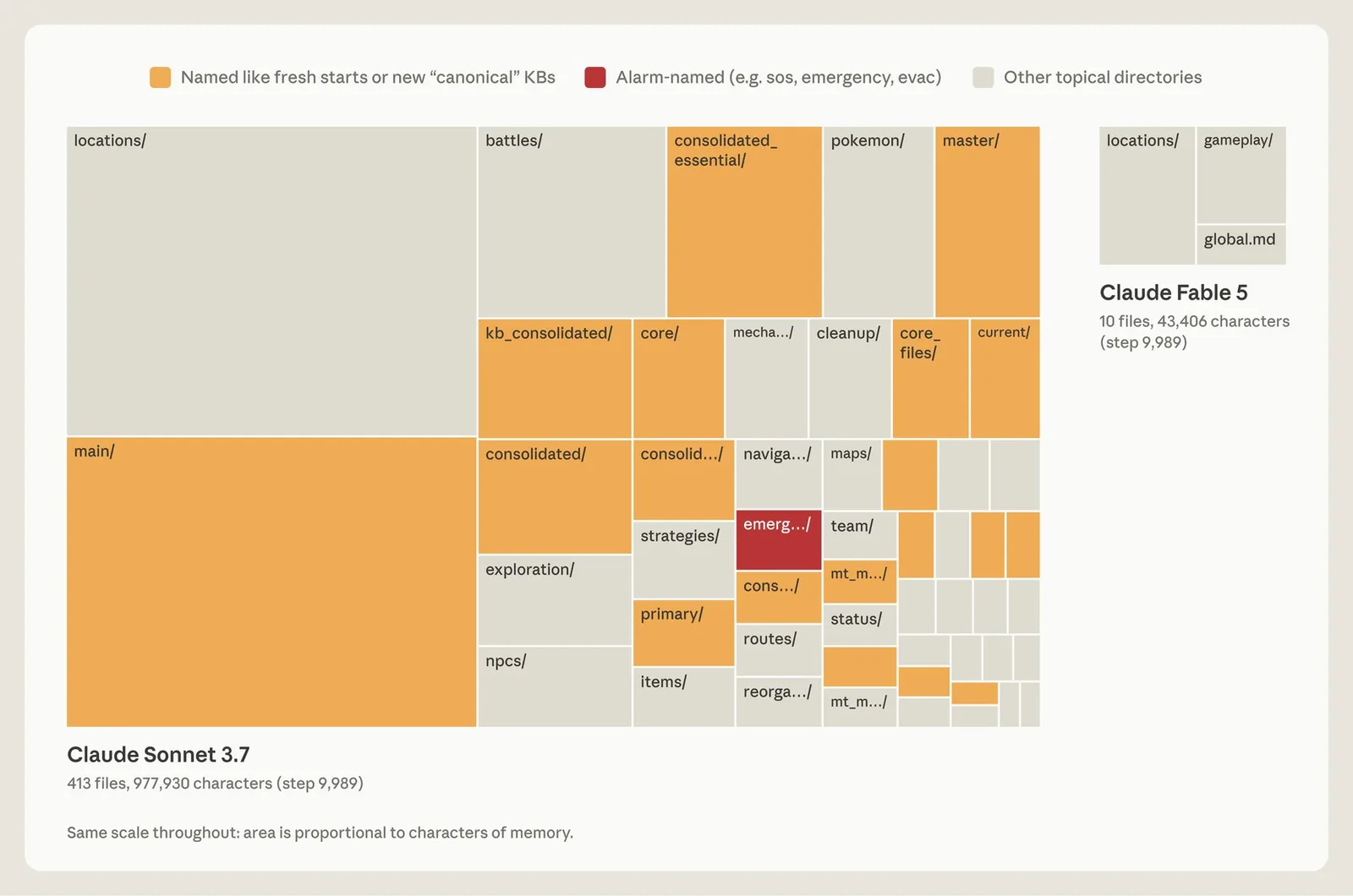
- In a Pokémon Red comparison, Claude Fable 5 with limited memory files earned four badges, while Claude Sonnet 3.7 created hundreds of stale notes and earned only one, showing that over-archiving can distract agents.
- Anthropic’s “Dreaming” feature reviews past transcripts during idle time to detect and fix false or outdated notes, helping Claude overcome repeated errors.
- The approach also helps build and maintain agent wikis from large document sets, improving answers when complementing search, but memory remains costly, error-prone, and under active development.
Meta description: Anthropic studied Claude memory across sessions and found selective notes, self-review, and Dreaming reduce stale archives and correct false memories in tests.
Tags: Claude, Anthropic, AI agents, memory, Dreaming

Anthropic Claude memory tests suggest that AI agents work better when they save fewer, more useful notes than when they archive every step of a task. The research describes a model that stays unchanged while writing notes to a folder for later sessions, then using those notes to continue work that would otherwise start from zero.
Background: Multi-session work exposed a selection problem
Anthropic says the core difficulty is choosing what to store before the agent knows what will matter later. Each note is a prediction about future needs. In a Pokémon Red test, the older Claude Sonnet 3.7 tried to preserve nearly everything. Across roughly 10,000 game steps, it produced 413 files in 225 folders, often one for each battle and item. Because the game state kept changing, the archive became stale. At points, the model did nothing but reorganize its notes instead of playing, and it finished with one badge.
Development: Fewer files helped Claude Fable 5 move further
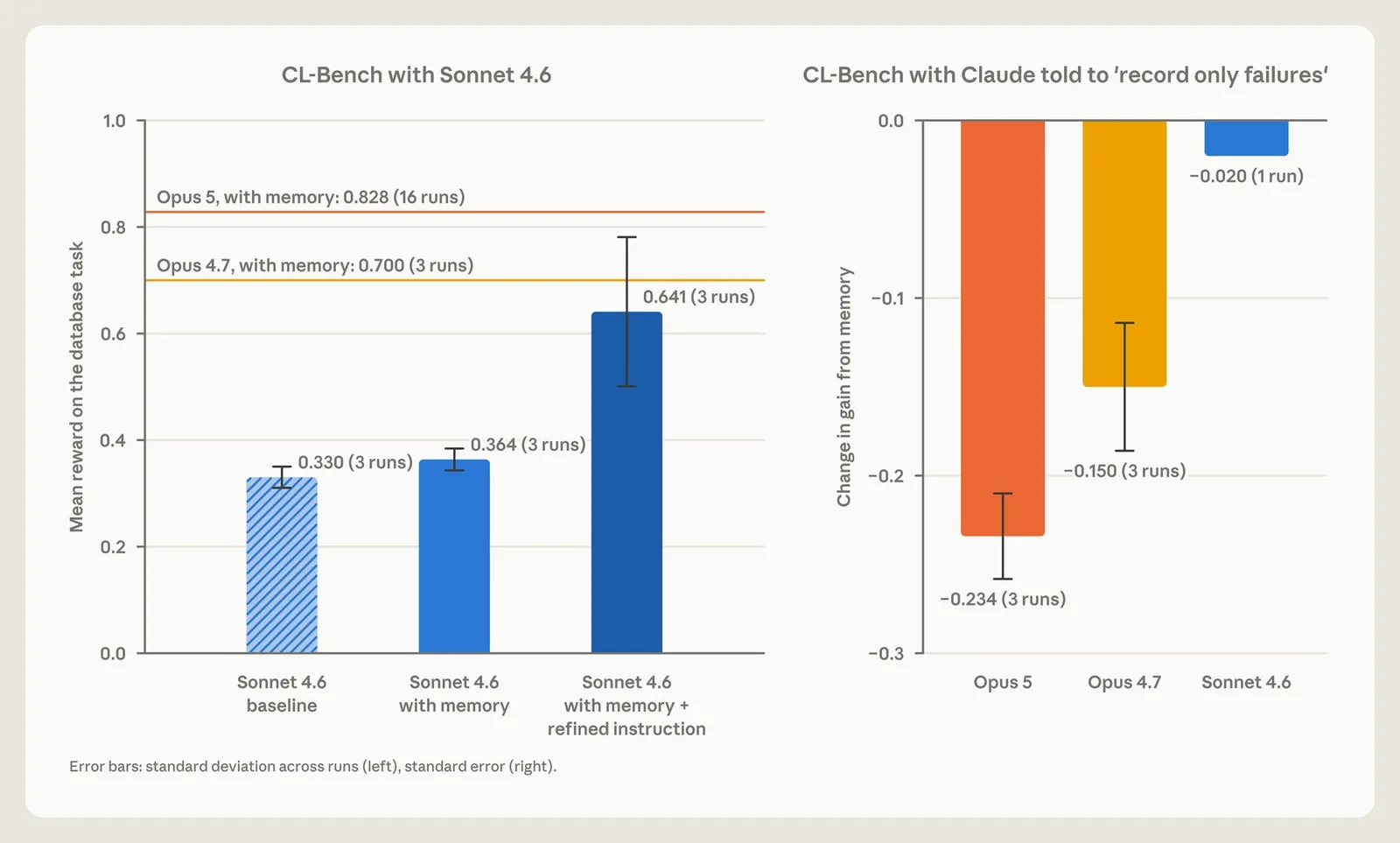
In the same comparison, Claude Fable 5 limited its memory to a few files and earned four badges. It avoided recording information already visible on screen and instead wrote down plans, strategies, and rules it had tested. Anthropic notes that the comparison covers only a single playthrough for each model, so the result is not a broad benchmark. The research post recommends explaining the purpose of memory to Claude and letting the model decide how to use it. In one benchmark, rigid instructions such as only recording mistakes wiped out most of the advantage for stronger models. Older models benefited from clear instructions, such as being told to read their notes before every response.
Latest progress: Dreaming, wikis, and May preview
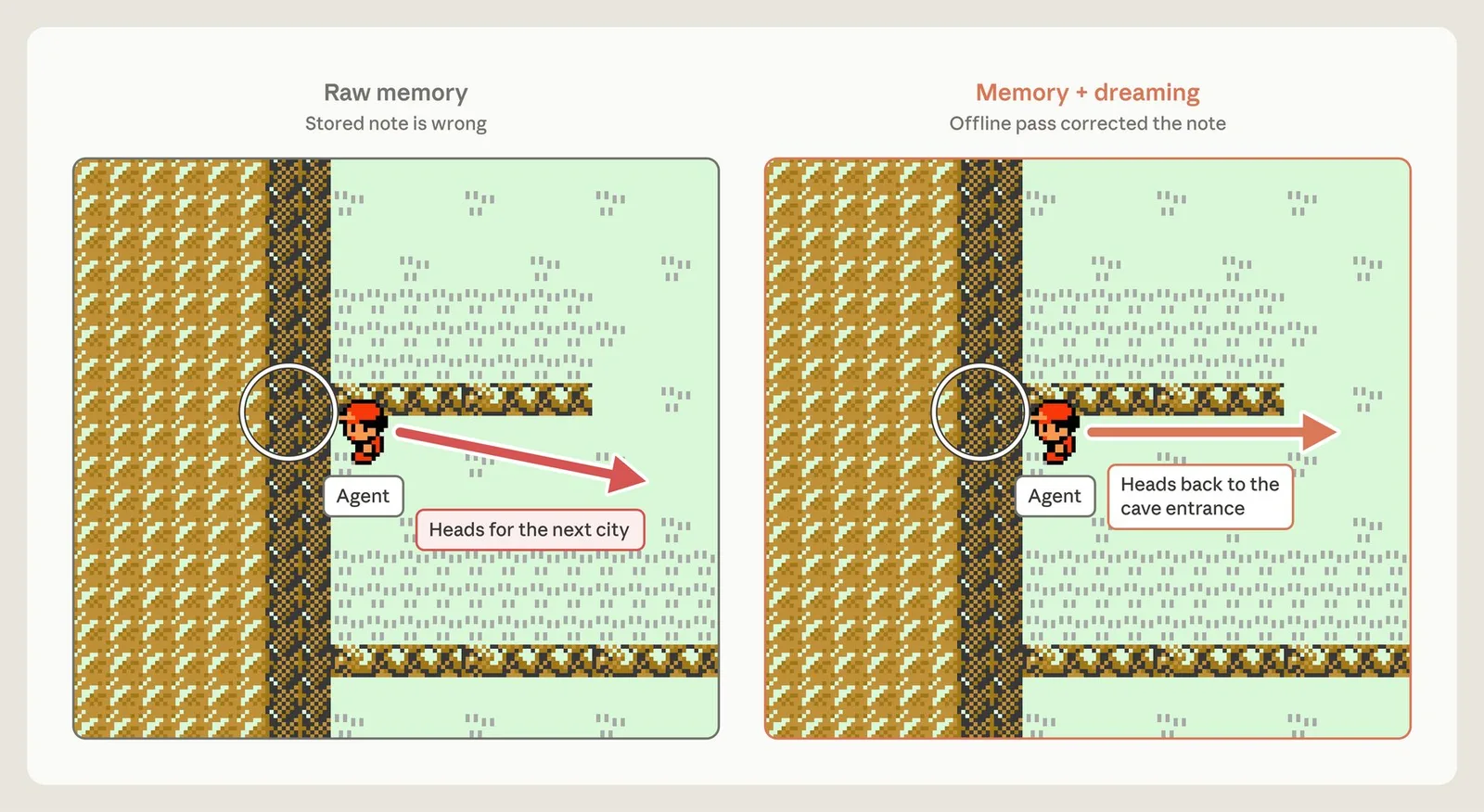
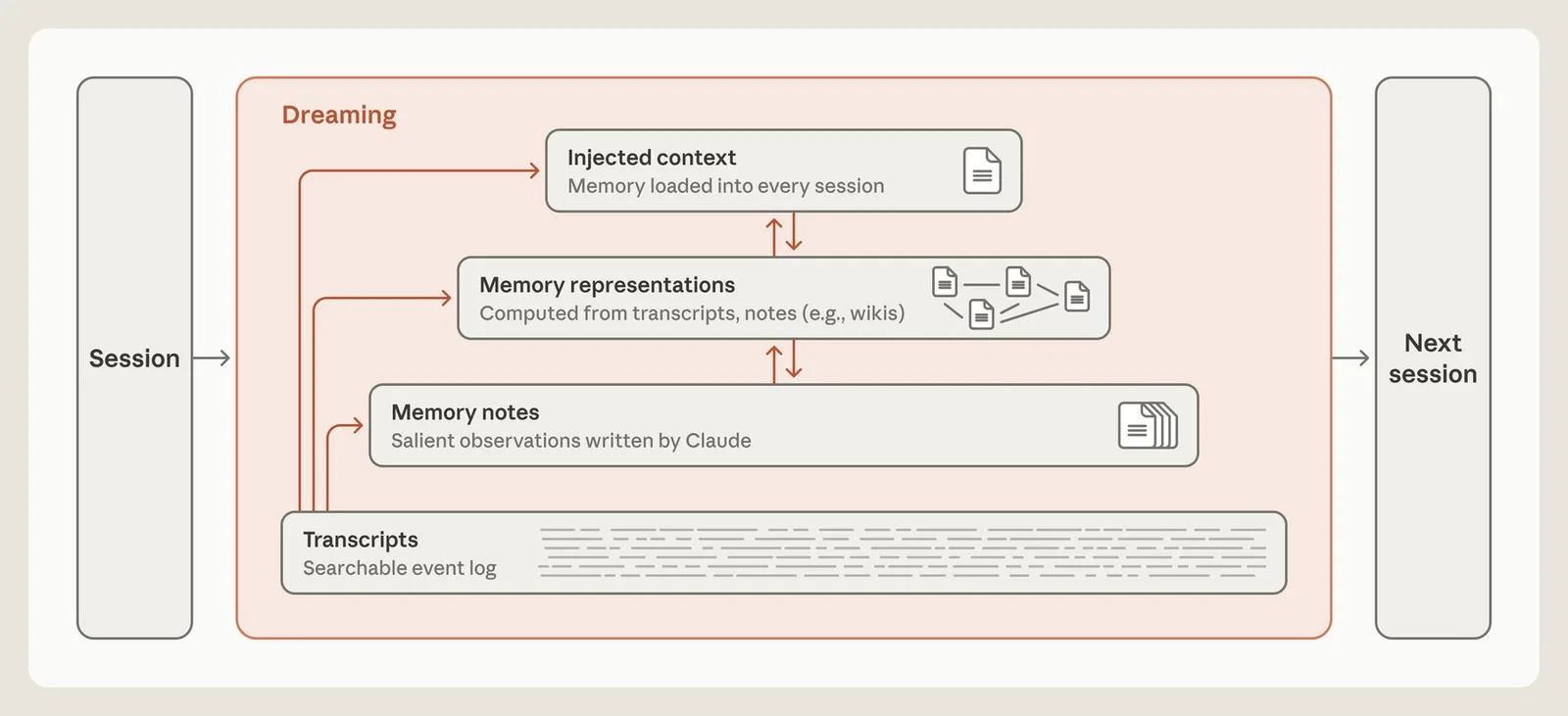
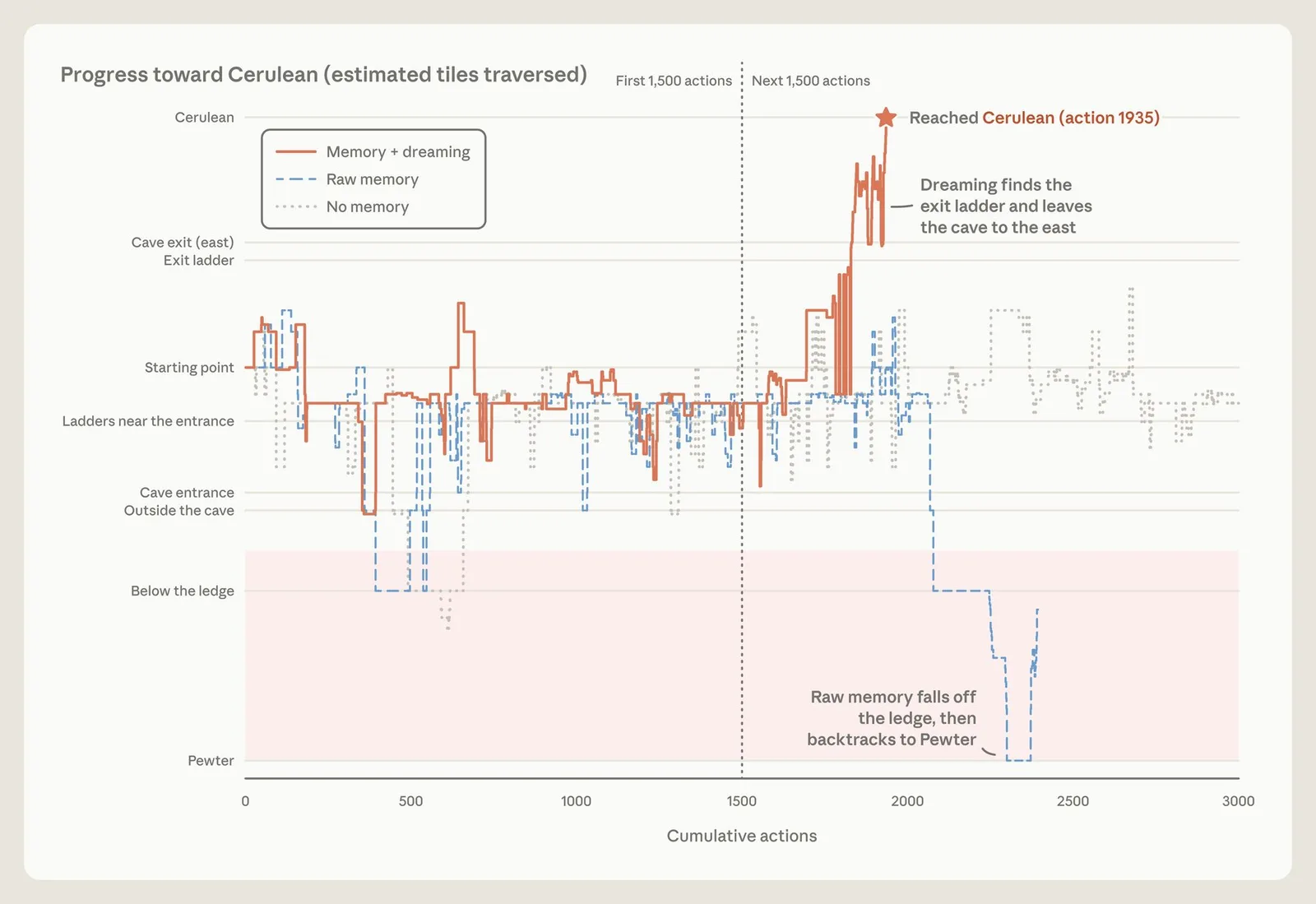
The larger risk is trusting a faulty note later. Anthropic describes Dreaming, built on research from Letta and UC Berkeley. The idea is similar to how the human brain processes experiences during sleep. During idle periods, Claude reviews transcripts of earlier sessions and checks its notes against them. In a Pokémon case, a wrong note about which side of a mountain held a landmark caused repeated failure, including falling into the same trap three times, wanting to give up, and missing its goal. After a Dreaming pass, Claude caught the error by checking the note against the transcript, corrected it, and made it past Mt. Moon to Cerulean City only with the fixed note. Another example notes that a wrong Pokémon Center location caused Claude to repeatedly fall back over a ledge.
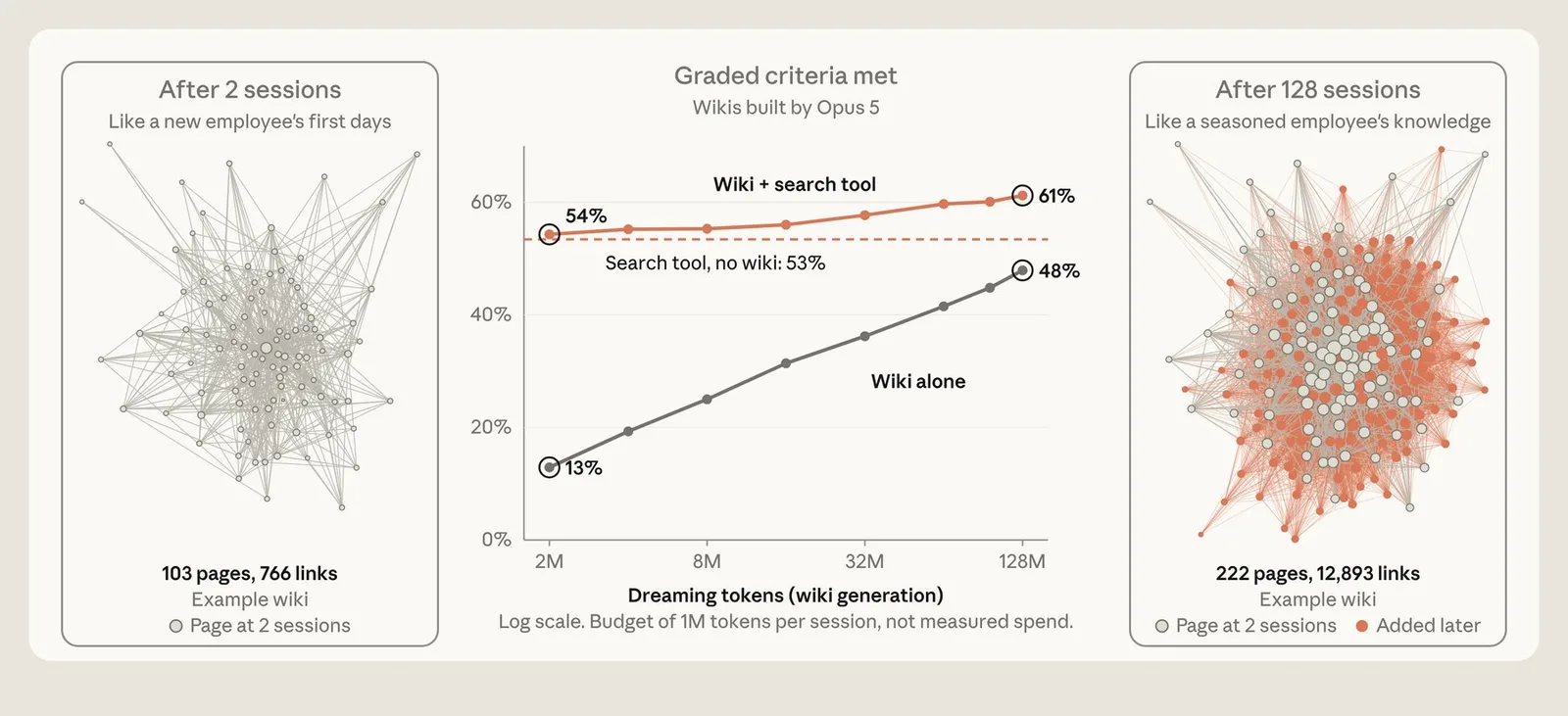
Dreaming also helped organize larger knowledge bases. Claude built a linked wiki from about 350,000 internal documents from Stainless, a software company Anthropic acquired. The process generated new pages while fixing gaps, duplicates, and broken links. The longer Claude worked on the wiki of Stainless documents, the better it answered questions, and the payoff was greatest when the wiki complemented search rather than replaced it. In a separate legal test, Claude scored 87 percent with the wiki when answers were spread across multiple documents, compared with 73 percent using search alone. For simple lookup tasks, the wiki performed roughly on par with search, and in one case it grew larger than the source documents.
Anthropic introduced Dreaming in May as a research preview for Claude Managed Agents, the company's cloud platform for AI agents. The service reads an existing memory store and up to 100 past sessions, removes duplicate and outdated entries, creates a reorganized store, and leaves the original untouched. At launch, Dreaming supported only Claude Opus 4.7 and Sonnet 4.6.
Current stage: Open limits and parallel systems
Anthropic says memory is still a work in progress. Taking notes mid-task can distract the agent. Dreaming adds compute cost, and its results arrive only after a delay. Wikis and notes need regular upkeep, or errors and hallucinations pile up. The company also warns against automatically loading too many memories into every session because they consume context and pass bad notes into future sessions. All of these tests come from Anthropic, and the overall takeaway is that useful agent memory depends less on storing as much as possible than on keeping the right information and correcting mistakes later.
Other labs are exploring related ideas. OpenAI overhauled ChatGPT memory in June and also calls the system Dreaming. That system maintains a user profile in the background and automatically corrects outdated information. According to OpenAI, this raised temporal accuracy from 52.2 to 75.1 percent. Researchers at Google and Google DeepMind also let AI agents dream, but they use dreaming to improve an agent's search strategy. Their agent works through alternative solutions using results it has already stored, without calling the model again. Google has built WikiSkill, a wiki for agents. As in Anthropic's system, WikiSkill keeps raw transcripts, distilled knowledge, and specific instructions in separate layers.
The current stage is therefore a research preview phase: selective notes, post-hoc correction, and layered memory appear to matter more than maximum storage, while cost, stale archives, and bad notes spreading into future sessions remain open.
Comments
No comments yet. Be the first to comment.