
OpenAI doubles usage limits on Pro plans as its rivalry with Anthropic intensifies.
OpenAI doubled Work and Codex limits on Pro tiers, restored Pro 200, kept Plus unchanged, and cited efficiency amid Anthropic rivalry.
Key Takeaways
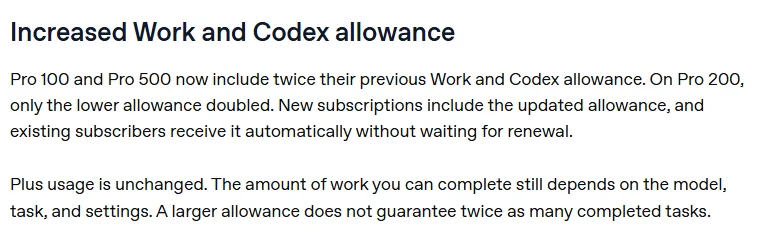
- OpenAI doubled Work and Codex usage limits on Pro 100 and Pro 500 plans, while leaving Plus unchanged.
- On Pro 200, OpenAI reversed a planned quota cut after user feedback and restored a lower allotment.
- The quota changes apply automatically, and expanded Dots limits remain in place but are tracked separately from Work and Codex.
- Doubling a quota does not necessarily mean completing twice as many tasks, because usage depends on model, task type, and settings.
- The move comes amid intensifying rivalry with Anthropic and OpenAI’s push for better efficiency through its newer 6.1 models, Terra and Sol.
Meta description: OpenAI doubles Work and Codex limits on Pro 100 and Pro 500, restores a lower Pro 200 quota, and keeps Dots expansion while pushing model efficiency.
Tags: OpenAI, Codex, Work, Pro plans, AI usage limits
Featured image: abstract technology-style illustration of layered cloud servers, data streams, and quota meters, no people, logos, or text
Background: Quotas Shape Paid AI Plans
OpenAI paid plan usage limits have doubled for several tiers, affecting Work and Codex quotas on Pro 100 and Pro 500 plans. The change arrives as subscribers weigh how much real work they can do within fixed allowances, and as OpenAI pushes efficiency gains from its newer 6.1 models Terra and Sol.
Paid AI plans are usually governed by usage quotas rather than unlimited access. A quota measures how much of a service a customer can consume within a billing period, but the amount of work produced per quota unit can vary. OpenAI has made that point explicit: doubling a quota does not mean customers complete twice as many tasks, because consumption depends on model, task type, and settings. Quota changes can therefore feel uneven in practice, because two users on the same plan may not use the allowance in the same way.
The Pro 100 and Pro 500 plans now receive twice the previous allotment for Work and Codex. On Pro 200, OpenAI doubled the lower quota and reversed a planned cut after user pushback. The Plus plan stays unchanged, so not every paid access level received the same increase.
Development: Changes Across Pro Tiers
The rollout is automatic. New subscriptions already include the updated quotas, and existing customers get them without needing to take action. The automatic application removes one common source of confusion, since customers do not need to re-sign up to receive the new allotment.
The change also preserves expanded limits for the new Dots for now, though Dot usage is tracked separately from Work and Codex. That separation matters because it means customers cannot simply assume every product line shares the same consumption pool. For users with multiple plans or product lines, the separate tracking of Dot usage means quota monitoring may need to be viewed by product rather than by plan alone.
The revised limits reflect how quota policy can move in response to user feedback, especially when a planned reduction is reversed and replaced with a higher allotment on one tier.
Latest Progress: Efficiency and Competition
OpenAI says it will keep shipping better models and efficiency gains to push usable capacity higher. Its recently released 6.1 models Terra and Sol are described as much more efficient while matching or beating their predecessors. More efficient models can reduce the amount of compute needed for a given result, which may make the same quota feel less restrictive over time, even if the numeric limit does not change again.
The timing is notable because Anthropic is preparing for its IPO, and both companies are competing hard for business-to-business dominance in AI. The competition for enterprise-oriented AI workloads makes capacity policy and model efficiency part of the same commercial story. For paying users, the practical question is not only whether limits rose, but whether each limit buys more completed work.
Comments
No comments yet. Be the first to comment.