
A malicious Claude Code extension on Cursor's marketplace tried to gain remote access and steal data.
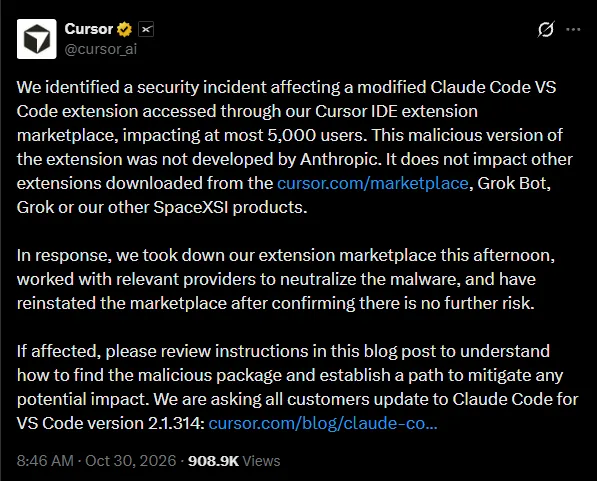
A tampered Claude Code extension for Cursor tried to steal data and set up remote access, affecting up to 5,000 users before removal and restoration.
Key Takeaways
- A tampered Claude Code extension appeared in Cursor’s VS Code marketplace for about 11 hours and affected up to 5,000 users.
- The malicious extension tried to collect identifying data such as hostname, username, operating system, and public IP address.
- It also attempted to set up remote access, though this likely would not have worked on most machines because it required admin privileges.
- Cursor removed the extension, took the entire marketplace offline, neutralized the malware with providers, and restored the marketplace after confirming no further risk.
- Cursor said no other extensions were affected.
Meta description: A tampered Claude Code extension for Cursor appeared in its marketplace for about eleven hours, affecting up to 5,000 users before Cursor pulled it.
Tags: Claude Code, Cursor, extension security, malware, VS Code marketplace

A tampered version of the Claude Code extension for Cursor appeared in Cursor’s VS Code extension marketplace on Thursday for about eleven hours, affecting up to 5,000 users according to the company. The incident matters because a package inside a developer marketplace can reach machines that already trust the coding tool, and this one tried to collect identifying data and set up remote access.
Background: A Trusted Path for Extension Installation
Developer marketplaces let tools such as Cursor add capabilities through extensions. Users often install them as part of routine work. In this case, the tampered listing was available in Cursor’s VS Code extension marketplace, and Anthropic had no involvement in developing it. The reported exposure window was about eleven hours on Thursday, and the company said it affected up to 5,000 users.
Development: Eleven Hours of Exposure
The extension tried to harvest user data like hostname, username, operating system, and public IP address. These fields identify a machine and its environment, so a compromised extension can turn a routine installation into a data-collection path. The package also attempted to set up remote access for the attacker. Cursor said that part likely would not have worked on most machines because it requires admin privileges, the elevated access needed to modify system settings or install deeper components. The eleven-hour window matters because marketplace listings can be discovered and installed before a tampered version is noticed.
Response: Removal, Offline Review, and Reinstatement
Once discovered, Cursor pulled the extension and took the entire marketplace offline. That broad step limited the chance that users would encounter the malicious listing or install other extensions during the same period. The company then worked with providers to neutralize the malware and confirmed there was no further risk. After those checks, the marketplace was reinstated. Cursor says no other extensions were affected. The sequence shows containment through removal, offline review, and restoration only after the malicious component had been addressed.
Current Stage: Restored Marketplace After an Eleven-Hour Incident
At this point, the known incident record follows a clear timeline: a tampered Claude Code extension for Cursor was available for about eleven hours, affected up to 5,000 users according to the company, attempted to harvest hostname, username, operating system, and public IP address, and tried to set up remote access that likely required admin privileges. Cursor pulled the extension, took the marketplace offline, worked with providers to neutralize the malware, confirmed no further risk, and reinstated the marketplace. The company said no other extensions were affected. The event now sits in a restored state, with the marketplace operating again and the reported exposure limited to the listed extension.
Comments
No comments yet. Be the first to comment.