
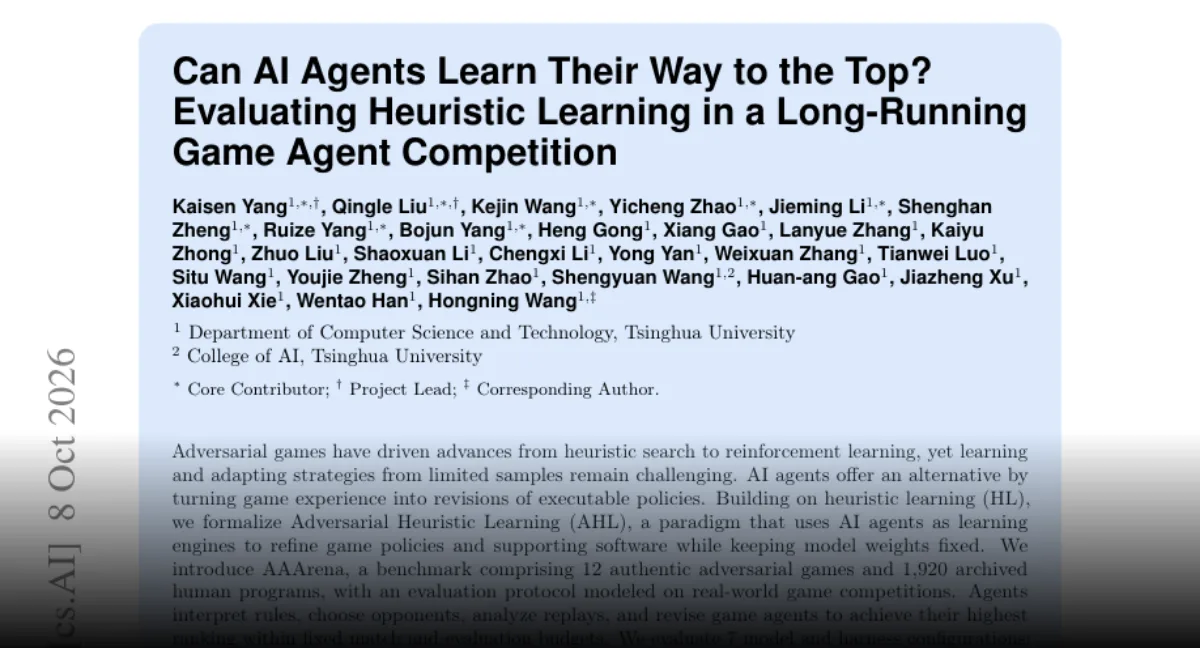
Can AI Agents Use Heuristic Learning to Reach the Top in a Long-Running Game Agent Competition?
AAArena tests AI agents in Adversarial Heuristic Learning across 12 games. Opus5.5 with Claude Code wins six gold medals; six leaderboards stay open.
Key Takeaways
- AAArena tests Adversarial Heuristic Learning (AHL), where AI agents improve executable game strategies through competition and feedback rather than model-weight updates.
- The benchmark uses 12 historical games, 1,920 human submissions, and a shared evaluation budget based on small matches, full evaluations, Elo ratings, and rankings.
- Opus5.5 with Claude Code earned six gold medals across 12 leaderboards, showing strong but incomplete ability to match top human competitors.
- No tested configuration topped the other six leaderboards, highlighting remaining gaps in rule understanding, opponent selection, replay review, and submission timing.
- The results separate model strength from agent workflow quality, emphasizing that effective autonomous learning loops are still under development.
Meta description: AAArena tests AI agents in Adversarial Heuristic Learning. Opus5.5 with Claude Code earns six gold medals across 12 games and 1,920 human submissions.
Tags: Adversarial Heuristic Learning, AAArena, Opus5.5, Claude Code, AI agents
Featured image: Abstract technology style image with connected nodes, match brackets, and replay panels; no real people, no company logos, no text.
AAArena tested whether AI agents can use Adversarial Heuristic Learning to improve programs through competition on 12 historical games and 1,920 human-written submissions. Opus5.5 with Claude Code earned six gold medals, while no tested configuration topped the other six leaderboards. The result shows that fixed foundation models can produce competitive programs in some games, but the broader learning loop still has gaps to close.
Background: Heuristic Learning Enters Adversarial Games
The idea starts with Learning Beyond Gradients and Jiayi Weng (@trinkle23897), who frames Heuristic Learning, or HL, as a process in which an agent acts as the learner. Instead of updating model weights through gradients, the learner uses experience and feedback to revise executable structures such as programs.
That framing makes a familiar contest pattern easier to see. A player reads the rules, writes a strategy, tests it, reviews losses, finds weaknesses, and turns new insights into code. The person becomes a learning engine because every match produces instructions for the next program.
The next step was to move that engine from a human desk into an automated agent. The formalized version is Adversarial Heuristic Learning, or AHL, which applies the same loop to competitive tasks. The foundation model weights stay fixed. The agent understands the rules, selects opponents, analyzes feedback, and generates and maintains the game-playing agent that enters each match.
Development: AAArena Builds a Shared Testing Track
Potential advantages were not enough. An agent could test more persistently, organize replays systematically, and draw inspiration from different players, but the question remained whether those habits translate into wins. Actual competition was needed.
The response was AAArena. The arena draws on contest archives to collect 12 historical competition games and 1,920 human-written program submissions. Agents then compete for leaderboard positions through the same basic process as human players: read the rules, play matches, and improve the code.
The arena also gives different agents a common evaluation budget. For each game, an agent receives 128 units for small matches and 16 evaluations against the full opponent pool. Small matches let the agent choose opponents, compete, and inspect replays. Full evaluations return the current strategy's Elo rating and rank. The agent decides when to learn and when to submit. For comparison, the best official result achieved within the budget is used.
Latest Progress: Opus5.5 Leads Six Leaderboards
The result is mixed but informative. Across seven AI models and their runtime configurations, Opus5.5 with Claude Code earned six gold medals. No tested configuration topped the other six leaderboards.
This split matters because it shows both the ceiling and the gap. Agents can already match strong human competitors in some games, and Opus5.5 with Claude Code reached the top of six leaderboards. At the same time, the remaining six leaderboards reveal where those abilities fall short.
The pattern also separates model capability from agent workflow. The benchmark is not only which model is strongest, but how well an agent can use a budget to choose opponents, learn from replays, submit at the right moment, and keep the executable structure improving.
Current Stage: Partial Victory, Unfinished Leaderboards
The current stage is not a completed solution. AAArena has moved AHL from a discussion about learning loops into a measured adversarial contest with historical games, human submissions, fixed budgets, Elo ratings, and ranks. Opus5.5 with Claude Code has won six of the 12 leaderboard positions, while no configuration has taken the other six.
What to watch next is whether agents can close the remaining gaps using the same signals: rule understanding, opponent selection, replay review, and timely submissions. The benchmark has already shown where they can stand shoulder to shoulder with strong human players, and where the learning engine still needs to improve.
Comments
No comments yet. Be the first to comment.