
METR Independently Assesses Anthropic's Acceleration of AI Research and Development in October 2026
METR says Anthropic's AI capability progress may have doubled due to AI assistance, raising short timeline and transparency concerns.
Key Takeaways
- METR’s high-access evaluation found that Anthropic’s capability progress on well-specified tasks is likely about twice as fast as its March 2024–October 2025 rate, implying roughly two years of historical progress in one year.
- The acceleration appears driven mainly by AI assistance in research and development rather than scaling training compute, with signs that autonomous AI contributions may become more important soon.
- Several experts treated the findings as a major update toward very short timelines for recursive self-improvement and potentially artificial superintelligence, raising concerns about rapid emergence of extreme capabilities.
- The estimate carries high uncertainty because much evidence was redacted; METR said the true speedup could be closer to 1.3x or 3x, depending on benchmark limitations, non-AI factors, and future automation.
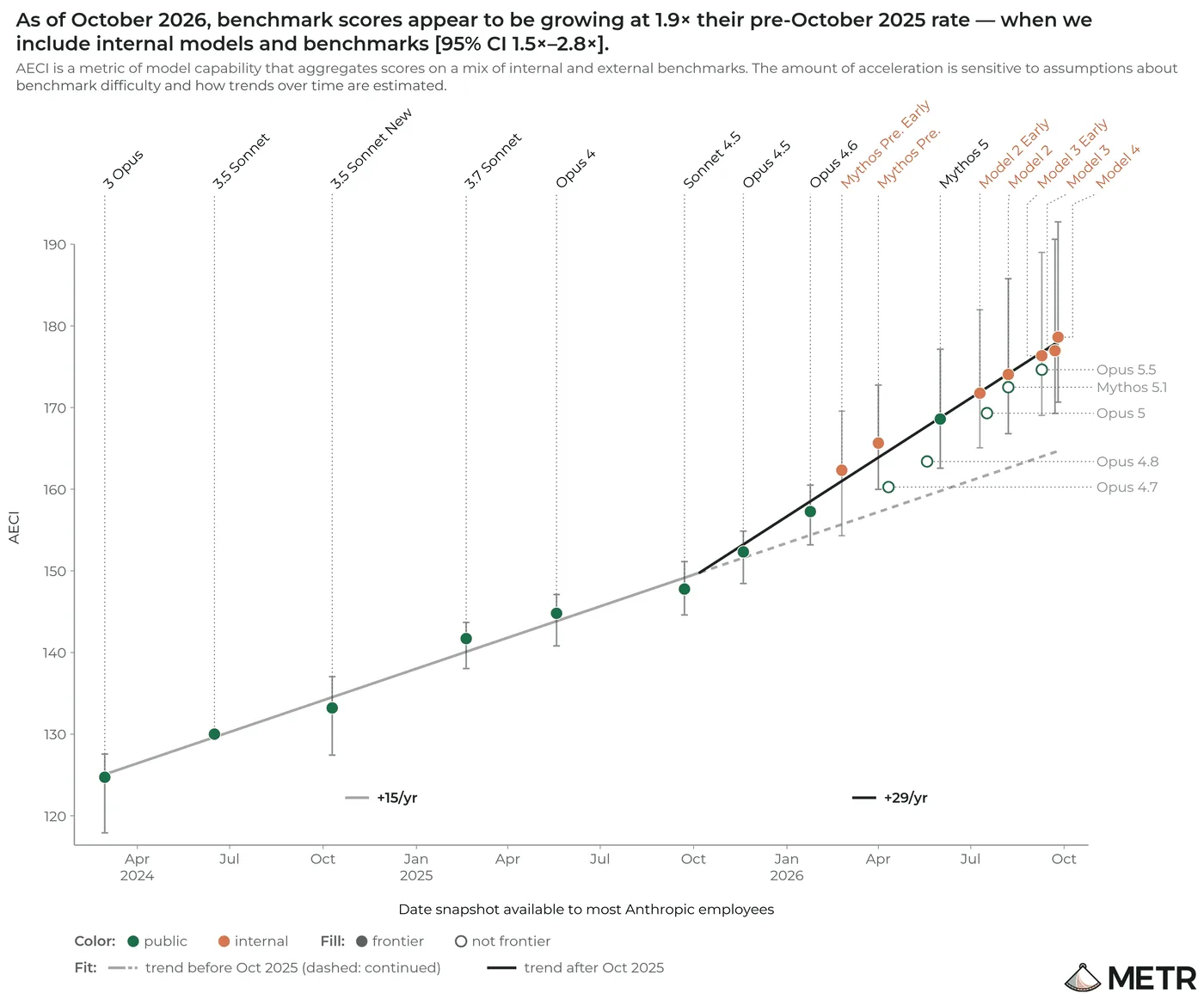
METR said its high-access evaluation at Anthropic, conducted from August 12 to October 29, 2026, found that Anthropic is likely improving model capabilities on well-specified tasks at around twice the rate it did between March 2024 and October 2025. The evaluation assessed whether AI is accelerating AI research and development. If AI systems significantly accelerate further AI development, METR said, that could lead to a sudden emergence of extreme and risky capabilities.
Background: Anthropic Opened Its Research Pipeline
Anthropic offered METR staff unprecedented access to internal data on its AI research and development process, including metrics on pretraining, reinforcement learning, training compute in each domain, benchmark scores for internal models, AI speedup analyses, forecasts of a future model's metrics, and interviews with relevant staff. The source described the assessment's scope, setup, and timeline, what information was shared, and what could not be shared because Anthropic redacted some key findings. The report's remainder contains detailed discussion and appendices with supplemental material.
Development: Benchmark Growth Doubled Since October 2025
Since October 2025, benchmark scores measured through Anthropic's version of the Epoch Capabilities Index have grown at an estimated 1.9 times the pre-October 2025 rate, with a 95 percent confidence interval of 1.5 times to 2.8 times. METR said that implies roughly two years of historical progress over the last year. It was confident the acceleration was not due to an acceleration in scaling training compute. Interviews and surveys were consistent with AI usage causing a doubling in the pace of capabilities progress, with staff self-reporting dramatic uplift, although those self-reports are challenging to interpret. The report said acceleration is primarily through AI assistance rather than fully autonomous contributions, but signs suggest autonomous contributions will play a larger role soon. METR did not see evidence for significant bottlenecks from algorithmic progress, training compute, experiment compute, or data limits in the next 12 months, but said its understanding changed several times and it was not confident in the current assessment.
Reactions: Short Timelines and Transparency Concerns
Ryan Greenblatt said the report on AI research and development automation is a big update toward artificial superintelligence within one to two years. He said it indicates AI progress is sped up by recursive self-improvement right now by around twice the historical rate, and that in AI 2027 this happens around March 2027. Greenblatt said he had been seriously wrong about the speedup, having previously expected much less acceleration in 2026, around 1.15 times to 1.3 times, and that specific privately available evidence appeared to have changed his view. He had not seen an unredacted version and spoke purely about the public report. Because much evidence was redacted, he said conclusions beyond the observed twice-faster benchmark rate, including whether the speedup is caused by recursive self-improvement, depend significantly on trust in the authors. He trusts the authors to be careful, rigorous, and generally do a good job, works at METR, and said less extensive redactions would reduce this need for trust.
Ajeya Cotra said colleagues found Anthropic's capabilities progress had doubled, mainly due to AI. She cited Greenblatt's modeling from public information suggesting the whole company's research and development would be going 4 times to 5 times faster, with labor uplift higher still. She called this a major update to very short timelines and said she was sad that much evidence was redacted, arguing that evidence transparency is important for the world to figure this out in time, especially evidence about risk.
Daniel Kokotajlo said the METR report confirmed his worry from two days earlier. He said the AI Futures Project was spooked by Anthropic's S1 update, and that if Anthropic really is imminently about to meet the Responsible Scaling Policy threshold of twice acceleration over baseline, timelines to full recursive self-improvement and superintelligence may be very short. He stressed this was a major conditional. He added that if AI Futures Model parameters are naively optimized to achieve twice acceleration over baseline progress in January 2027, superintelligence could arrive sooner than depicted in AI 2027. The source also referenced a Twitter thread, GradientDissenter's take, and a discussion prompt.
Uncertainty: Why the Estimate Could Move
In its subjective conclusions about risk, METR said its twice-the-rate estimate carries high uncertainty and that the true acceleration could be closer to 1.3 times or 3 times the historical rate. It said most of the acceleration today is likely attributable to Anthropic's extensive use of AI to do research and development, though other causes likely played a large role in late 2025. The lack of observed bottlenecks or strong diminishing returns means significant risk that further capabilities progress could lead to even faster acceleration, although important bottlenecks may be missing.
The report listed ways the estimate could move. It could be underestimating acceleration if METR did not assign enough importance to evidence that some growth rates have further increased recently, that further automation of AI research and development tasks could accelerate progress, and that benchmark growth has sometimes understated growth in real-world impact. It could be overestimating acceleration if it did not assign enough importance to non-AI factors, the benchmark's focus on verifiable tasks, and reasons why Anthropic's early 2023 to 2025 growth rate was unusually low.
What to Watch Next
The near-term questions are whether redacted evidence will become public enough to test whether AI assistance, rather than other causes, drives the doubling; whether the research pipeline avoids algorithmic, compute, data, or experiment constraints over the next 12 months; and whether fully autonomous contributions begin to play a larger role. For now, METR places Anthropic in a phase where measured capabilities progress is roughly twice the historical rate, but the uncertainty range remains wide and the underlying evidence is only partially public.
Meta description
METR says Anthropic's AI research benchmark progress has doubled since October 2025, but redactions and uncertainty limit confidence in the findings.
Tags
METR, Anthropic, AI research acceleration, capabilities benchmarks, AI timelines
Featured image
Abstract technology style, cool blue and violet neural pathways connecting research tools and benchmark gauges, no people, no company logos, no text.
Comments
No comments yet. Be the first to comment.