
OpenAI Rebuilt AI Shopping From the Ground Up With ChatGPT Wallet
OpenAI's ChatGPT Wallet replaces Instant Checkout for US Pro users, using tokenized cards and merchant guidance for supervised AI-agent purchases.
Key Takeaways
- OpenAI has introduced ChatGPT Wallet as its second attempt at agent-powered shopping, replacing the earlier Instant Checkout feature.
- The launch is limited to U.S. users with ChatGPT Pro and an eligible U.S. bank card, and it uses tokenized payments from American Express, Mastercard, and Visa so agents never see real card numbers.
- Purchases still require user approval for each transaction, while OpenAI’s longer-term goal is to let agents complete purchases within set spending limits, categories, and timeframes.
- OpenAI is also releasing a Commerce Partner Playbook to help merchants reduce bot blocks and support agent-driven checkout through browser integration or plugins.
OpenAI Takes a Second Shot at Agent Payments With ChatGPT Wallet
OpenAI has introduced ChatGPT Wallet, a second attempt at letting AI agents pay for user purchases, replacing its earlier Instant Checkout approach. The launch is limited to the US through Dots, requires ChatGPT Pro and an eligible US bank card, and adds American Express, Mastercard, and Visa token support so agents can complete transactions without seeing real card details. It matters because rivals have already built agent shopping, and OpenAI is now adding payment infrastructure plus merchant guidance to reduce bot blocks.
Background: Rivals Move and OpenAI Replaces Instant Checkout
Before OpenAI introduced Wallet, several rival assistants already had paths to online buying. Anthropic's Claude Duet, Meta's Muse, and xAI's Grok Bot have built-in payments and use single-use cards through Stripe Link in part. Google and Perplexity also allow purchases through checkout tools such as Google Pay and Instant Buy.
OpenAI's first attempt was Instant Checkout, which let people buy directly in the chat. The company discontinued it because its flexibility was insufficient. ChatGPT Wallet is the replacement, built so an agent can pay on behalf of a user rather than simply pushing a buy button inside one chat flow.
Launch: US Access, Pro Requirement, and Tokenized Payment
At launch, the feature is available only in the US through Dots. Users must be adults and need a ChatGPT Pro subscription and an eligible US bank card.
To start, users add their card once. For each purchase, ChatGPT shows items, total, selected card. Then user approves with Face ID or fingerprint. The agent and store never see real card numbers. Three payment partners, American Express, Mastercard, and Visa, issue a payment token, a stand-in card number with its own security code. OpenAI says card rewards and normal bank protections for eligible disputes still apply.
Longer term, OpenAI wants users to hand purchases fully to agents within spending limits, product categories, and timeframes.
Process: From Search to Approved Checkout
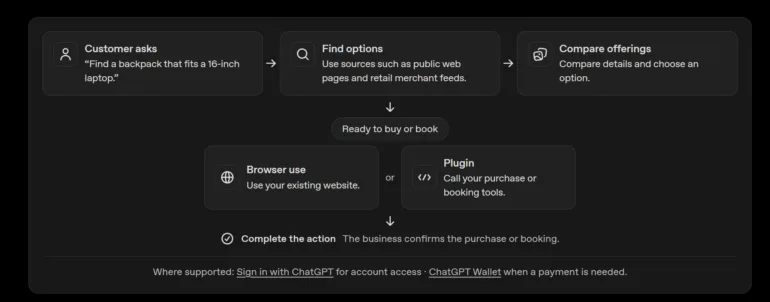
OpenAI describes a fixed flow. A customer first describes what they want. ChatGPT searches the open web, APIs, or merchant product feeds for options. The user compares and picks one.
ChatGPT then completes the purchase either through a browser on the merchant's existing website or through a plugin that supports structured actions such as managing the cart. Merchants can connect their existing website through browser integration or a dedicated plugin, while ChatGPT Wallet and Sign-in with ChatGPT handle payment and authentication.
Latest: Merchant Playbook and the Current Stage
Online storefronts and payment systems often treat AI agents as bots and stop their purchases for security reasons. OpenAI is releasing a Commerce Partner Playbook to address this. The guide tells merchants how to adjust firewalls, provide product data, and work with payment providers such as Stripe, Adyen, and Riskified so agent-driven purchases go through.
As of launch, ChatGPT Wallet is a pilot limited to the US and ChatGPT Pro users, with human approval at each step. The second attempt is therefore narrower than full agent autonomy: it establishes tokenized payment, merchant connection, and approval mechanics first. The next signal will be whether the Commerce Partner Playbook and Dots rollout allow agents to move from supervised purchases toward the set-limit handoffs OpenAI describes.
Comments
No comments yet. Be the first to comment.