
Australia's central bank says AI is affecting younger workers first, especially in software and customer service.
Young Australian workers in AI-exposed roles face weaker hiring, but broader job displacement remains limited as AI also creates new demand.
Key Takeaways
- Australia’s Reserve Bank finds AI has not caused broad job losses so far, but it is hitting younger workers in highly AI-exposed entry-level roles such as software, clerical work, and customer service.
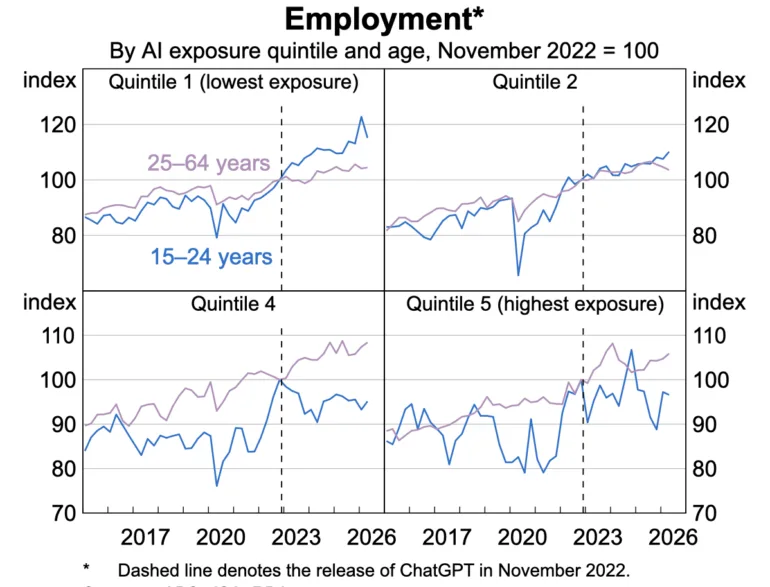
- Since late 2022, workers aged 15 to 24 in the most exposed occupations have faced fewer job postings, weaker employment rates, and higher unemployment, while older workers have largely held steady or gained.
- Similar U.S. studies show early pressure on junior workers, including a 13% relative decline in employment for 22- to 25-year-olds in AI-exposed roles and nearly 20% for young software developers.
- AI is also creating new demand and complementing existing work, with companies prioritizing upskilling and AI-related job postings growing sharply, but fewer junior roles could eventually reduce the pipeline of experienced workers.
Meta description: Reserve Bank of Australia analysis and later studies show AI job displacement is limited so far, but young workers in exposed roles face weaker hiring.
Background: A Monitor Built for Early Signals
AI job displacement in Australia has so far looked small across the whole labor market, but young workers entering highly exposed fields such as software development are faring worse. Mike Major, writing for the Reserve Bank of Australia, argued that the first effects would be easiest to spot at the entry level and in occupations with high theoretical exposure to AI, including programming, clerical work, and customer service.
The analysis set late 2022 as the starting point, when ChatGPT launched. Job postings fell across all monitored groups, with the sharpest drop in the highest-exposure group. In that group, workers aged 15 to 24 and young college graduates had weaker employment rates and higher unemployment than older workers. For jobs in quintile 5, young people's employment declined after late 2022, while older workers' employment rose.
Major cautioned against early conclusions because the work does not establish direct causation and measures theoretical exposure, not actual use by companies. Post-pandemic shifts in the business cycle or remote work could also affect the numbers. SEEK data showed another side: AI was complementing existing work and creating new demand for AI skills.
Development: Young Workers in AI-Exposed Roles
Research outside Australia found a similar pattern, though with caveats. An August 2025 Stanford study based on millions of US payroll records found employment among 22- to 25-year-olds in AI-exposed occupations down 13 percent in relative terms since late 2022. Among young software developers, the decline was nearly 20 percent. More experienced workers in the same occupations held steady or gained ground.
A March 2026 Anthropic study found signs of declining hiring among 22- to 25-year-olds in exposed occupations, with job-finding rates down about 14 percent. It found no systematic rise in overall unemployment. The study emphasized that theoretical automation potential and actual AI use are far apart.
Anthropic also reported a company-level example. An internal review found the share of junior hires in technical roles had fallen from 27 percent to 9 percent since early 2025. In August 2026, AI agents across the company were already logging six times as many hours as human employees. Anthropic conceded that, as an extremely AI-intensive software company, it is a special case. Researchers still warned of a "tragedy of the cognitive commons," in which disappearing junior roles lead to a future shortage of experienced professionals, assuming those professionals are still needed.
Latest Evidence: Adoption, Hiring, and New Demand
A large study of 25,000 workers in Denmark confirmed the lack of economy-wide impact. Despite a 64 percent AI adoption rate, researchers found no measurable changes in wages or hours worked. Workers saved an average of just 2.8 percent of their working time.
A January 2026 analysis of 10.6 million LinkedIn profiles and US unemployment data cautioned against blaming the downturn on AI alone. The research team led by Morgan Frank at the University of Pittsburgh found that problems in exposed occupations started in early 2022, months before ChatGPT launched. Macroeconomic factors, including the Federal Reserve's shift in interest rate policy or a correction after pandemic-era hiring surges, may play a bigger role than previously assumed.
Meanwhile, AI is creating new demand. The World Economic Forum's Future of Jobs Report 2025 found that 77 percent of surveyed companies were prioritizing upskilling over job cuts. Researchers projected a net gain of 78 million jobs by 2030. LinkedIn showed AI-related job postings grew sixfold in one year.
Current Stage: What the Numbers Suggest
The current stage is not one of broad AI job displacement in Australia or in the wider data reviewed here. It is a stage of selective pressure: older workers and overall unemployment have not shown a systematic rise, while young workers in high-exposure entry roles face weaker postings, lower employment rates, and slower hiring.
For readers, the split means AI adoption does not automatically equal broad job loss; the pressure is concentrated at the entry point, where fewer junior openings may shape the next generation of experienced workers. The next question is whether the shrinking junior pipeline, paired with rising AI use inside companies, will turn into a longer-term shortage of experienced professionals.
Tags: AI job displacement, Reserve Bank of Australia, youth employment, Anthropic hiring, Future of Jobs Report
Featured image: An abstract technology-style graphic with network nodes, charts, and soft gradients; no real people, no company logos, no text.
Comments
No comments yet. Be the first to comment.