
Does the Game-to-Real Benchmark Show That Toy Games Can Reveal and Transfer to Real-World Visual Reasoning?
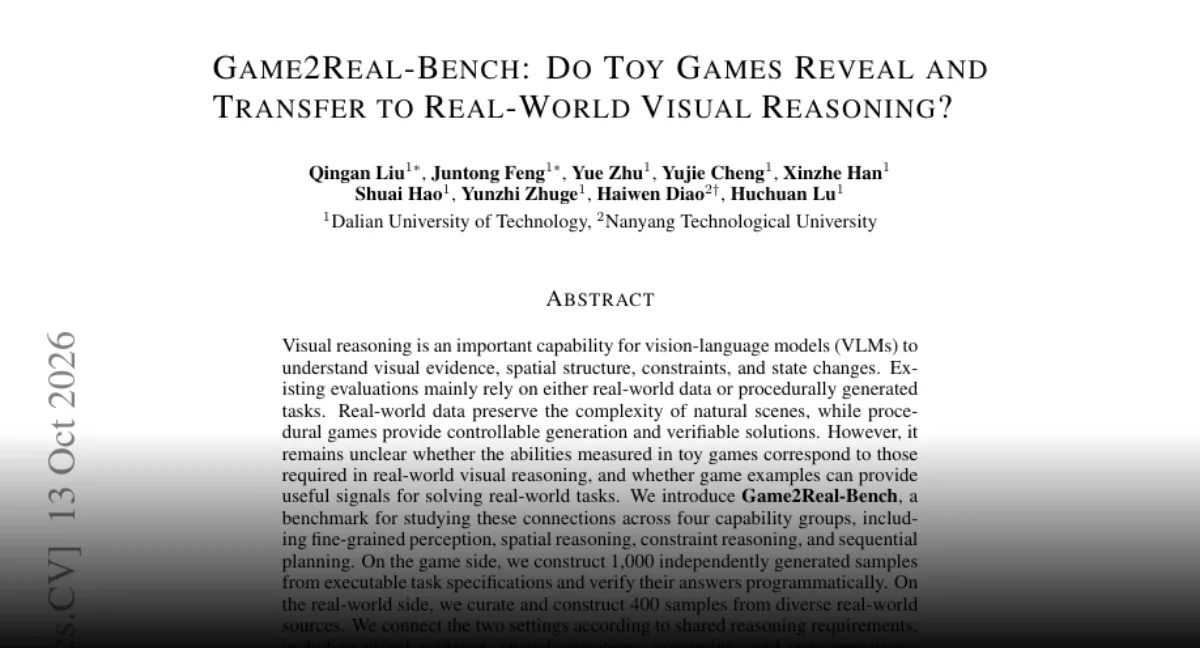
Game2Real-Bench tests 25 vision language models on 1,000 game and 400 real samples, showing 0.935 correlations and selective transfer gains.
Key Takeaways
- Game2Real-Bench compares controlled game tasks with real-world visual reasoning using 1,000 game samples, 400 real-world samples, and four reasoning capability groups.
- Across 25 vision-language models, game and real-world performance showed a strong 0.935 correlation, suggesting game-based results can reflect real-world reasoning trends.
- One-shot game-to-real transfer had mixed effects: it helped constraint reasoning for some models but hurt fine-grained perception, so game demonstrations are not universally beneficial.
- The project also releases Game2Real-Dataset with about 24,000 programmatically verified game samples, along with benchmark code and resources for further research.
Meta description: Game2Real-Bench compares 1,000 game samples with 400 real-world visual reasoning cases, tests 25 vision language models, and reports 0.935 correlations.
Tags: Game2Real-Bench, visual reasoning, vision language models, benchmark, AI

Game2Real-Bench asks a practical question for vision-language models: whether success in controlled game tasks reflects the visual reasoning needed in real-world scenes. The benchmark compares 1,000 game samples with 400 real-world samples and evaluates 25 representative vision-language models across both settings. Its results give readers a way to judge when toy-game evidence is useful and when it can mislead.
Background: Game Tasks and Real Scenes Measure Different Things
Visual reasoning requires a model to understand visual evidence, spatial structure, constraints, and state changes. Existing evaluations usually fall into two camps. Real-world data preserve the complexity of natural scenes, but are hard to generate and verify. Procedurally generated games offer controlled examples and programmatically checkable answers, yet it was unclear whether the abilities tested in games correspond to abilities needed in real visual tasks.
Game2Real-Bench was built to study that gap. It connects two settings through shared reasoning requirements rather than visual similarity. The requirements include visual evidence, spatial operations, constraints, and state transitions.
Development Process: Building a Two-Side Benchmark
On the game side, the project constructed 1,000 independently generated samples from executable task specifications and verified answers programmatically. On the real-world side, it curated and constructed 400 samples from diverse real-world sources.
The benchmark organizes capability into four groups: fine-grained perception, spatial reasoning, constraint reasoning, and sequential planning. This structure lets readers see whether a model that solves a game puzzle also handles the reasoning pattern required in a real-world task.
Evaluation Results: Strong Agreement Across 25 Models
The evaluation covered 25 representative vision-language models. Performance across game and real-world tasks showed consistent cross-setting trends. The study reports a Pearson correlation of 0.935 and a Spearman correlation of 0.935 between the two settings. That high agreement suggests that rankings on game tasks can reflect similar reasoning patterns observed in real-world tasks.
The benchmark also examined game-to-real transfer through one-shot in-context learning on four models. In this setup, a model receives one demonstration from the game side before working on a related real-world task. The effect varied across capabilities and models. Constraint reasoning showed positive gains for several models, while fine-grained perception consistently declined when game demonstrations were used.
These findings give a cautious but useful reading: toy games can reveal some reasoning patterns, but demonstrations are not universally helpful. The value of a game example depends on the capability being tested and the model receiving the demonstration.
Dataset and Availability: Training Support and Open Resources
To support model training, Game2Real-Dataset was built to provide a larger aligned resource base. It contains nearly 24,000 game samples across 18 tasks and 65 question-answer families. These samples are generated from executable task specifications and verified programmatically.
The benchmark, dataset, and code are available at https://github.com/QingAnLiu/Game2Real-Bench.
The project is currently at the evaluation and release stage: it provides a structured way to compare game-based and real-world visual reasoning, along with open resources for follow-up work. The next question for readers is whether game demonstrations can be selected by capability to help constraint reasoning or sequential planning without hurting fine-grained perception.
Comments
No comments yet. Be the first to comment.